
ธรณีวิทยาของดาวเคราะห์
| ส่วนหนึ่งของชุดบทความเกี่ยวกับ |
| ธรณีวิทยา |
|---|
 |
|
|

ธรณีวิทยาของดาวเคราะห์หรือที่รู้จักกันในชื่อดาราศาสตร์ธรณีวิทยาหรือเอกธรณีวิทยาเป็น สาขา วิทยาศาสตร์ดาวเคราะห์ที่เกี่ยวข้องกับธรณีวิทยาของวัตถุบนท้องฟ้าเช่นดาวเคราะห์และดวงจันทร์ดาวเคราะห์น้อยดาวหางและอุกกาบาต[ 1 ] [ 2 ] แม้ว่าคำนำหน้า geo- โดยทั่วไปจะบ่งบอกถึงหัวข้อที่เกี่ยวกับโลกแต่ธรณีวิทยาของดาวเคราะห์ได้รับการตั้งชื่อเช่นนั้นด้วยเหตุผลทางประวัติศาสตร์และความสะดวก เนื่องจากเนื้อหาที่เกี่ยวข้อง จึงมีความเชื่อมโยงอย่างใกล้ชิดกับธรณีวิทยาแบบดั้งเดิมที่อิงกับโลก[ 3 ]
ธรณีวิทยาของดาวเคราะห์ครอบคลุมหัวข้อต่างๆ เช่น การกำหนดคุณสมบัติและกระบวนการของโครงสร้างภายในของดาวเคราะห์ภาคพื้นดินกระบวนการบนพื้นผิวเช่นการเกิดภูเขาไฟหลุมอุกกาบาตแม้กระทั่ง การกระทำ ของแม่น้ำและลม ในกรณีที่เกี่ยวข้อง แม้ว่าชั้นนอกสุดของ ดาวเคราะห์ยักษ์จะประกอบด้วยก๊าซเป็นหลักแต่ก็รวมอยู่ในสาขาธรณีวิทยาของดาวเคราะห์ด้วย โดยเฉพาะอย่างยิ่งในส่วนภายในของดาวเคราะห์เหล่านั้น สาขาต่างๆ ในธรณีวิทยาของดาวเคราะห์ส่วนใหญ่มาจากสาขาต่างๆ ในวิทยาศาสตร์ธรณีวิทยา แบบดั้งเดิม เช่นธรณีฟิสิกส์ธรณีสัณฐานวิทยาและธรณีเคมี
ประวัติศาสตร์
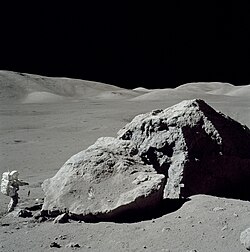
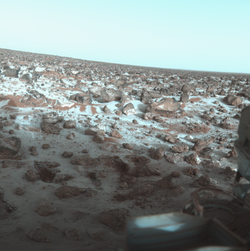
Eugene Merle Shoemaker is credited with bringing geologic principles to planetary mapping and creating the branch of planetary science in the early 1960s, the Astrogeology Research Program, within the United States Geological Survey. He made important contributions to the field and the study of impact craters, selenography (study of the Moon), asteroids, and comets.[4]
Major centers for planetary science research include the Lunar and Planetary Institute, Applied Physics Laboratory, Planetary Science Institute, Jet Propulsion Laboratory, Southwest Research Institute, and Johnson Space Center. Additionally, several universities conduct extensive planetary science research, including Montana State University, Brown University, the University of Arizona, California Institute of Technology, University of Colorado, Western Michigan University, Massachusetts Institute of Technology, and Washington University in St. Louis. Planetary geologists usually study either geology, astronomy, planetary science, geophysics, or one of the earth sciences at the graduate level.
Tools
Simulated interplanetary missions performed on Earth have studied procedures and tools for planetary geology. Various tools, including common archaeological tools such as hammers, shovels, brushes, were evaluated for use by planetary geologists.[5] Along with these common tools, new advanced technologies have become available. These include spectroscopic databases, and data (such as mission logs, images and mapping) from previous unmanned interplanetary missions.[6] Scientists use maps, images, telescopes on Earth, and orbiting telescopes (such as the Hubble Space Telescope).[7] The maps and images are stored in the NASA Planetary Data System where tools such as the Planetary Image Atlas help to search for certain items such as geological features including mountains, ravines, and craters.[8]
Features and terms
Planetary geology uses a wide variety of standardized terms for features.[9] All planetary feature names recognized by the International Astronomical Union (IAU) combine one of these terms with a possibly unique identifying name. The conventions which decide the more precise name are dependent on which planetary body the feature is on, but there are standard descriptors common to all astronomical planetary bodies. New terms must be recognized by the IAU Working Group for Planetary System Nomenclature, and are commonly added as features are mapped and described by new planetary missions.[10] This means that in some cases, names may change as improved imagery becomes available,[10] or in other cases widely adopted informal names are changed to be in line with the rules.[11] The standard names are chosen to consciously avoid interpreting the underlying cause of the feature, but rather to describe only its appearance.[9]
By planetary body
See also
- Astrobiology – Science concerned with life in the universe
- Exoplanet – Planet outside of the Solar System
- Exoplanetology
- Planetary habitability – Known extent to which a planet is suitable for life
- LHS 3844 b – Exoplanet in the constellation Indus
Further reading
- J. F. Bell III; B. A. Campbell; M. S. Robinson (2004). Remote Sensing for the Earth Sciences: Manual of Remote Sensing (3rd ed.). John Wiley & Sons. Archived from the original on Sep 16, 2016. Retrieved 2006-08-23.
- Roberge, Aki (1998-04-21). "The Planets After Formation". Department of Terrestrial Magnetism. Archived from the original on 2006-08-13. Retrieved 2006-08-23.
- Hauber E et al. (2019) Planetary geologic mapping. In: Hargitai H (ed ) Planetary Cartography and GIS. Springer.
- Hargitai H et al. (2015) Classification and Characterization of Planetary Landforms. In: Hargitai H, Kerszturi Á (eds) Encyclopedia of Planetary Landforms. Springer.
- Rossi, Angelo Pio; Gasselt, Stephan van, eds. (2018). Planetary Geology. Astronomy and Planetary Sciences. Springer International Publishing. ISBN 978-3-319-65177-4.