
Belding's ground squirrel
| Belding's ground squirrel | |
|---|---|
 | |
Scientific classification | |
| Kingdom: | Animalia |
| Phylum: | Chordata |
| Class: | Mammalia |
| Infraclass: | Placentalia |
| Order: | Rodentia |
| Family: | Sciuridae |
| Genus: | Urocitellus |
| Species: | U. beldingi |
| Binomial name | |
| Urocitellus beldingi (Merriam, 1888) | |
 | |
| Distribution of the Belding's ground squirrel | |
| Synonyms | |
Spermophilus beldingiMerriam, 1888 | |
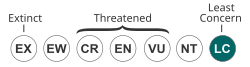
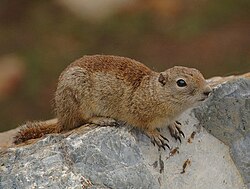
Belding's ground squirrel (Urocitellus beldingi), also called pot gut, sage rat or picket-pin,[2] is a squirrel that lives on mountains in the westernUnited States. In California, it often is found at 6,500 to 11,800 feet (2,000–3,600 m) in meadows between Lake Tahoe and Kings Canyon. This species is not of conservation concern, and its range includes some protected areas.[1]
Physical description
The Belding's ground squirrel is medium-sized with "a relatively short tail, short limbs, and small ears".[3] It has a gray pelage become more cinnamon at the underside and reddish-brown on the back. Its body length is 230 to 300 millimetres (9.1–11.8 in). The tail is 44 to 76 millimetres (1.7–3.0 in) and is bushy but also flattened. The distal hairs of the tail have three color bands, one black, one white and one red. On average, the ground squirrel weighs 290 grams (0.64 lb). Its feet are covered in little to no hair. Compared to other ground squirrel species, its cheek pouches are moderate in size.
Ecology
Range and habitat
Being native to the northwestern United States, the Belding's ground squirrel ranges covers northeastern Oregon and part of Washington, north California, southwestern Idaho, north and central Nevada and northwestern Utah.[4] These animals are most abundant at higher altitudes, occurring in alpine and subalpine meadows.[5] They also inhabit sagebrush flats, brush/grass habitats and cultivated areas at lower elevations.[4] The grounds squirrels are largely restricted to open areas with enough fresh vegetation and water. They do not live in dense forests, tall grasses, rocky slopes or thick shrubbery as they cannot watch for predators. In addition they do not prefer grass that is too short as they cannot hide from predators.[6]
Food and feeding
Belding's ground squirrels have a largely herbivorous diet. However they will also eat insects, carrion, other vertebrates, and even other conspecifics. They mostly eat flowers and seeds.[4] They also eat nuts, grains, roots, bulbs, mushrooms and green vegetation. Belding's ground squirrels do not keep food in caches. Instead they store fat reserves.[4][7] As such, the ground squirrels eat large quantities of food before hibernation, doubling their body weight.[4] They spend as much as 40% of the summer eating.[7] When eating, the ground squirrel feeds itself with its front paws while standing on its back paws.[7]
Hibernation
Belding's ground squirrels hibernate at different times, depending on the sex and age of the individual and the altitude of their environment. Adult males go into hibernation between late July and early September when at higher altitudes.[7] Females may follow them in late September, depending on the elevation.[4][6] Juveniles follow their parent into hibernation with juvenile females first going when they are 13 weeks old and males when they are 10 weeks old.[5] They enter when the grasses begin to dry and turn brown, thus avoiding the hot, dry, late-summer famine.[6]
The ground squirrels hibernate in burrow chambers called hibernacula. Males hibernate alone while females tend to hibernate together.[4] The time in which ground squirrel emerge from their hibernation also depends on different factors. At lower elevations, males emerge relatively synchronously in February, while at higher elevations they emerge at the end of April.[4][6] Females emerge later than males, and their emergence is spread over several weeks.[8]
Activity cycles
Belding's ground squirrels begin to leave their burrows at sunrise. They are most active in the morning (e.g., feeding, digging, and interacting socially).[6] They warm themselves by stretching out on rocks or on the warm ground.[7] Their activities tend to decrease as the temperature increases. They typically reenter their burrows in mid-afternoon, reemerge in late-afternoon, and submerge for the night at sunset. Juveniles emerge and submerge later than adults.[6]
Demography
The demography of a free-living population at Tioga Pass, California was studied using mark-recapture techniques over 11 consecutive field seasons.[9] Results indicated that the 7—8 month hibernation period (October—May) is the most hazardous time, when 66 to 70% of juveniles and 36 to 39% of adults disappear. Late season snowstorms can also greatly increase mortality, especially among females[10] Males that survived their first winter were recaptured for an additional 1.1 years vs. 1.6 years for females. In general, females live twice as long as males. Few males lived more than 6 years, whereas some females lived more than 11 years; as a result the sex of ratio of the adult population was female—biased, especially among the older population.[9]
Behavior
Family relations
กระรอกดินเบลดิงอาศัยอยู่ใน สังคมที่ พึ่งพา ญาติพี่น้อง โดยปฏิสัมพันธ์ส่วนใหญ่เกิดขึ้นระหว่างตัวเมีย ลูกหลาน และญาติห่างๆ[ 11 ] [ 5 ]ตัวเมียจะอาศัยอยู่ในพื้นที่ที่เกิดและใช้ชีวิตอยู่ในบริเวณนั้น ในขณะที่ตัวผู้จะเริ่มกระจายตัวหลังจากหย่านมได้ 2 เดือน และในฤดูใบไม้ผลิถัดไป และจะไม่กลับไปยังพื้นที่เกิดอีกเลย[ 12 ] [ 13 ]ตัวเมียจะร่วมมือกันเพื่อปกป้องอาณาเขต ปกป้องลูกกระรอกจากการถูกฆ่า แบ่งปันพื้นที่หาอาหาร และส่งเสียงเตือนภัยเมื่อมีผู้ล่าเข้ามาใกล้[ 14 ]ความร่วมมือระหว่างตัวเมียมีความสัมพันธ์กับระดับความสัมพันธ์ทางสายเลือดของพวกมัน[ 15 ]กระรอกดินจะจดจำญาติของตนได้โดยการเปรียบเทียบกลิ่นของตัวเองและกลิ่นของลูกกระรอกตัวอื่นๆ ที่พบเจอ[ 16 ]กลิ่นเหล่านี้มาจากต่อมหลังและต่อมทวารหนัก ซึ่งทำให้เกิดกลิ่นฉุนในบริเวณที่พวกมันอาบฝุ่น[ 6 ]สัตว์แต่ละตัวมีชุดกลิ่นเฉพาะตัวที่สัตว์อื่นสามารถใช้ในการจดจำได้ หากลักษณะกลิ่นของแต่ละตัวตรงกับตัวมันเองหรือพี่น้องร่วมครอกอย่างใกล้ชิด ก็มีแนวโน้มว่าจะเป็นญาติกัน การทดสอบในห้องปฏิบัติการ[ 16 ]แสดงให้เห็นว่าตัวเมียสามารถแยกแยะระหว่างญาติและไม่ใช่ญาติ รวมถึงญาติใกล้ชิดและญาติห่างไกล ซึ่งรวมถึงพี่น้องต่างพ่อต่างแม่ที่เกิดในครอกที่ต่างกัน[ 17 ]การสังเกตภาคสนาม[ 18 ] [ 15 ]แสดงให้เห็นว่าตัวเมียชอบญาติใกล้ชิดมากกว่าญาติห่างไกล และแสดงพฤติกรรมก้าวร้าวต่อไม่ใช่ญาติ ตัวผู้ที่โตเต็มวัยไม่แสดงการจดจำญาติหรือพฤติกรรมเอื้อประโยชน์แก่ญาติ[ 16 ]
เสียงสัญญาณเตือนภัย
Belding's ground squirrels are preyed on by various mammals (e.g., coyotes, badgers, and weasels) and birds (e.g., red-tailed and rough-legged hawks). Ground squirrels also perceive humans, livestock, and cars as threats.[19] Belding's ground squirrels respond to predators by giving two distinct types of alarm calls.[20] The first, known as the churr call or the trill, is made as a series of 5 or more notes, given rapidly.[21] These calls are given for predators that pose less immediate threats, usually terrestrial predators.[22] After sighting terrestrial predators, nearby ground squirrels do not call until they make it to safety whereas animals that are farther away seek a convenient vantage point (a rock or dirt mound) where the alarm callers stand on their hind legs (posting), to get a better view and keep track of the predator.[19][11]
The second alarm call, known as the whistle, is made as a single high-pitched note.[23] This call is made in response to immediate threats, usually aerial ones.[22] All individuals in hearing range will exhibit evasive behavior such as crouching[22] or, more commonly, fleeing into the nearest shelter.[19] When escaping from aerial predators, squirrels call while they are running. In addition, with aerial predators, males and females will call whereas with terrestrial predators only females with kin give alarm calls.[11] The implication is that trills function to warn kin of impending danger (nepotism), whereas whistles benefit the callers themselves. By sounding the alarm, callers signal that a predator is rapidly approaching. Listeners to rush for shelter, calling as they go, thereby creating predator-confusing pandemonium due to the sudden appearance of a group of running, vocalizing animals. This may reduce the likelihood that any one individual caller will be caught.
Reproduction and parenting
For Belding's ground squirrels mating occurs 2–3 weeks after emergence from hibernation, usually in late May to early June at higher elevations.[4] The ground squirrels mate promiscuously, as both males and females mate with multiple partners.[4] Females are sexually receptive for less than five hours each year.[24] Thus when a female is receptive, the males immediately gather around her.[4] They will fight viciously to gain access, grappling, kicking, scratching, and biting each other. Larger, older, and stronger males are more likely to mate.[9] A single female can mate with as many as five different males during her brief receptive period. A female's first mate generally sires the majority of her litter. Multiple mating increases the likelihood of pregnancy and also increases genetic diversity within litters.[4]
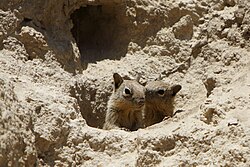
Females give birth to one litter a year.[8] Pregnant females will dig nesting burrows and gather grass and grass roots to make nests. Nesting-only territories are established around these burrows. Females protect the burrows against intruding unrelated conspecifics by attacking and chasing them. Defense of the territories lasts until the young are weaned.[4] The gestation period of this ground squirrel lasts 23–31 days and young are born in late June to early July at higher elevations. At lower elevations, such as Central Oregon, young are born in March [4][6] Litter sizes range from 3–8 young. Litter sizes and reproductive values change with female age, being lowest for young (1 yr) and old (5—9 yr) females and highest for 2 to 4 olds.[9]
ตัวเมียเลี้ยงลูกโดยไม่ได้รับความช่วยเหลือจากตัวผู้ ในช่วงสองสามสัปดาห์แรกของชีวิต ลูกกระรอกจะอาศัยอยู่ในโพรงรังใต้ดินของแม่ ลูกกระรอกจะออกมาจากโพรงที่เกิดครั้งแรกเมื่อหย่านม ซึ่งก็คือเมื่ออายุประมาณ 27 วัน ที่ Tioga Pass ในเดือนกรกฎาคมและต้นเดือนสิงหาคม ในโอเรกอนตอนกลางในช่วงกลางถึงปลายเดือนเมษายน[ 5 ]ลูกกระรอกจะอยู่ใกล้ทางเข้าโพรงที่เกิดเป็นเวลาหลายวัน จากนั้นจึงเริ่มสำรวจพื้นที่กว้างขึ้น ตัวผู้หนุ่มจะออกไปสำรวจไกลกว่าตัวเมีย และตัวผู้จะเริ่มกระจายตัวก่อนสิ้นสุดฤดูร้อนแรกการฆ่าลูกเกิดขึ้นบ่อยครั้งในกระรอกดินของเบลดิง กระรอกที่บุกรุกจะลากลูกกระรอกที่ร้องเสียงแหลมและดิ้นไปมาออกจากโพรงรัง แล้วฆ่ามันทันทีโดยการกัดหัว[ 14 ]บางครั้งผู้ฆ่าก็จะกินซากศพด้วย ตัวเมียที่โตเต็มวัยและตัวผู้ที่อายุหนึ่งปีมักจะเป็นผู้ฆ่ามากกว่า[ 14 ]ผู้ก่อเหตุฆาตกรรมทารกไม่ได้อาศัยอยู่ในพื้นที่เดียวกับเหยื่อ ผู้หญิงไม่เคยฆ่าญาติของตนเอง และพวกเธอจะช่วยเหลือญาติในการปกป้องลูกของตนจากการฆาตกรรมทารก
อนุกรมวิธาน
กระรอกดินของเบลดิงได้รับการอธิบายครั้งแรกโดยคลินตัน ฮาร์ท เมอร์เรียมในปี พ.ศ. 2431 ในชื่อSpermophilus beldingiปัจจุบันมีการยอมรับสายพันธุ์ย่อย 3 สายพันธุ์โดยทั่วไป: [ 25 ]
- U. b. beldingi (Merriam, 1888)
- อาคารยู.บี.เครเบอร์ 1940
- U. b. oregonus (Merriam, 1898)
ลิงก์ภายนอก
 Media related to Urocitellus beldingi (category) at Wikimedia Commons