กลับไปหน้าบทความ

อ่าน 3 นาที

Bicorn

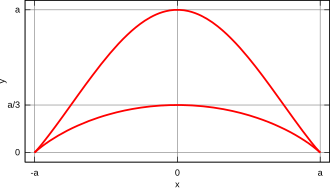
In geometry , the bicorn , also known as a cocked hat curve due to its resemblance to a bicorne , is a rational quartic curve defined by the equation [ 1 ] y 2 ( a 2 − x 2 ) = ( x...

Bicorn

Bicorn

In geometry, the bicorn, also known as a cocked hat curve due to its resemblance to a bicorne, is a rationalquartic curve defined by the equation[1]y2(a2x2)=(x2+2aya2)2.{\displaystyle y^{2}\left(a^{2}-x^{2}\right)=\left(x^{2}+2ay-a^{2}\right)^{2}.} It has two cusps and is symmetric about the y-axis.[2]

History

In 1864, James Joseph Sylvester studied the curve y4xy38xy2+36x2y+16x227x3=0{\displaystyle y^{4}-xy^{3}-8xy^{2}+36x^{2}y+16x^{2}-27x^{3}=0} in connection with the classification of quintic equations; he named the curve a bicorn because it has two cusps. This curve was further studied by Arthur Cayley in 1867.[3]

Properties
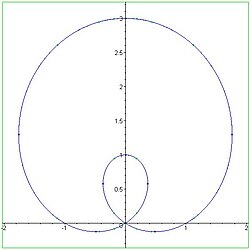
A transformed bicorn with a = 1

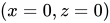
The bicorn is a plane algebraic curve of degree four and genus zero. It has two cusp singularities in the real plane, and a double point in the complex projective plane at (x=0,z=0){\displaystyle (x=0,z=0)}. If we move x=0{\displaystyle x=0} and z=0{\displaystyle z=0} to the origin and perform an imaginary rotation on x{\displaystyle x} by substituting ix/z{\displaystyle ix/z} for x{\displaystyle x} and 1/z{\displaystyle 1/z} for y{\displaystyle y} in the bicorn curve, we obtain (x22az+a2z2)2=x2+a2z2.{\displaystyle \left(x^{2}-2az+a^{2}z^{2}\right)^{2}=x^{2}+a^{2}z^{2}.} This curve, a limaçon, has an ordinary double point at the origin, and two nodes in the complex plane, at x=±i{\displaystyle x=\pm i} and z=1{\displaystyle z=1}.[4]

The parametric equations of a bicorn curve are x=asinθy=a(2+cosθ)cos2θ3+sin2θ{\displaystyle {\begin{aligned}x&=a\sin \theta \\y&=a\,{\frac {(2+\cos \theta )\cos ^{2}\theta }{3+\sin ^{2}\theta }}\end{aligned}}} with πθπ.{\displaystyle -\pi \leq \theta \leq \pi .}

See also

สรุปเนื้อหา

ข้อมูลสำคัญจากบทความ

ข้อมูลสำคัญเกี่ยวกับ Bicorn

In geometry , the bicorn , also known as a cocked hat curve due to its resemblance to a bicorne , is a rational quartic curve defined by the equation [ 1 ] y 2 ( a 2 − x 2 ) = ( x...

History

In 1864, James Joseph Sylvester studied the curve y 4 − x y 3 − 8 x y 2 + 36 x 2 y + 16 x 2 − 27 x 3 = 0 {\displaystyle y^{4}-xy^{3}-8xy^{2}+36x^{2}y+16x^{2}-27x^{3}=0} in connection with the classification of quintic equations ; he named the curve a bicorn...

Properties

The bicorn is a plane algebraic curve of degree four and genus zero. It has two cusp singularities in the real plane, and a double point in the complex projective plane at ( x = 0 , z = 0 ) {\displaystyle (x=0,z=0)} .

External links

Weisstein, Eric W. "Bicorn". MathWorld .