
Blue ringtail
| Blue ringtail | |
|---|---|
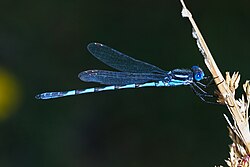 | |
| Male, Tasmania, Australia | |
 | |
| Female, Tasmania, Australia | |
Scientific classification | |
| Kingdom: | Animalia |
| Phylum: | Arthropoda |
| Clade: | Pancrustacea |
| Class: | Insecta |
| Order: | Odonata |
| Suborder: | Zygoptera |
| Family: | Lestidae |
| Genus: | Austrolestes |
| Species: | A. annulosus |
| Binomial name | |
| Austrolestes annulosus | |
 | |
| Synonyms[3] | |
| |
The blue ringtail (Austrolestes annulosus) is an Australian damselfly.[1] It is found on most of the continent.
Taxonomy
The blue ringtail was first described by Edmond de Sélys Longchamps in 1862.[4]
Description
The abdomen is 3 cm long.[5] It can easily be confused with Austrocoenagrion lyelli or Caliagrion billinghursti, but can be differentiated through dorsal patterns. They are a thin, medium-sized damselfly with varying coloration, which depends on maturity and temperature. However most are a striking blue with minimal black markings. Females are slightly more robust than males, and have a black and white/pale blue coloration.
Distribution and habitat
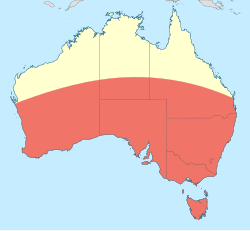
It is widely distributed in most of Australia, except for the northern and north-eastern parts.[4] It is active through September to April in still water bodies such as riverine pools, lakes and ponds, including temporary pools.
Etymology
The genus name Austrolestes combines the prefix austro- (from Latin auster, meaning “south wind”, hence “southern”) with Lestes, a genus name derived from Greek λῃστής (lēstēs, “robber”).[6]
The species name annulosus is derived from the Latin annulus ("ring") and the suffix -osus ("abounding in"), referring to the broad ring on the second abdominal segment.[7]
Gallery
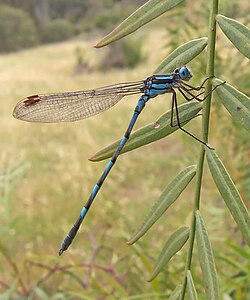 Male
Male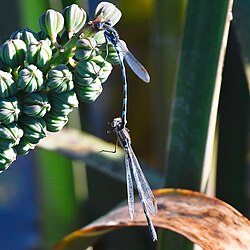 Mating pair
 Female wings
 Male wings