
อ่าน 6 นาที
Blueflower Formation
The Blueflower Formation is a geologic formation in the Northwest Territories, and is a part of the Rackla Group.
Blueflower Formation
| Blueflower Formation | |
|---|---|
| Stratigraphic range: Ediacaran | |
| Type | Formation |
| Unit of | Rackla Group |
| Sub-units | Lower and Upper Member |
| Underlies | Risky Formation |
| Overlies | (Unconformably) Gametrail Formation |
| Lithology | |
| Primary | Siliciclastic |
| Other | Limestone, Mudstone, Siltstone, Sandstone |
| Location | |
| Region | Northwest Territories |
| Country | Canada |
| Type section | |
| Named for | Blueflower Mountain |
| Named by | Aitken |
| Year defined | 1989[3] |
The Blueflower Formation is a geologic formation in the Northwest Territories, and is a part of the Rackla Group. It preserves fossils dating back to the Ediacaranperiod, in both shallow and deep-water environments.
Geology
The Blueflower Formation can be found outcropping in the Wernecke Mountains in Canada, and is a part of the wider Rackla Group. It is overlain by the Risky Formation,[1] whilst it is unconformably underlain by the dolostone Gametrail Formation.[4] The formation is also unique in preserving both deep-water and shallow-water environments. The shallow-water sections are primarily composed of siliciclastic rocks, with sandy-carbonates throughout, and is also fossiliferous in nature, meanwhile the deep-water sections are split into three members.[1]
Members
The deep-water sections of this formation are composed of three members, two of which are informally named, which are as follows in stratigraphic order (lowest to highest):
- Yuletide Member: This member is primarily composed of inter-bedded conglomerate, sandstone and siltstone.[4]
- Disk Member: This member is dominated by black shales, which is inter-bedded with siltstone, sandstone, and authigenic carbonate lenses and nodules. This member is also fossiliferous in nature, containing a number of discoidal forms such as Aspidella, which give the member its informal name.[4]
- Upper Member: This member is predominately composed of sandstones, containing coarse-grained trough- and tabular-cross-bedded rocks, all of which is inter-bedded with shales.[4]
Dating
The base of the Blueflower Formation has been dated using Re–Os Dating, whilst the upper layers have been dated based on the fossil material. Using samples from the base of the formation, the recovered dates were 567.3±3 Ma and 566.9±3.5 Ma, placing the lower layers within the Avalon assemblage. Meanwhile, various fossils collected from rocks higher up in the formation are noted to be akin to formations placed within the White Sea and Nama assemblages, with the tentative proarticulateWindermeria correlating these layers to the White Sea assemblage.[2]
Paleobiota
Unlike most other Ediacaran formations, the Blueflower Formation is unique in that is preserves shallow and deep-marine environments, and as it correlates with other Avalonian formations such as those in Newfoundland and Labrador, it allowed scientists to figure out whether the Ediacaran Biota started out in deep-marine environments before making their way into shallower waters.[1] The forms that can be found across the formation are the familiar Petalonamae such as Charniodiscus, including juvenile petalonamids from the Lower Member, and from the Upper Member tubular forms such as Annulatubus, and the enigmatic Windermeria.[1][2]
A recent paper also describes White Sea aged fossils within the lower sections of the formation, with the fossiliferous rocks being notably enriched in Carbon-13, an enrichment which has only been found in rocks dating to 567.3 million years ago and 566.9 million years ago, placing them within the Avalon assemblage and pushing their appearance some 7 million years before the White Sea assemblage begins, and includes organisms such as the olgunidFunisia and the proarticulate Dickinsonia. It is also the first example of White Sea assemblage organisms not only being found in a deep-water environment,[2] but also the first example of several organisms being found within Laurentia.[5]
Color key
| Notes Uncertain or tentative taxa are in small text; |
Bilaterian
| Genus | Species | Environment | Notes | Images |
|---|---|---|---|---|
| Kimberella[2] |
| Deep-water | Mollusc-like organism, first record in Laurentia and outside of Australia. |  |
Porifera
| Genus | Species | Environment | Notes | Images |
|---|---|---|---|---|
| Funisia[2] |
| Deep-water | Olgunid tubular organism, first record in Laurentia and outside of Australia. |  |
Petalonamae
| Genus | Species | Environment | Notes | Images |
|---|---|---|---|---|
| Charniodiscus[6][1] |
| Frondose organism. |  | |
| Pteridinium[7][2] |
| Frondose organism, originally reported as Inkrylovia.[8] | 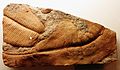 | |
| Swartpuntia (?)[2] |
| Deep-water | Frondose organism. |  |
| Juvenile Fronds[1] |
| Shallow-water | Juvenile frondose organisms, exact genus affinities unknown. |
Proarticulata
| Genus | Species | Environment | Notes | Images |
|---|---|---|---|---|
| Windermeria[9][1][2] |
| Shallow-water | Elongated motile organism. | 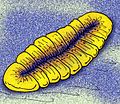 |
| Dickinsonia[2] |
| Deep-water | Oval motile organism, with glided reflection. First record in Laurentia. | 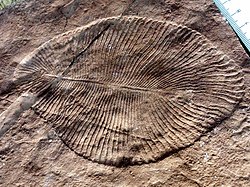 |
Trilobozoan
| Genus | Species | Environment | Notes | Images |
|---|---|---|---|---|
| Rugoconites (?)[6] |
| Shallow-water | Tri-lobed organism, too poorly preserved for confident assignment. |
Cnidarian
| Genus | Species | Environment | Notes | Images |
|---|---|---|---|---|
| Ediacaria[6][10] |
| Discoid organism. |  | |
| Kullingia[6][10] |
| Discoidal organism. |
incertae sedis
| Genus | Species | Environment | Notes | Images |
|---|---|---|---|---|
| Annulatubus[11][2] |
| Shallow-water | Tubular organism. | |
| Aspidella[1][12][2] |
| Shallow and Deep-water | Discoid organism. | 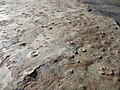 |
| Aulozoon[2] |
| Deep-water | Sessile, tubular organism, first record in Laurentia and outside of Australia. | |
| Cyclomedusa[8][6] |
| Discoid organism. |  | |
| Eoandromeda[8][6] |
| Eight-armed radial organism, first record in Laurentia. | ||
| Hiemalora[9] |
| Discoid organism, possibly holdfasts of petalonamids. |  | |
| Medusinites[6][2] |
| Deep-water | Discoidal organism. Specimens described in Evans et al, 2026 notably bear stalk-like structures. | |
| Sekwia[8][10] |
| Discoid organism. | ||
| Sekwitubulus[11][2] |
| Shallow and Deep-water | Tubular organism. |
Flora
| Genus | Species | Environment | Notes | Images |
|---|---|---|---|---|
| Beltanelliformis[8][6][1][12] |
| Shallow-water | Cyanobacterial colony. |  |
| Vendotaenia (?)[6] |
| Shallow-water | Ribbon-like organism. |
Ichnogenera
| Genus | Species | Environment | Notes | Images |
|---|---|---|---|---|
| Archaeonassa[11] |
| Burrows. | 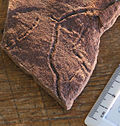 | |
| Gordia[8][6] |
| Burrows. | ||
| Helminthoidichnites[10][11] |
| Shallow and deep-water | Burrows. | |
| Helminthopsis[10][11] |
| Shallow-water | Burrows. |  |
| Kimberichnus[2] |
| Deep-water | Feeding traces of Kimberella. |  |
| Planolites[6][10][11] |
| Shallow and deep-water | Burrows. |  |
| Torrowangea[8][11] |
| Burrows. |
Undescribed
| Genus | Species | Environment | Notes | Images |
|---|---|---|---|---|
| problematicum[1] |
| Deep-water | Ribbon-like fossils, affinities unknown. | |
| tubicolous organism[1] |
| Deep-water | Annulated tubular fossils, which may be flexible in nature, affinities unknown. | |
| unnamed frond specimen[8][1] |
| Shallow-water | Frond-like fossils. Previously reported as Rugoinfractus, although was instead considered a body fossil and not a trace fossil, affinities unknown.[8] | |
| segmented problematicum[11] |
| Shallow-water | Segmented fossil, appears to be trilobate. | |
| Probable Arboreomorpha[2] |
| Deep-water | Segmented fossil, bears similarities to the arboreomorphs. | |
| “petaloids”[2] |
| Deep-water | Segmented petaloid fossils, which are either assignable to Pteridinium, Windermeria, and Inkrylovia.[2] | |
| New taxon?[2] |
| Deep-water | Fossil with two anchor-shaped structures arising from a central division, and bears similarities to Parvancorina. Is noted to possibly be a new genus. |
See also
สรุปเนื้อหา
ข้อมูลสำคัญจากบทความ
ข้อมูลสำคัญเกี่ยวกับ Blueflower Formation
The Blueflower Formation is a geologic formation in the Northwest Territories, and is a part of the Rackla Group.
Geology
The Blueflower Formation can be found outcropping in the Wernecke Mountains in Canada , and is a part of the wider Rackla Group. It is overlain by the Risky Formation , [ 1 ] whilst it is unconformably underlain by the dolostone Gametrail Formation .
Members
The deep-water sections of this formation are composed of three members, two of which are informally named, which are as follows in stratigraphic order (lowest to highest):
Dating
The base of the Blueflower Formation has been dated using Re–Os Dating , whilst the upper layers have been dated based on the fossil material. Using samples from the base of the formation, the recovered dates were 567.3 ± 3 Ma and 566.9 ± 3.