
ลิงมาร์โมเซ็ตหัวบัฟฟี่
| ลิงมาร์โมเซ็ตหัวสีบัฟฟี่[ 1 ] [ 2 ] | |
|---|---|
 | |
การจำแนกทางวิทยาศาสตร์ | |
| อาณาจักร: | แอนิมอลเลีย |
| ไฟลัม: | คอร์ดาต้า |
| ระดับ: | สัตว์เลี้ยงลูกด้วยนม |
| อินฟราคลาส: | รก |
| คำสั่ง: | ไพรเมต |
| ตระกูล: | Callitrichidae |
| ประเภท: | คาลลิทริกซ์ |
| สายพันธุ์: | ซี. ฟลาวิเซปส์ |
| ชื่อทวินาม | |
| คาลลิทริกซ์ ฟลาวิเซปส์ ( โทมัส , 1903) | |
 | |
| ขอบเขตทางภูมิศาสตร์ | |
| คำพ้องความหมาย | |
| |
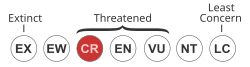
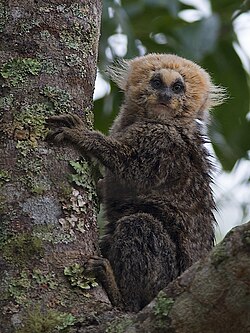
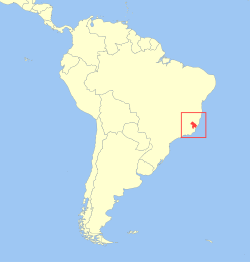
ลิงมาร์โมเสทหัวสีเหลืองอ่อน ( Callithrix flaviceps ) เป็นลิง มาร์โมเสท สายพันธุ์หายากที่พบเฉพาะในป่าฝนทางตะวันออกเฉียงใต้ของบราซิลพบได้ใน รัฐ เอสปิริโตซานโต ตอนใต้ และอาจพบในรัฐริโอเดจาเนโร ตอนเหนือด้วย และการกระจายพันธุ์ขยายไปถึงรัฐมินาสเจไรส์[ 5 ]
คำอธิบาย
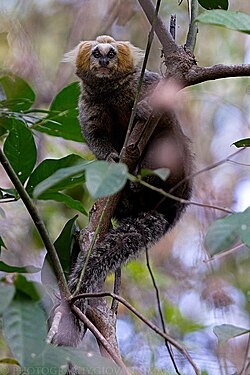
น้ำหนักเฉลี่ยของลิงมาร์โมเซ็ตหัวสีเหลืองที่โตเต็มวัยอาจอยู่ระหว่าง 119 กรัมถึง 710 กรัม ลิงมาร์โมเซ็ตเหล่านี้มีอัตราการเผาผลาญต่ำ และมีลำไส้ใหญ่ส่วนต้น ที่ขยายใหญ่ขึ้น ทำให้สามารถบริโภคอาหารที่มีใยอาหารสูงได้
นิเวศวิทยาและพฤติกรรม
เนื่องจากขนาดที่เล็ก ลิงมาร์โมเซ็ตหัวสีเหลืองอ่อนจึงเสี่ยงต่อการถูกล่าจากสัตว์ผู้ล่า หลายชนิด ภัยคุกคามทั่วไป ได้แก่เสือโอเซลอต งูอนาคอนดาและเหยี่ยวแต่ยังมีสัตว์อื่นๆ อีกมากมาย เช่นนกทูแคนและแรคคูนกินปู[ 6 ]ที่ล่าพวกมัน ลิงมาร์โมเซ็ตหัวสีเหลืองอ่อนมีรูปแบบการหลีกเลี่ยงผู้ล่าที่แตกต่างกันสี่แบบ โดยหลักแล้ว ลิงมาร์โมเซ็ตหัวสีเหลืองอ่อนจะหลีกเลี่ยงผู้ล่าทางอากาศด้วยสัญญาณเตือนภัยที่มีความเข้มต่ำ โดยส่งเสียงหวีดเบาๆ ด้วยปากที่ปิดสนิทเพื่อเตือนสมาชิกในกลุ่มตัวอื่นๆ พฤติกรรมรองในการรับมือกับภัยคุกคามทางอากาศคือสัญญาณเตือนภัยที่มีความเข้มสูง ลิงมาร์โมเซ็ตเหล่านี้จะส่งเสียงหวีดแบบอ้าปากครึ่งหนึ่งเพื่อเตือนสมาชิกตัวอื่นๆ ให้หลบอยู่ใต้กิ่งไม้หรือต้นไม้ บางครั้งอาจหยุดการเคลื่อนไหวทันทีเพื่อหลีกเลี่ยงการถูกเปิดเผย รูปแบบการหลีกเลี่ยงนี้เป็นสัญชาตญาณ และบางครั้งอาจส่งผลให้ลิงเหล่านี้กระโดดลงมาจากยอดไม้หนึ่งไปยังอีกยอดไม้หนึ่งในระยะ 10 เมตร
The third type of anti-predator alarm is for low-intensity terrestrial threats. A few marmosets in the group will give a call to the rest, alerting them of a possible threat such as a snake. The buffy-headed marmosets then proceed to "mob" the predator by amassing in large groups, thus giving an incentive for the predator to not attack. Low calls, often made with the intention of frightening the predator, are a technique that is surprisingly effective. When dealing with threats such as raccoons, they will do so, but maintain their distance from 15–20 m away. The last reaction is one for high-intensity terrestrial situations. In instances of dealing with larger or more threatening predators, such as the tayra, the buffy-headed marmosets amass in a large group, yelping in piercingly loud manner to try and scare the predator away.[7]
Distinct vocalizations are used depending on whether they are for inter-group communication of extra-group communication. For inter-group communication, a short-distance call is used, while for an extra-group communication call, a loud, shrill long-distance call is used.[8] Specific vocalizations are used when an adult buffy-headed marmoset discovers a source of food with others. Younger ones respond by running towards the calling marmoset, while expressing vocalizations of excitement. The dominant female will sometimes also express these vocalizations of excitement. If the food is not given, the female and younger marmosets will stay near the adult buffy-headed marmoset while conveying short vocalizations, to display their presence and express a need for food.[9]
Diet
The buffy-headed marmoset is known primarily for eating fruits, gum, and plant exudates. A small portion of their diet is composed of bird eggs and nestlings. While most marmosets are known for being gumnivorous, the buffy-headed marmoset is predominantly mycophagous-insectivorous. Additionally, they may prey on both vertebrates and invertebrates: primarily orthopterans, phasmids, coleopterans, caterpillars, and tree frogs.[10]
Fungi
Often found at the base of bamboo, fungi are also known to be included in the diet of buffy-headed-marmosets. Because this group of marmosets primarily inhabits areas in which fungi are abundant, it tends to be a consistent source of sustenance throughout the year. Fruits and exudates vary seasonally, and thus are not as readily available, nor as frequently consumed. Fungi, when present, are typically preferred by the buffy-headed marmosets, and likely more nutritious by comparison to their other dietary components.[11]
See also
Further reading
- Ferrari, S. F. (1992). The care of infants in a wild marmoset (Callithrix flaviceps) group. American Journal of Primatology 26(2) 109-18
- Ferrari, S. F. and K. B. Strier. (1992). Exploitation of Mabea fistulifera nectar by marmosets (Callithrix flaviceps) and muriquis (Brachyteles arachnoides) in south-east Brazil. Journal of Tropical Ecology 8: 225–239.
- Grelle, C. E. V. and R. Cerqueira. (2006). Determinants of geographical range of Callithrix flaviceps (Thomas) (Primates, Callitrichidae).Rev. Bras. Zool. [online]. 23(2) 414–20.
- Hilário, R. R. and S. F. Ferrari. (2010). Feeding ecology of a group of buffy-headed marmosets (Callithrix flaviceps): fungi as a preferred resource. American Journal of Primatology 72(6) 515–21.
External links

- ARKive - images and movies of the Buffy-headed marmoset (Callithrix flaviceps)