
อ่าน 6 นาที
J. Carson Mark
Jordan Carson Mark (July 6, 1913 – March 2, 1997) was a Canadian-American mathematician best known for his work on developing nuclear weapons for the United States at the Los...
J. Carson Mark
J. Carson Mark | |
|---|---|
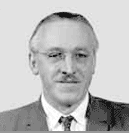 J. Carson Mark | |
| Born | Jordan Carson Mark July 6, 1913 |
| Died | March 2, 1997 (aged 83) |
| Citizenship | American |
| Alma mater | University of Western Ontario(BA, 1935)University of Toronto(PhD, 1938) |
| Known for | nuclear weapon development |
| Scientific career | |
| Fields | Mathematics |
| Institutions | Los Alamos National Laboratory |
| Thesis | On the Modular Representations of the Group GLH(3,P) (1939) |
| Richard Brauer | |
Jordan Carson Mark (July 6, 1913 – March 2, 1997) was a Canadian-American mathematician best known for his work on developing nuclear weapons for the United States at the Los Alamos National Laboratory. Mark joined the Manhattan Project in 1945, and continued to work at Los Alamos under the leadership of Norris Bradbury after World War II ended. He became the leader of the Theoretical Division at the laboratory in 1947, a position he held until 1973. He oversaw the development of new weapons, including the hydrogen bomb in the 1950s. On the hydrogen bomb project he was able to bring together experts like Edward Teller, Stanislaw Ulam and Marshall Holloway despite their personal differences.
In July and August 1958, and again the following year, Mark was a scientific adviser to the United States delegation at the Conference of Experts on Detection of Nuclear Explosions. He served on the United States Air Force's Scientific Advisory Board, and its Foreign Weapons Evaluation Group. After he retired from Los Alamos in 1973 he served on the Nuclear Regulatory Commission's Advisory Committee on Reactor Safeguards, and was a consultant for the Nuclear Control Institute.
Biography
Jordan Carson Mark was born in Lindsay, Ontario, July 6, 1913. He had a brother, James, and five sisters, Margaret, Dorothy, Muriel, Frances and Tony.[1] He received a Bachelor of Arts (BA) degree in mathematics and physics from the University of Western Ontario in 1935, and a Doctor of Philosophy (PhD) in mathematics from the University of Toronto in 1938,[2] writing his thesis "On the Modular Representations of the Group GLH(3,P)" under the supervision of Richard Brauer.[3]
มาร์คสอนคณิตศาสตร์ที่มหาวิทยาลัยแมนิโทบาตั้งแต่ปี 1938 จนถึงช่วงสงครามโลกครั้งที่สองจากนั้นจึงเข้าร่วมห้องปฏิบัติการมอนทรีออลของสภาวิจัยแห่งชาติแคนาดาในปี 1943 เขามาที่ห้องปฏิบัติการลอสอะลามอสในเดือนพฤษภาคม 1945 ในฐานะส่วนหนึ่งของคณะผู้แทนอังกฤษในโครงการแมนฮัตตัน [ 2 ]แม้ว่าเขาจะยังคงเป็นพนักงานของรัฐบาลแคนาดา[ 4 ] เขาอยู่ที่ลอสอะลามอสหลังจากสงครามสิ้นสุดลง และได้เป็นหัวหน้าแผนกทฤษฎีในปี 1947 ซึ่ง เป็นตำแหน่งที่เขาดำรงอยู่จนกระทั่งเกษียณอายุในปี 1973 [ 1 ]เขาได้รับสัญชาติสหรัฐอเมริกาในช่วงทศวรรษ 1950 [ 5 ]
ในปี พ.ศ. 2490 ห้องปฏิบัติการลอสอะลามอส ภายใต้การนำของนอร์ริส แบรดเบอรี มีขนาดเล็กกว่าในช่วงสงครามมาก เนื่องจากเจ้าหน้าที่ส่วนใหญ่ในช่วงสงครามได้กลับไปยังมหาวิทยาลัยและห้องปฏิบัติการของตนแล้ว แต่ก็ยังคงเป็นศูนย์กลางการพัฒนาอาวุธนิวเคลียร์ของอเมริกา และแผนกทฤษฎีก็เป็นศูนย์กลางของห้องปฏิบัติการเป็นเวลาหลายปี ห้องปฏิบัติการได้ก้าวหน้าอย่างมากในการปรับปรุงอาวุธ ทำให้ผลิต จัดเก็บ และจัดการได้ง่ายขึ้น การ ทดสอบ ปฏิบัติการแซนด์สโตนในปี พ.ศ. 2491 แสดงให้เห็นว่ายูเรเนียม-235สามารถนำมาใช้ในอาวุธนิวเคลียร์แบบระเบิดได้[ 6 ]
Mark played a key role in the development of thermonuclear weapons in the early 1950s. A crash program to develop the hydrogen bomb was approved by PresidentHarry S. Truman in January 1950 at Edward Teller's urging before the laboratory had a workable design.[2] This put the laboratory under great pressure. Hans Bethe recalled that "There was a lot of controversy in Los Alamos in those days, and Carson always was imperturbable and stood in the middle of it and had a balanced judgment."[1] When Stanislaw Ulam finally came up with a workable design, it was Mark that he approached first. Mark took the Ulam design to Bradbury, and they put the idea to Teller. "Teller then completed and extended the invention," Bethe noted, "so, in this case, Carson was the mediator between two people who really didn't like each other."[1] "Within an hour of Carson's ... remarks," Teller recalled, "I knew how to move ahead".[5] The Teller-Ulam design would become that of all thermonuclear weapons.[1]

When it came to testing the design in the Ivy Mike nuclear test, Mark again had a crucial go-between role. Bradbury placed Marshall Holloway in charge, but Holloway and Teller did not get along. Mark later recalled that:
I had to be the link with Holloway, since Teller refused. Bradbury asked me to do it. We [Holloway and I] got along fine. Teller up and left for Chicago without notice. Edward had nothing to do with the final preparations for the Mike shot. He inquired occasionally, but if had tried to help, he would have slowed it down. Bethe did participate. Holloway got the job done with little time to spare. I got along well with Marshall [Holloway] and his "henchmen".[7]
The Ivy Mike test was successful, obliterating an island in Enewetak Atoll in the Pacific on November 1, 1952.[5]
แฟรงค์ ฮาร์โลว์ซึ่งเข้าร่วมแผนกทฤษฎีในปี 1953 และได้รับการแต่งตั้งเป็นหัวหน้ากลุ่มโดยมาร์คในปี 1959 ตั้งข้อสังเกตว่ามาร์คให้ความสนใจเป็นพิเศษกับระบบคอมพิวเตอร์ ซึ่งในขณะนั้นเป็นสาขาที่กำลังพัฒนาอย่างรวดเร็ว[ 8 ]เนื่องจากการวิจัยอาวุธส่วนใหญ่ในช่วงทศวรรษ 1960 ไม่เกี่ยวข้องกับแผนกทฤษฎีอีกต่อไป มาร์คจึงขยายขอบเขตการวิจัยออกไป โดยให้การสนับสนุนการวิจัยด้านอุทกพลศาสตร์ฟิสิกส์นิวตรอนและทฤษฎีการขนส่ง [ 5 ] เขายังสนับสนุน การวิจัยเกี่ยวกับ นิวตริโนของเฟรเดอริค ไรน์สซึ่งไรน์สได้รับรางวัลโนเบลสาขาฟิสิกส์ในปี 1995 [ 2 ]
ในเดือนกรกฎาคมและสิงหาคม พ.ศ. 2491 และอีกครั้งในปีถัดมา มาร์คเป็นที่ปรึกษาทางวิทยาศาสตร์ให้กับคณะผู้แทนสหรัฐอเมริกาในการประชุมผู้เชี่ยวชาญด้านการตรวจจับการระเบิดนิวเคลียร์[ 1 ]ผู้แทนจาก ประเทศ กลุ่มตะวันตกและตะวันออกได้หารือเกี่ยวกับวิธีการตรวจจับในบริบทของการเจรจาซึ่งในที่สุดนำไปสู่สนธิสัญญาห้ามการทดสอบนิวเคลียร์บางส่วนซึ่งห้ามการทดสอบนิวเคลียร์เกือบทุกรูปแบบ[ 9 ]เขามุ่งมั่นที่จะป้องกันการแพร่กระจายอาวุธนิวเคลียร์ เขาได้กล่าวสุนทรพจน์ในการประชุม Pugwashและเขียนบทความเพื่อลบล้างความเชื่อผิดๆ ที่ว่าพลูโทเนียมเกรดเครื่องปฏิกรณ์ไม่สามารถนำมาใช้กับอาวุธนิวเคลียร์ได้[ 2 ] [ 10 ]
มาร์คเป็นสมาชิกของสมาคมคณิตศาสตร์อเมริกันและสมาคมฟิสิกส์อเมริกัน[ 1 ]และดำรงตำแหน่งในคณะกรรมการที่ปรึกษาทางวิทยาศาสตร์ของกองทัพอากาศสหรัฐฯ และกลุ่มประเมินอาวุธต่างประเทศ หลังจากเกษียณอายุจากลอสอะลามอสในปี 1973 เขาได้ดำรงตำแหน่งใน คณะกรรมการที่ปรึกษาด้านการคุ้มครองเครื่องปฏิกรณ์ของคณะกรรมการกำกับดูแลนิวเคลียร์ และเป็นที่ปรึกษาให้กับ สถาบันควบคุมนิวเคลียร์หนึ่งในเอกสารสุดท้ายของเขาเกี่ยวกับขีดความสามารถด้านอาวุธนิวเคลียร์ของอิรัก[ 2 ]
มาร์คเสียชีวิตที่ลอสอะลามอส รัฐนิวเม็กซิโกเมื่อวันที่ 2 มีนาคม พ.ศ. 2540 จากภาวะแทรกซ้อนที่เกี่ยวข้องกับการตกจากที่สูง เขาเหลือภรรยาคือแคธลีน ลูกสาว โจน เอลิซาเบธ มาร์ค และแมรี และลูกชาย โทมัส เกรแฮม และคริสโตเฟอร์ พี่ชาย เจมส์ และน้องสาว โดโรธี ไว้เบื้องหลัง[ 1 ]
หมายเหตุ
- ^ a b c d e f g h Hilchey, Tim (9 มีนาคม 1997). "J. Carson Mark นักฟิสิกส์วัย 83 ปี ผู้ มีส่วนร่วมในงานวิจัยระเบิดไฮโดรเจน เสียชีวิต"นิวยอร์กไทมส์สืบค้นเมื่อ4 สิงหาคม 2009
- ^ abcdefPetschek, Albert G.; Bell, George I.; Bethe, Hans A. (October 1997). "Obituary: J. Carson Mark". Physics Today. 50 (10): 124–126. Bibcode:1997PhT....50j.124P. doi:10.1063/1.881942.
- ^"Jordan Mark". Mathematics Genealogy Project. Retrieved October 1, 2014.
- ^Hawkins 1961, p. 30.
- ^ abcd"Staff Biographies - J. Carson Mark". Los Alamos National Laboratory. Archived from the original on July 16, 2012. Retrieved October 1, 2014.
- ^Mark, Carson; Hunter, Raymond E.; Wechsler, Jacob J. (Spring 1983). "Weapon Design - We've Done a Lot but We Can't Say Much"(PDF). Los Alamos Science (7): 159–163. Retrieved October 1, 2014.
- ^"Oral History Transcript — Dr. Carson Mark". American Institute of Physics. Retrieved October 1, 2014.
- ^"Obituary for J. Carson Mark". Nuclear Weapons Archive. Retrieved October 1, 2014.
- ^"Treaty Banning Nuclear Weapon Tests in the Atmosphere, in Outer Space and Under Water". United States Department of State. Retrieved October 1, 2014.
- ^Mark, J. Carson (1993). "Explosive Properties of Reactor-Grade Plutonium". Science & Global Security. 4 (1): 111–128. Bibcode:1993S&GS....4..111M. doi:10.1080/08929889308426394. Retrieved October 1, 2014.
External links
- Audio Interview with J. Carson Mark by Richard Rhodes Voices of the Manhattan Project
- Carlson, Bengt (July–August 2003). "How Ulam set the stage". Bulletin of the Atomic Scientists. 59 (4): 46–51. doi:10.2968/059004013. Retrieved August 4, 2009.
สรุปเนื้อหา
ข้อมูลสำคัญจากบทความ
ข้อมูลสำคัญเกี่ยวกับ J. Carson Mark
Jordan Carson Mark (July 6, 1913 – March 2, 1997) was a Canadian-American mathematician best known for his work on developing nuclear weapons for the United States at the Los...
Biography
Jordan Carson Mark was born in Lindsay, Ontario , July 6, 1913. He had a brother, James, and five sisters, Margaret, Dorothy, Muriel, Frances and Tony.
หมายเหตุ
^ a b c d e f g h Hilchey, Tim (9 มีนาคม 1997). "J. Carson Mark นักฟิสิกส์วัย 83 ปี ผู้ มีส่วนร่วมในงานวิจัยระเบิดไฮโดรเจน เสียชีวิต"นิวยอร์ก ไทมส์ สืบค้นเมื่อ 4 สิงหาคม 2009 ^ a b c d e f Petschek, Albert G.; Bell, George I. ; Bethe, Hans A. (October 1997).
External links
Audio Interview with J. Carson Mark by Richard Rhodes Voices of the Manhattan Project Carlson, Bengt (July–August 2003). "How Ulam set the stage" . Bulletin of the Atomic Scientists . 59 (4): 46– 51. doi : 10.2968/059004013 . Retrieved August 4, 2009 .