The popularity of the beaver hat declined in the early/mid-19th century as silk hats became more fashionable across Europe.
Castor and demicastor hats
Early modern records refer to "castor" and "demicastor" hats, derived from the French and Latin word for beaver, "castor".[10] Demicastor was a felt made from beaver, rabbit fur, and wool.[11] In Scotland, Anne of Denmark gave a castor hat to her husband James VI as a New Year's Day gift in January 1591. She also gave castor hats to her servants, including the secretary Calixtus Schein.[12] James VI played cards with the Duke of Lennox for the stake of a new "black castor hat lined with velvet".[13] In April 1665, a Sussex vicar recorded his purchase of a "shaggy demicastor hat of the fashion".[14]
Carroting
"Carroting" was a chemical treatment —that contained poisonous ingredients such as mercury— that assisted greatly in the felting process.[15] The history of the process was considered a “trade secret” and thus many people used different ratios or recipes to make their carroting solution. [15] Carroting allowed the beaver fur to be felted so tightly that it was the only material that would allow a wide a durable rim.[15]
This process made it possible to make quality hats out of low quality furs such as hare—which are domestic but difficult to felt without the chemical process.[15]
Through the use of mercury in the carroting process, the heavy metal would eventually enter the blood system of the hatters leading to the term "mad as a hatter."[15]
Early modern records refer to "castor" and "demicastor" hats, derived from the French and Latin word for beaver, "castor". [ 10 ] Demicastor was a felt made from beaver, rabbit fur, and wool.
Carroting
"Carroting" was a chemical treatment —that contained poisonous ingredients such as mercury — that assisted greatly in the felting process.

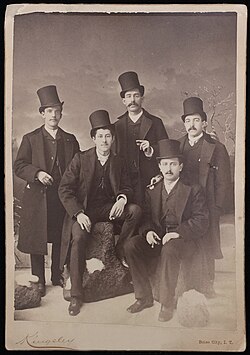

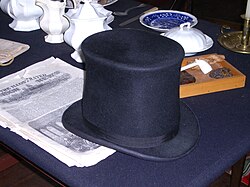 หมวกสักหลาดจำลองผ้าไหมจาก Lower Fort Garry NHS
 รูปทรงและสไตล์ของหมวกขนบีเวอร์ 1776–1825
 หมวกขนบีเวอร์ของอัศวินเทมพลาร์เมสันในศตวรรษที่ 19
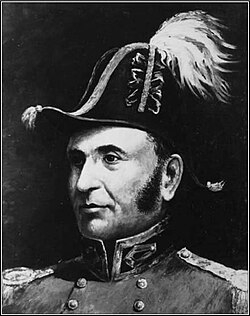 จอห์น บาย (ค.ศ. 1779–1836) วิศวกรการทหารชาวอังกฤษ
 เอ็ดเวิร์ด อาร์เธอร์ วอลตัน – หมวกทรงบีเวอร์
 สื่อที่เกี่ยวข้องกับหมวกบีเวอร์ในวิกิมีเดียคอมมอนส์