
พอลิเมอไรเซชันแบบถ่ายโอนตัวเร่งปฏิกิริยา
พอลิเมอไรเซชันแบบถ่ายโอนตัวเร่งปฏิกิริยา ( CTP ) หรือพอลิคอนเดนเซชันแบบถ่ายโอน ตัวเร่งปฏิกิริยา เป็น พอลิเมอไรเซชันแบบการเติบโตของสายโซ่ที่มีชีวิต ชนิดหนึ่งที่ใช้ในการสังเคราะห์พอลิเมอร์แบบคอนจูเกต [ 1 ] ข้อดีของการใช้ CTP เหนือวิธีการอื่นๆ คือการกระจายตัวของโมเลกุล ต่ำ และการควบคุมน้ำหนักโมเลกุลเฉลี่ยในพอลิเมอร์ที่ได้ มีโมโนเมอร์เพียงไม่กี่ชนิดเท่านั้นที่ได้รับการพิสูจน์แล้วว่าสามารถเกิด CTP ได้[ 2 ]
ประวัติศาสตร์
รายงานแรกของ CTP มาจากห้องปฏิบัติการของ Yokozawa [ 3 ]และ McCullough [ 4 ] พร้อมกัน ในปี 2547 โดยพบว่าโพลีไทโอฟีนสามารถสังเคราะห์ได้ด้วยการกระจายตัวต่ำและควบคุมน้ำหนักโมเลกุลได้ การค้นพบนี้จุดประกายความสนใจในกลไกการพอลิเมอไรเซชันเพื่อให้สามารถขยายไปสู่โมโนเมอร์อื่นๆ ได้ มีพอลิเมอร์เพียงไม่กี่ชนิดที่สามารถสังเคราะห์ได้ผ่าน CTP ดังนั้นพอลิเมอร์แบบคอนจูเกตส่วนใหญ่จึงถูกสังเคราะห์ผ่านการเติบโตแบบขั้นบันไดโดยใช้ ปฏิกิริยาครอสคัปปลิง ที่ เร่ง ปฏิกิริยาด้วยแพลเลเดียม
ลักษณะเฉพาะ
CTP เป็นกระบวนการที่ใช้เฉพาะกับ โมโนเมอร์ อะรีนเพื่อให้ได้พอลิเมอร์แบบคอนจูเกต พอลิเมอร์ที่ได้จาก CTP มักมีการกระจายตัวต่ำเนื่องจากลักษณะการเติบโตของสายโซ่แบบมีชีวิต สามารถใช้ แมสสเปกโทรเมตรีในการระบุหมู่ปลายของพอลิเมอร์เพื่อตรวจสอบว่าพอลิเมอร์นั้นถูกสังเคราะห์ผ่านการเติบโตของสายโซ่หรือไม่
ประเภท
CTP ใช้ปฏิกิริยาครอสคัปปลิง (ดูกลไกด้านล่าง) กับโมโนเมอร์ที่มีหมู่ทรานส์เมทัลเลติงที่ใช้แมกนีเซียม สังกะสี โบรอน และดีบุก ทำให้เกิด ปฏิกิริยา Kumada CTP, Negishi CTP, Suzuki CTP และStille CTP ตามลำดับ
กลไก
กลไกของ CTP ยังคงเป็นที่ถกเถียงกันอยู่ ลักษณะการเติบโตของสายโซ่แบบมีชีวิตของ CTP สามารถอธิบายได้ด้วยการมีอยู่ของ π-complex (ดังที่ได้อธิบายไว้ในส่วนนี้) แต่ก็สามารถอธิบายได้ผ่านปฏิกิริยาของพอลิเมอร์ด้วยเช่นกัน
การเริ่มต้น

การเริ่มต้นจากโลหะ(II) ชนิดใดชนิดหนึ่ง (Ni หรือ Pd) เกี่ยวข้องกับโมโนเมอร์สองตัวที่เปลี่ยนโลหะไปยังศูนย์กลางโลหะเพื่อสร้างสารเชิงซ้อนที่สามารถเกิดการกำจัดแบบรีดักชันได้ สารเชิงซ้อนที่เกิดขึ้นหลังจากการกำจัดแบบรีดักชันเรียกว่า π-complex เนื่องจากตัวเร่งปฏิกิริยาจับกับระบบ π ของโมโนเมอร์ ตัวเร่งปฏิกิริยาสามารถเปลี่ยนไอโซเมอร์เป็น π-complex อื่นๆ ได้ผ่านกระบวนการที่เรียกว่า "การเดินวงแหวน" ไปยังพันธะ π ที่อยู่ติดกับพันธะ CX ที่ปลายโซ่ ทำให้ เกิด การเติมออกซิเดชันได้ ผลิตภัณฑ์ของการเติมออกซิเดชันคือพอลิเมอร์-โลหะ(II)-เฮไลด์ที่ออกฤทธิ์ และสามารถทำปฏิกิริยากับโมโนเมอร์ในปฏิกิริยาการแพร่กระจายได้[ 5 ]
การขยายพันธุ์
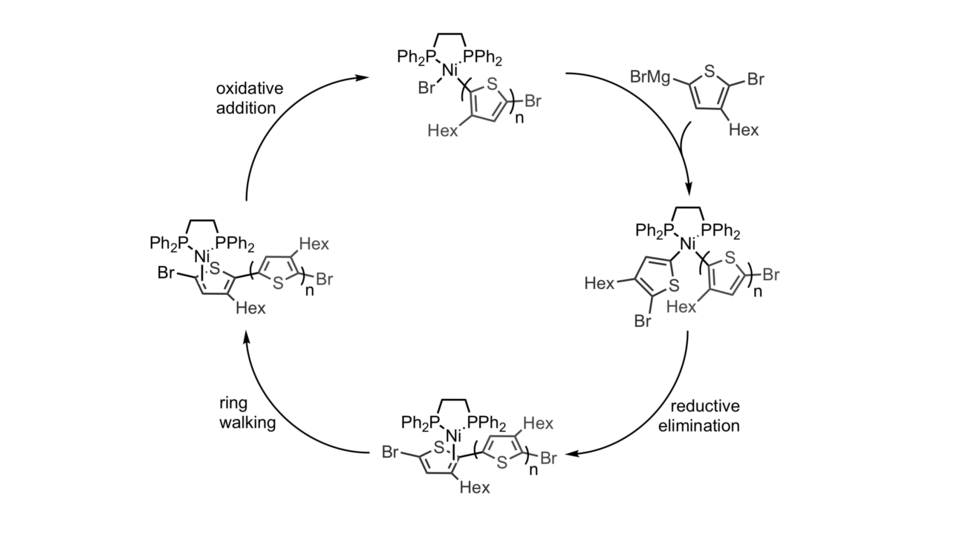
The propagation steps of CTP occurs through a cycle of transmetalation, reductive elimination, ring walking, and oxidative addition. The existence of a π-complex allows for the polymerization to be controlled as it ensures that the catalyst cannot dissociate from the polymer chain (and start new chains). This means that the number of polymer chains at the end of the polymerization should be equal to the number of catalysts in solution, and that the average degree of polymerization of the sample at the end of polymerization should be equal to the ratio of monomers to catalysts in solution.[6]
Termination
A characteristic of CTP is living chain-growth character, meaning that the catalyst will have a reactive chain end for the entirety of the polymerization. Therefore, to terminate the polymerization, a quenching agent must be added, such as a strong acid to protonate the polymer, or a nucleophile to add an end cap the polymer.
If the π-complex is too weakly bound, termination of polymer chains can occur before a quenching agent is added, causing lower molecular weight polymers to form. Current research into CTP focuses on finding catalysts that form strong catalyst-polymer π-complexes such that the polymerization remains living.
Analysis
Success of CTP is often evaluated using gel permeation chromatography, matrix-assisted laser desorption/ionization, nuclear magnetic resonance spectroscopy. GPC characterization enables determination of average molecular weight. MALDI and NMR allow for identification of end groups of the polymer chain.
Polymer reactivity versus π-complex
The chain growth nature of CTP can also be described without invoking a catalyst-polymer π-complex. If we assume that no π-complex forms and instead every time a monomer was added to a polymer, the polymer becomes more reactive, we would also see chain growth since the largest polymers in the reaction would be the most reactive and would react with monomers preferentially.[7] The presence of this mechanism and one mediated by a π-complex can be elucidated by studying the end groups of the polymers using mass spectrometry.[8]
Polymers that can be synthesized by CTP
A non-exhaustive list of the polymers that can be synthesized using CTP:[9]
- Polythiophene
- Polyphenylene
- Polyselenophene
- Polytellurophene
- Polythiazole
- Polybenzothiadiazole
- Polypyrrole
- Polyfluorene