
โมร็อกโกนัส
| โมร็อกโกนัส ช่วงเวลา: | |
|---|---|
 | |
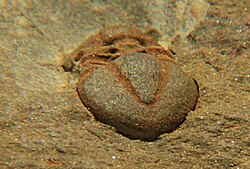
| การลอกคราบภายในของMarocconus notabilisมุมมองจากด้านบน ขนาด 9 มม. | |
การจำแนกทางวิทยาศาสตร์ | |
| อาณาจักร: | แอนิมอลเลีย |
| ไฟลัม: | อาร์โทรโปดา |
| กลุ่มสายพันธุ์ : | † อาร์ติโอโพดา |
| ระดับ: | † ไทรโลบิต่า (?) |
| คำสั่ง: | † แอกโนสติดา |
| ตระกูล: | † วงศ์Weymouthiidae |
| ประเภท: | † โมร็อคโคนัสออซดิกเมน , 2009 [ 1 ] |
| สายพันธุ์: | † ม. โนตาบิลิส |
| ชื่อทวินาม | |
| † Morocconus notabilis ( เกเยอร์ , 1988) | |
| คำพ้องความหมาย | |
Morocconusเป็นสกุลที่สูญพันธุ์ไปแล้ว จากกลุ่มฟอสซิลสัตว์ทะเลจำพวกไตรโลไบต์ ซึ่ง เป็นที่รู้จักกันดี ยังคงมีการถกเถียงกันอยู่ว่ามันมีชีวิตอยู่ในช่วงปลายยุคแคมเบรียนตอนต้นหรือช่วงต้นยุคแคมเบรียนตอนกลาง Morocconus notabilisเป็นเพียงชนิดเดียวที่รู้จักในสกุลนี้ (กล่าวคือ สกุลนี้ มีเพียง ชนิดเดียว )
อนุกรมวิธาน
Morocconusแทนที่Cephalopyge Geyer, 1988ซึ่งเป็นชื่อพ้องรองของCephalopyge Hanel, 1905ซึ่งเป็นทากทะเลอย่างไรก็ตามCephalopygeยังคงถูกใช้กันอย่างแพร่หลายสำหรับไทรโลไบต์ชนิดนี้ และชื่อใหม่Morocconusได้รับการกล่าวถึงเพียงครั้งเดียวในเอกสารทางวิทยาศาสตร์[ 6 ]
การกระจาย
Morocconus notabilisเป็นที่รู้จักจากยุคแคมเบรียนตอนล่างสุดหรือยุคแคมเบรียนตอนกลางตอนต้นสุดของโมร็อกโก ( การก่อตัวของ Jbel Wawrmastเทือกเขา Anti-Atlas) [ 7 ]

นิเวศวิทยา
Morocconus notabilisเกิดขึ้นในชั้นเดียวกันกับCambropallas telesto [ 7 ]
คำอธิบาย

Like all Agnostida, Morocconus is diminutive and the headshield (or cephalon) and tailshield (or pygidium) are of approximately the same size (or isopygous) and outline. Like all Weymouthiidae, it lacks eyes and rupture lines (or sutures). The cephalon is subcircular except for the straight posterior. The external surface of the cephalon is smooth, convex, and is hanging over an extremely narrow border. The central raised area of the cephalon (or glabella) is evident on the internal mold by a clear defining furrow, long triangular in outline (about 1⅓× as long as the maximum width), with rounded tips and only one transverse furrow (SO). The occipital ring (LO) is short (measured along the length of the animal), and hangs over the posterior margin. The thorax has three segments, like all other Weymouthiidae for which the thorax is known. The pygidium is also externally smooth, and convex. The internal mold shows a long triangular axis, narrower than the glabella (about 1⅓× as long as the maximum width), with rounded tips extending to the posterior margin, and without visible segmentation. The pygidium has no border furrow.[7]
อ่านเพิ่มเติม
- Gerd Geyer และ T. Vincent. 2015. ปริศนาของพาราดอกไซด์คลี่คลายแล้ว: การปรากฏตัวของพาราดอกไซด์ที่เก่าแก่ที่สุดและความเกี่ยวข้องกับขอบเขตล่างของยุคแคมเบรียน ซีรีส์ 3. Paläontologische Zeitschrift 89:335–398