
เอิร์นสต์ ฟอน มันส์เฟลด์
กราฟ ฟอน มันส์เฟลด์ | |
|---|---|
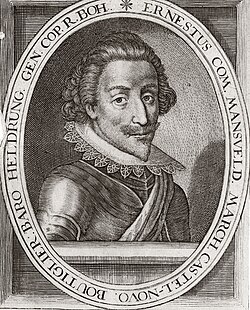 | |
| เกิด | ประมาณ ค.ศ. 1580 |
| เสียชีวิต | 29 พฤศจิกายน ค.ศ. 1626 (อายุราว 46 ปี) |
| จำนวนปี ที่ปฏิบัติงาน | ค.ศ. 1595–1626 |
| พ่อ | ปีเตอร์ เอิร์นสต์ ที่ 1 ฟอน มานสเฟลด์-วอร์เดอออร์ต |
ปีเตอร์ เอิร์ นสต์ กราฟ ฟอน มันส์เฟลด์(เยอรมัน: Peter Ernst Graf von Mansfeld; ประมาณค.ศ. 1580 – 29พฤศจิกายนค.ศ. 1626 ) หรือเรียกสั้นๆ ว่าเอิร์นสต์ ฟอน มันส์เฟลด์เป็นแม่ทัพชาวเยอรมัน แม้จะเป็นชาวคาทอลิกแต่เขากลับต่อสู้เพื่อฝ่ายโปรเตสแตนต์ในช่วงต้นของสงครามสามสิบปีเขาเป็นหนึ่งในนายพลทหารรับจ้างชั้นนำของสงครามช่วงต้น
ชีวประวัติ
เอิร์นส์เป็น บุตร นอกสมรสของเคานต์ปีเตอร์ เอิร์นส์ ฟอน มันส์เฟลด์ (ค.ศ. 1517–1604) กับแอนนา ฟอน เบนเซอราธ[ 1 ]บิดาของเขาเป็นสมาชิกของราชวงศ์มันส์เฟลด์และผู้ปกครอง ราช สำนักสเปน ในขณะที่มารดาของเขาเป็นขุนนางชั้นต่ำกว่า มาก บุตรทั้งสามคนที่เกิดจากความสัมพันธ์นี้ได้รับการรับรองให้เป็นบุตรโดยชอบด้วยกฎหมายเมื่อบิดามารดาของเขาแต่งงานกันในวันที่ 28 กุมภาพันธ์ ค.ศ. 1591 ที่บรัสเซลส์เขาได้รับการเลี้ยงดูใน ศาสนา คาทอลิกที่พระราชวังของบิดาในลักเซมเบิร์ก[ 2 ]
เขาได้รับประสบการณ์ทางทหารครั้งแรกในช่วงสงครามยาวนานในฮังการี ซึ่ง ชาร์ลส์ (ค.ศ. 1543–1595) พี่ชายต่างมารดาของเขา ซึ่งเป็นทหารที่มีชื่อเสียงเช่นกัน ได้ดำรงตำแหน่งผู้บัญชาการระดับสูงในกองทัพ จักรวรรดิในขณะที่พี่ชายของเขาเสียชีวิตจากโรคระบาดในเวลาไม่นาน เอิร์นสต์หนุ่มกลับอยู่ที่สมรภูมิรบเป็นเวลาหลายปี ในสงครามสืบราชบัลลังก์จูลิชเขาได้เข้าร่วมกับอาร์ชดยุคเลโอโปลด์ที่ 5 แห่งออสเตรียจนกระทั่งความอกตัญญูของเจ้าชายองค์นั้น ไม่ว่าจะจริงหรือเป็นเพียงจินตนาการ ทำให้เขาหันไปเข้าข้างศัตรูของราชวงศ์ฮับส์บูร์กแม้ว่าเขาจะยังคงเป็นชาวโรมันคาทอลิก แต่ตั้งแต่ประมาณปี ค.ศ. 1610 เขาได้เป็นพันธมิตรกับ เจ้าชาย โปรเตสแตนต์ อย่างเปิดเผย และในช่วงต้นของสงครามสามสิบปีเขาเป็นหนึ่งในผู้สนับสนุนชั้นนำของพวกเขา[ 1 ]ในปี ค.ศ. 1615-1617 เขาได้เข้าร่วมในสงครามอูสโกก[ 3 ]
He was despatched by Charles Emmanuel, Duke of Savoy, at the head of about 2,000 men to aid the revolting Bohemians when war broke out in 1618. He took Pilsen, but in the summer of 1619 he was defeated at the Battle of Sablat; after this he offered his services to the Emperor Ferdinand II and remained inactive while the titular king of Bohemia, Frederick V, Elector Palatine of the Rhine, was driven in headlong rout from Prague. Mansfeld, however, was soon appointed by Frederick to command his army in Bohemia, and in 1621 he took up his position in the Upper Palatinate, successfully resisting the efforts made by Tilly to dislodge him.[1]
From the Upper Palatinate, he passed into the Rhenish Palatinate. Here he relieved Frankenthal and took Hagenau; then, joined by his commander, the elector Frederick, he defeated Tilly at Wiesloch (25 April 1622) and plundered Alsace and Hesse. However, Mansfeld's ravages were not confined to the lands of his enemies; they were ruinous to the districts he was commissioned to defend.[1] At length, Frederick dismissed Mansfeld's troops from his service. With Christian of Brunswick the count then entered the service of the United Provinces and marched to the Republic through the Spanish Netherlands. In August 1622, at Fleurus his army had to fight its way through a Spanish attempt to block him. His army recuperated and reequipped in September and then marched with the Dutch army to relieve the city of Bergen op Zoom, besieged by Spain. After that, he took up his quarters in East Frisia, capturing fortresses and inflicting great hardships upon the inhabitants. A mercenary and a leader of mercenaries, Mansfeld often interrupted his campaigns by journeys made for the purpose of raising money, or in other words of selling his services to the highest bidder, and in these diplomatic matters he showed considerable skill.[1]
About 1624 he paid three visits to London, where he was hailed as a hero by the populace, and at least one to Paris. James I, being the father-in-law of Frederick V, Elector Palatine, was anxious to furnish him with men and money for the recovery of the Palatinate, but it was not until January 1625 that Mansfeld and his army of "raw and poor rascals" sailed from Dover to the Netherlands before failing to relieve the siege of Breda. Later in the year, the Thirty Years' War having been renewed under the leadership of Christian IV of Denmark, he re-entered Germany to take part therein but on 25 April 1626 Wallenstein inflicted a severe defeat upon him at the bridge of Dessau. Mansfeld, however, quickly raised another army, with which he intended to attack the hereditary lands of the house of Austria, and pursued by Wallenstein he pressed forward towards Hungary, where he hoped to accomplish his purpose by the aid of Bethlen Gábor, prince of Transylvania but when Bethlen changed his policy and made peace with the emperor, Mansfeld was compelled to disband his troops. Already weakened by ill health, he set out for Venice, but when he reached Rakovica near Sarajevo, in Bosnia, he took a turn for the worse and died on 29 November 1626, of natural causes. According to one account, Mansfeld, knowing his end was near, donned his armour and propped by two of his soldiers he gave a farewell speech to his remaining followers and died at sunrise while standing up.[3] He was buried in Split.[4]
Notes
- ↑Regarding personal names: Graf was a title before 1919, but now is regarded as part of the surname. It is translated as Count. Before the August 1919 abolition of nobility as a legal class, titles preceded the full name when given (Graf Helmuth James von Moltke). Since 1919, these titles, along with any nobiliary prefix (von, zu, etc.), can be used, but are regarded as a dependent part of the surname, and thus come after any given names (Helmuth James Graf von Moltke). Titles and all dependent parts of surnames are ignored in alphabetical sorting. The feminine form is Gräfin.
แหล่งที่มา
- บทความนี้ได้นำข้อความจากสิ่งพิมพ์ที่อยู่ในสาธารณสมบัติ มาใช้ : Chisholm, Hugh , ed. (1911). " Mansfeld, Ernst ". Encyclopædia Britannica . Vol. 17 ( ฉบับที่ 11). Cambridge University Press. หน้า599– 600. หมายเหตุท้ายบท:
- เอฟ. สตีฟ, เอิร์นส์ ฟอน แมนส์เฟลด์ (มิวนิก, 1890)
- R. Reuss , Graf Ernst von Mansfeld im böhmischen Kriege (บรันสวิก, 1865)
- เอซี เดอ วิลแลร์มงต์, เออร์เนสต์ เดอ มานสเฟลด์ (บรัสเซลส์, 1866)
- แอล. กราฟ อูเอทเทอรอดต์ ซู ชาร์เฟินแบร์ก, เอิร์นส์ กราฟ ซู มานส์เฟลด์ (Gotha; 1867)
- เจ. กรอสส์มันน์, Des Grafen Ernst von Mansfeld Letzte Pläne und Thaten (Breslau, 1870)
- อี. ฟิสเชอร์, เดส มานส์เฟลเดอร์ส ท็อด (เบอร์ลิน, 1878)
- เอส.อาร์. การ์ดิเนอร์ , ประวัติศาสตร์อังกฤษ , เล่ม 4 และ 5 (1901);
- เจ.แอล. มอตลีย์ , ชีวิตและความตายของจอห์นแห่งบาร์เนเวลด์ (ฉบับปี 1904; เล่มที่ 2)
อ่านเพิ่มเติม
- เอิร์นส์ ฟอน มันส์เฟลด์ - ประกาศ (มีภาษาอังกฤษด้วย) เกี่ยวกับชีวประวัติล่าสุดของผู้นำทหารรับจ้าง (ตีพิมพ์ในเดือนกันยายน 2010)
- บทวิจารณ์และสรุป (เป็นภาษาอังกฤษ)ของชีวประวัติภาษาเยอรมันที่กล่าวถึงก่อนหน้านี้
ลิงก์ภายนอก
- เอิร์นสต์ ฟอน มันส์เฟลด์