
Diversity factor
In the context of electricity, the diversity factor is the ratio of the sum of the individual non-coincident maximum loads of various subdivisions of the system to the maximum demand of the complete system. It is a way to quantify the diversity among consumer classes.[1]
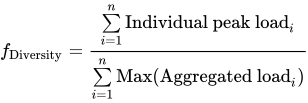
The diversity factor is always greater than 1. The aggregate load is time dependent as well as being dependent upon equipment characteristics. The diversity factor recognizes that the whole load does not equal the sum of its parts due to this time interdependence or "diversity." For example, one might have ten air conditioning units that are 20 tons each at a facility with an average full load equivalent operating hours of 2000 hours per year. However, since the units are each thermostatically controlled, it is not known exactly when each unit turns on. If the ten units are substantially larger than the facility's actual peak AC load, then fewer than all ten units will likely come on at once. Thus, even though each unit runs a total of a couple of thousands (2000) hours a year, they do not all come on at the same time to affect the facility's peak load. The diversity factor provides a correction factor to use, resulting in a lower total power load for the ten AC units. If the energy balance done for this facility comes out within reason, but the demand balance shows far too much power for the peak load, then one can use the diversity factor to bring the power into line with the facility's true peak load. The diversity factor does not affect the energy; it only affects the power.
Coincidence factor
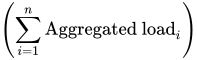
The coincidence factor is the reciprocal of the diversity factor. The simultaneity factor may be identical to either the coincidence factor or the diversity factor, depending on the sources of definition; the International Electrotechnical Commission defines the coincidence and simultaneity factors identically, with the diversity factor being their reciprocal. Since the only change in definition is to take the inverse, all one needs to know is if the factor is greater than or less than one.
Diversity factor in heat networks
In the heat networks design the coincidence factor is often called a diversity factor (CIBSE guidance,[2] DS 439[3]). So, in the context of hot water systems the diversity factor is always less than 1. For space heating, for more than 40 dwellings the factor levels out to approximately 0.62. For domestic hot water at 40 dwellings it is slightly below 0.1 and keeps decreasing further with additional connections.
Diversity
คำว่า"ความหลากหลาย" (diversity ) ซึ่งเป็นคำที่ไม่เป็นทางการ แตกต่างจาก " ปัจจัยความหลากหลาย" (diversity factor ) โดยหมายถึงเปอร์เซ็นต์ของเวลาที่เครื่องจักร อุปกรณ์ หรือสิ่งอำนวยความสะดวกนั้นทำงานที่ระดับภาระสูงสุดหรือระดับปกติ ตัวอย่างเช่น ความหลากหลาย 70% หมายความว่าอุปกรณ์ดังกล่าวทำงานที่ระดับภาระปกติหรือสูงสุด 70% ของเวลาที่เชื่อมต่อและเปิดใช้งานอยู่
ภาระที่หลากหลายและปัจจัยการกระจายความเสี่ยง
โหลดที่กระจายตัวคือพลังงานรวมที่คาดว่าจะถูกดึงไปใช้ในช่วงเวลาที่มีความต้องการสูงสุดโดยอุปกรณ์หรือระบบอุปกรณ์โหลดสูงสุดของระบบคือผลรวมของความสามารถในการรับโหลดเต็มที่ของแต่ละอุปกรณ์ปัจจัยการใช้ประโยชน์ปัจจัยการกระจายตัวปัจจัยความต้องการและปัจจัยโหลดกระบวนการนี้เรียกว่าการกระจายโหลดปัจจัยการกระจายตัวจึงถูกกำหนดดังนี้:

ในสาขาวิศวกรรมไฟฟ้า
ปัจจัยความหลากหลาย (Diversity factor) มักถูกนำมาใช้ในหัวข้อทางวิศวกรรมหลายด้าน ตัวอย่างหนึ่งคือการศึกษาการประสานงานของระบบ โดยใช้ปัจจัยความหลากหลายนี้ในการประมาณภาระของโหนดใดโหนดหนึ่งในระบบ
ดูเพิ่มเติม
ลิงก์ภายนอก
- Barney L. Capehart. "ปัจจัยการโหลดอุปกรณ์ ปัจจัยการใช้งาน และปัจจัยความหลากหลาย ตลอดจนการอภิปรายทั่วไปเกี่ยวกับขั้นตอนการตรวจสอบพลังงาน" . www.ise.ufl.edu .