
Lewis Harold Bell Lasseter
Lewis Harold Bell Lasseter | |
|---|---|
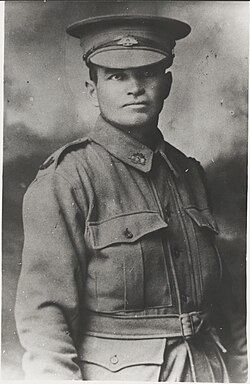 Lasseter in the uniform of the First AIF c. 1915 | |
| Born | Lewis Hubert Lasseter (1880-09-27)27 September 1880Bamganie, Victoria, Australia |
| Died | c. 31 January 1931 (aged 50) Tjunti, NT, Australia |
Resting place | Alice Springs Cemetery, Alice Springs, NT, Australia |
| Known for | claiming to discover Lasseter's Reef |
| Children | Bob Lasseter |
Lewis Harold Bell Lasseter (27 September 1880 –c. 31 January 1931[1]), also known as Harold Lasseter, was an Australian gold prospector who claimed to have found a fabulously rich gold reef in central Australia, subsequently known as Lasseter's Reef.
Life
Lasseter was born in 1880 at Bamganie, Victoria, Australia. Self-educated, he was literate and well-spoken, and commonly described as eccentric and opinionated. He travelled in both Australia and the United States and worked in a variety of occupations, marrying twice and fathering five children.
Lasseter twice enlisted in the First Australian Imperial Force. In 1916, he joined the reinforcements for the 3rd Pioneer Battalion being raised in Melbourne but was discharged before leaving Australia after repeatedly going AWOL. In 1917, he enlisted again, this time in Adelaide, but was discharged as medically unfit for service following a brawl, again without leaving Australia.[2]
Lasseter's Reef
Lasseter was made famous by his sensational claim, first asserted in 1929, that, as a young man, he had discovered a fabulously rich gold reef, an entity now known as "Lasseter's Reef", in central Australia.
He perished in the desert near the Western Australia–Northern Territory border in early 1931 after he separated himself from an expedition (CAGE I) that was mounted in an effort to rediscover the supposed reef. His body was found and reburied in Lasseter's Cave in March 1931 by Bob Buck, a central Australian bushman and pastoralist sent to search for Lasseter. Buck was accompanied by Ernest Gustav Brandon-Cremer a recruited photographer of the CAGE II Expedition to discover the body of Lasseter. In December 1957 Lowell Thomas and Lee Robinson re-interred the body in the Alice Springs cemetery.
เฟร็ด เบลคเลย์ หัวหน้าคณะสำรวจของลาเซเตอร์ในปี 1930 ตราหน้าลาเซเตอร์ว่าเป็นคนหลอกลวงที่โกงนักลงทุนด้วยแผนการอันชาญฉลาดเพื่อโน้มน้าวให้พวกเขาเชื่อว่ามีแหล่งทองคำอยู่จริง[ 3 ]เบลคเลย์ยังอ้างว่าลาเซเตอร์ไม่ได้เสียชีวิตในออสเตรเลียตอนกลาง แต่หนีไปอเมริกา ข้ออ้างนี้ถูกปฏิเสธในหนังสือ Lasseter Did Not Lieโดย A. Stapleton (ตีพิมพ์ในแอดิเลด ปี 1981) [ 4 ]ด้วยคำกล่าวอ้างที่ขัดแย้งกันมากมายตลอดหลายปีที่ผ่านมา จึงเป็นเรื่องยากหรือเป็นไปไม่ได้เลยที่จะแยกประวัติศาสตร์ออกจากตำนานเกี่ยวกับแฮร์รี่ ลาเซเตอร์
ในวัฒนธรรมสมัยนิยม
นักเขียนชาวออสเตรเลียIon Idriessได้ตีพิมพ์หนังสือLasseter's Last Rideในปี 1931 ซึ่งเล่าเรื่องราวการสำรวจในปี 1930 และการเสียชีวิตของ Lasseter โดยอ้างอิงจากการสัมภาษณ์และจดหมายของ Lasseter
มีการกล่าวถึง Lasseter ในเพลง "Warakurna" จากอัลบั้มDiesel and Dust ปี 1987 ของวงร็อกMidnight Oil จากออสเตรเลีย ซึ่งมีเนื้อหาเกี่ยวกับสิทธิของชาวอะบอริจิ น
เรื่องราวของเขาเป็นหัวเรื่องของหนังสือสารคดีเรื่อง "การตามหาแฮโรลด์ ลาสเซเตอร์ : เรื่องจริงของชายผู้อยู่เบื้องหลังตำนาน" โดยเมอร์เรย์ ฮับบาร์ด (1993)
ภาพยนตร์สารคดีเรื่อง Lasseter's BonesของLuke Walker ในปี 2013 สำรวจชีวิตและตำนานของ Lasseter และบันทึกความพยายามมากมายของผู้สร้างภาพยนตร์ในการค้นหาแนวปะการัง Lasseter ที่มีชื่อเสียง[ 5 ]ภาพยนตร์เรื่องนี้ยังติดตาม Bob ลูกชายวัยชราของ Lasseter ในการเดินทางสำรวจทะเลทรายครั้งสุดท้ายเพื่อค้นหาทองคำที่หายไปของพ่อ และสำรวจแง่มุมที่ซับซ้อนมากมายของปริศนา Lasseter [ 6 ] Lasseter's Bones ได้รับการเสนอชื่อเข้าชิง รางวัลภาพยนตร์สารคดียอดเยี่ยมในงานFilm Critics Circle of Australia Awards [ 7 ]
ในเดือนมกราคม 2017 ตอนหนึ่งของรายการ Expedition Unknownทางช่อง American Travel Channelที่ชื่อว่า "Lasseter's Gold" ได้ตรวจสอบปริศนานี้[ 8 ]
มรดก
- ถ้ำลาเซเตอร์ , นอร์เทิร์นเทร์ริทอรี
- ทางหลวงลาเซเตอร์ , นอร์เทิร์นเทร์ริทอรี
- โรงแรมและคาสิโนลาสเซเตอร์ส เมืองอลิสสปริงส์ รัฐนอร์เทิร์นเทร์ริทอรี
ลิงก์ภายนอก
- สามารถดู สำเนา บันทึกประจำวันของเขา ทางออนไลน์ได้ซึ่งบันทึกดังกล่าวถูกค้นพบโดยคณะค้นหา และสามารถเข้าถึงได้ผ่านทางหอสมุดแห่งรัฐนิวเซาท์เวลส์