
อ่าน 4 นาที
Highly optimized tolerance
In applied mathematics , highly optimized tolerance (HOT) is a method of generating power law behavior in systems by including a global optimization principle.
Highly optimized tolerance
In applied mathematics, highly optimized tolerance (HOT) is a method of generating power law behavior in systems by including a global optimization principle. It was developed by Jean M. Carlson and John Doyle in the early 2000s.[1] For some systems that display a characteristic scale, a global optimization term could potentially be added that would then yield power law behavior. It has been used to generate and describe internet-like graphs, forest fire models and may also apply to biological systems.
Example
The following is taken from Sornette's book.
Consider a random variable, , that takes on values with probability . Furthermore, let's assume for another parameter


for some fixed . We then want to minimize

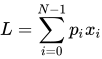
subject to the constraint

Using Lagrange multipliers, this gives
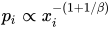
giving us a power law. The global optimization of minimizing the energy along with the power law dependence between and gives us a power law distribution in probability.
See also
สรุปเนื้อหา
ข้อมูลสำคัญจากบทความ
ข้อมูลสำคัญเกี่ยวกับ Highly optimized tolerance
In applied mathematics , highly optimized tolerance (HOT) is a method of generating power law behavior in systems by including a global optimization principle.
Example
The following is taken from Sornette's book.
See also
self-organized criticality Retrieved from "https://en.wikipedia.org/w/index.php?title=Highly_optimized_tolerance&oldid=1315099933"