
Hypsosinga
Hypsosinga is a genus of orb-weaver spiders first described by Anton Ausserer in 1871,[2] with a wide global distribution.[1]
Distribution
Most Hypsosinga species are found in Eurasia from Greenland to Japan, while a few occur in Africa and North America
In 2015, female Hypsosinga heri spiders were identified at the RSPBRadipole Lake nature reserve in Dorset, England. The previous recorded sightings of the species in the UK were in 1898 and 1912 at Wicken Fen, Cambridgeshire.[3]
Life style
Hypsosinga live on low plants where their small orb-webs frequently go unnoticed. Levy (1984) reported on a species that lives under stones and which could easily be confused with theridiids (especially Steatoda spp.). Hypsosinga make a complete orb-web sually with a retreat. They are frequently sampled in sweep nets in grassland.[4]
Description

The genera Singa and Hypsosinga comprise small spiders identifiable by a shiny body decorated with spots or lines. Hypsosinga has a carapace that is smooth and rather wide in front, wider than the eye area, with no thoracic depression or sometimes only a small longitudinal black mark in the male.[4]
The integument is shiny, the eye area is usually black, and the posterior median eyes are usually their own diameter apart. Hypsosinga differs from Singa in having the posterior median eyes as the largest, while the ocular quadrangle is wider behind than in front, or rectangular.[4]
The abdomen in Hypsosinga, unlike that of Singa, tends to be oval and widest in the middle, with either two dorsal longitudinal bands or four dark spots. The epigynum differs from those of both Singa and Araneus in lacking a scape.[4]
Etymology
ชื่อสกุลมาจากภาษากรีก "hypso" ซึ่งหมายถึง "สูง" โดยอ้างถึง clypeus ที่สูงกว่าของสกุล Singa [ 5 ]
สายพันธุ์
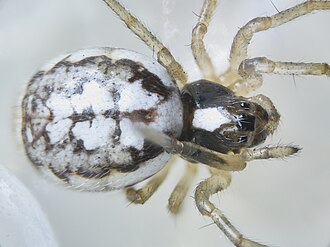 ไฮปโซซิงกา อัลโบวิตตาตา
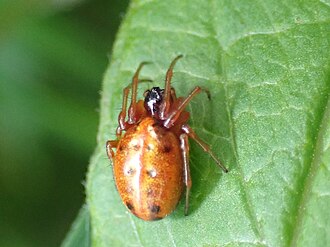 เอช. เฮริ
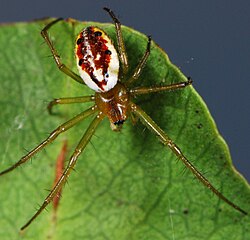 ตัวเมียH. holzapfelae
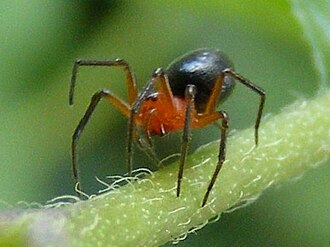 เอช. พิกมาเอีย
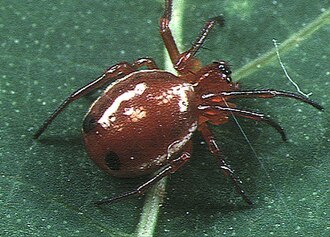 ตัวเมียH. sanguinea
ณ เดือนตุลาคมพ.ศ. 2568 สกุลนี้ประกอบด้วยสิบเก้าชนิดและสามชนิดย่อย: [ 1 ]
- Hypsosinga alberta Levi , 1972 –รัสเซีย (ไซบีเรียตะวันออก),แคนาดา
- Hypsosinga alboria Yin, Wang, Xie & Peng, 1990 –จีน
- Hypsosinga albovittata (Westring, 1851) –ยุโรป ,แอฟริกาเหนือ ,ตุรกี ,คอเคซัส , รัสเซีย (ยุโรปถึงตะวันออกไกล),ตะวันออกกลาง ,เอเชียกลาง
- Hypsosinga clax Oliger, 1993 – รัสเซีย (ตะวันออกไกล)
- Hypsosinga funebris ( Keyserling , 1892) – แคนาดา,สหรัฐอเมริกา
- Hypsosinga groenlandica Simon , 1889 – สหรัฐอเมริกา แคนาดากรีนแลนด์
- Hypsosinga heri ( Hahn , 1831) – ยุโรป, คอเคซัส, รัสเซีย (ยุโรปถึงเอเชียกลาง, ไซบีเรียตะวันตก),อิสราเอล ,อิหร่าน , เอเชียกลาง, จีน
- Hypsosinga holzapfelae ( Lessert , 1936 ) –เคนยาโมซัมบิกแอฟริกาใต้
- ฮิปโซซิงกา คาซัคสตานิกาโปโนมาเรฟ, 2007 –คาซัคสถาน
- Hypsosinga lithyphantoides Caporiacco , 1947 –ยูกันดาเคนยา แอฟริกาใต้
- ฮ.ล. Dealbata Caporiacco, 1949 – เคนยา
- Hypsosinga pulla Mi & Li, 2021 – จีน
- Hypsosinga pygmaea ( Sundevall , 1831) –อเมริกาเหนือยุโรป ตุรกี อิสราเอล คอเคซัส รัสเซีย (ยุโรปถึงตะวันออกไกล) อิหร่าน เอเชียกลาง จีนเกาหลี ญี่ปุ่นถูกนำเข้ามาในแอฟริกาใต้
- H. p. nigra (ไซมอน, 1909) –เวียดนาม
- เอช.พี. nigriceps ( Kulczyński , 1903) – ตุรกี
- Hypsosinga rubens ( Hentz , 1847) – แคนาดา, สหรัฐอเมริกา
- Hypsosinga sanguinea ( CL Koch , 1844) – ยุโรป, แอฟริกาเหนือ, ตุรกี, รัสเซีย (ยุโรปถึงตะวันออกไกล), อิหร่าน, เอเชียกลาง, จีน, เกาหลี,ญี่ปุ่น (ชนิดต้นแบบ)
- Hypsosinga satpuraensis Bodkhe, Uniyal & Kamble, 2016 –อินเดีย
- Hypsosinga taprobanica (Simon, 1895) –ศรีลังกา
- Hypsosinga turkmenica Bakhvalov, 1978 – Turkmenistan
- Hypsosinga vaulogeri (Simon, 1909) – เวียดนาม
- Hypsosinga wanica Song, Qian & Gao, 1996 – จีน
- 1 2 3 "สกุล Hypsosinga" . แคตตาล็อกแมงมุมโลก. doi : 10.24436/2 . สืบค้นเมื่อ25 ตุลาคม 2025 .
- ↑ออสเซอเรอร์, เอ. (1871) Beiträge zur Kenntniss der Arachniden-Familie der Territelariae Thorell (ผู้แต่ง Mygalidae) Verhandlungen der Kaiserlich-Königlichen Zoologisch-Botanischen Gesellschaft ใน Wien 21 : 117– 224.
- ↑ "“พบแมงมุม Hypsosinga heriที่ ‘สูญพันธุ์’ ในเขตอนุรักษ์ดอร์เซ็ต”บีบีซี นิวส์ ออนไลน์ 15 มิถุนายน 2015 สืบค้นเมื่อ15 มิถุนายน 2015
- 1 2 3 4ดิพเพนนาร์-โชมาน, AS; ฮาดแดด, CR; ฟู้ด, เซาท์แคโรไลนา; ลอทซ์, แอลเอ็น; เวบบ์, พี. (2022) Araneidae แห่งแอฟริกาใต้ เวอร์ชัน 2: ตอนที่ 2 (E-Ne) . คู่มือการระบุภาพถ่าย Arachnida การสำรวจแห่งชาติแอฟริกาใต้ พี20. ดอย : 10.5281/zenodo.6619195 .
 บทความนี้มีเนื้อหาที่เผยแพร่ภายใต้ลิขสิทธิ์CC BY 4.0
 - ↑ "สกุล Hypsosinga" . BugGuide . สืบค้นเมื่อ 2019-05-13 .
ลิงก์ภายนอก
- การสังเกตการณ์โดยพลเมืองเกี่ยวกับ Hypsosinga บนเว็บไซต์ iNaturalist
- Hypsosingaที่ BugGuide