
IRNSS-1G
 | |
| Mission type | Navigation |
|---|---|
| Operator | ISRO |
| COSPAR ID | 2016-027A |
| SATCAT no. | 41469 |
| Mission duration | Planned: 12 yearsElapsed: 10 years, 2 months, 13 days |
| Spacecraft properties | |
| Spacecraft | IRNSS-1G |
| Spacecraft type | Satellite |
| Bus | I-1K |
| Manufacturer | ISRO Satellite CentreSpace Applications Centre |
| Launch mass | 1,425 kilograms (3,142 lb) |
| Dry mass | 598 kilograms (1,318 lb) |
| Power | 1600 W |
| Start of mission | |
| Launch date | 12:50,April 28, 2016(+05:30) (2016-04-28T12:50:00+05:30) |
| Rocket | PSLV-XL C33 |
| Launch site | Satish Dhawan (First) |
| Contractor | ISRO |
| Orbital parameters | |
| Reference system | Geocentric |
| Regime | Geosynchronous Orbit (GSO) |
| Longitude | 129.429213 East |
| Perigee altitude | 35,780.961 km (22,233.258 mi)[1] |
| Apogee altitude | 35,796.200 km (22,242.727 mi)[1] |
| Inclination | 4.2637 |
| Period | 23:56:12.33 |
| Epoch | 17151.68965311 |
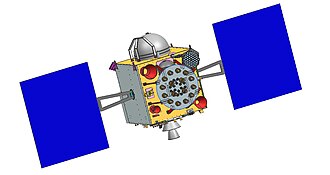
IRNSS-1G was the seventh and final[2] of the Indian Regional Navigation Satellite System (IRNSS) series of satellites after IRNSS-1A, IRNSS-1B, IRNSS-1C, IRNSS-1D, IRNSS-1E and IRNSS-1F. This system of satellites will provide navigational services to the Indian region. The satellite was launched successfully on 28 April 2016 at 07:20 UTC.[2]
IRNSS-1G along IRNSS-1A is being used only for NavIC's short message broadcast service and not for navigation.[3][4]
Launch
The satellite was launched from the First Launch Pad (FLP) of Satish Dhawan Space Centre, Sriharikota on board PSLV-C33 XL on 28 April 2016 at 12:50 PM IST.[2][5] The countdown of the launch had begun 51:30 hours before at 9:20 AM IST on 25 April 2016.[6]
After the launch of IRNSS-1G the Indian government named the IRNSS system as NAVIC (Navigation with Indian Constellation).[7]
Specifications
Mission life: 12 years (planned).[6]
Lift-off mass:1,425 kilograms (3,142 lb)
มวลแห้ง: 598 กิโลกรัม (1,318 ปอนด์ ) [ 8 ]
เพย์โหลด: เพย์โหลดการวัดระยะ CDMAใน ย่าน ความถี่C [ 9 ] [ 10 ]เพย์โหลดการนำทางใน ย่านความถี่ L-5และSและนาฬิกาอะตอมรูบิเดียม[ 11 ]
พลังงาน:ใช้แผงโซลาร์เซลล์แบบสามจุดเชื่อมต่อสอง แผงเพื่อสร้างพลังงาน 1660 วัตต์ และแบตเตอรี่ลิเธียมไอออน 90 แอมป์-ชั่วโมงหนึ่งก้อน [ 8 ]
ระบบขับเคลื่อน: ระบบเชื้อเพลิงคู่แบบMMH / MON3 พร้อมเครื่องขับดัน ควบคุมทิศทาง 12×22N และLAM 440N หนึ่งตัว [ 10 ]
วงโคจร: วงโคจรจีโอซิงโครนัสที่ลองจิจูดตะวันออก 129.5° โดยมีมุมเอียง 5° [ 8 ] [ 12 ]
ค่าใช้จ่าย:ประมาณ125 ล้านรูปี( 13 ล้านดอลลาร์สหรัฐ) [ 13 ]


ดูเพิ่มเติม
ลิงก์ภายนอก
- โครงการในอนาคตของ ISRO