
เพนเทียมเอ็ม
Pentium Mคือตระกูลไมโครโปรเซสเซอร์x86 แบบแกนเดี่ยว 32 บิตสำหรับอุปกรณ์พกพาของ Intelซึ่งใช้สถาปัตยกรรมไมโคร P6 รุ่นที่หก ที่เปิดตัวในเดือนมีนาคม พ.ศ. 2546 และเป็นส่วนหนึ่งของแพลตฟอร์มโน้ตบุ๊ก Intel Carmel ภายใต้ แบรนด์Centrino ใหม่ในขณะนั้น [ 2 ]โปรเซสเซอร์Pentium M มี กำลังการออกแบบความร้อนสูงสุด(TDP) 5–27 วัตต์ ขึ้นอยู่กับรุ่น และมีจุดประสงค์เพื่อใช้ในแล็ปท็อป (ดังนั้นคำต่อท้าย "M" จึงหมายถึงอุปกรณ์พกพา ) โปรเซสเซอร์เหล่านี้พัฒนามาจากแกนหลักของ CPU รุ่นสุดท้าย ที่ใช้แบรนด์ Pentium IIIโดยเพิ่ม อินเทอร์เฟ ซบัสด้านหน้า (FSB) ของPentium 4 ส่วนหน้า สำหรับการถอดรหัสและออกคำสั่งที่ได้รับการปรับปรุง การคาดการณ์สาขาที่ได้รับการปรับปรุงการสนับสนุนSSE2และแคชที่ใหญ่ขึ้นมาก
Pentium M เข้ามาแทนที่Pentium 4 เวอร์ชันแล็ปท็อป ( Pentium 4-MobileหรือP4-M ) ซึ่งประสบปัญหาเรื่องการใช้พลังงานและความร้อนCPU รุ่นแรกที่ใช้ชื่อแบรนด์ Pentium M ซึ่ง มีชื่อรหัสว่าBaniasตามมาด้วยDothan [ 3 ] ตระกูล Pentium M ถูกถอดออกจากรายการราคาอย่างเป็นทางการในเดือนกรกฎาคม พ.ศ. 2552 เมื่อโปรเซสเซอร์ Pentium M ถูกแทนที่ด้วยตระกูลPentium Dual-Core สำหรับมือถือ
ภาพรวม
โปรเซสเซอร์ Pentium M ถือเป็นการเปลี่ยนแปลงครั้งสำคัญและพลิกโฉมวงการของ Intel เนื่องจากไม่เพียงแต่เป็นโปรเซสเซอร์เรือธงสำหรับโน้ตบุ๊กในช่วงปี 2003 ถึง 2006 เท่านั้น แต่ยังเป็นการปรับปรุงอย่างมากจาก ดีไซน์ Pentium III Tualatin (ซึ่งเองก็มีพื้นฐานมาจาก ดีไซน์แกนประมวลผล Pentium IIซึ่งได้รับการพัฒนาอย่างมากจากPentium Pro ) โดยได้รับการปรับแต่งให้ประหยัดพลังงาน ซึ่งเป็นคุณลักษณะสำคัญในการยืดอายุการใช้งานแบตเตอรี่ของโน้ตบุ๊ก ด้วยการใช้พลังงานเฉลี่ยต่ำมากและสร้างความร้อนน้อยกว่าโปรเซสเซอร์สำหรับเดสก์ท็อป Pentium M ทำงานที่ความเร็วสัญญาณนาฬิกาต่ำกว่าPentium 4 เวอร์ชันสำหรับแล็ปท็อป ( Pentium 4-MobileหรือP4-M ) แต่มีประสิทธิภาพใกล้เคียงกัน โดย ทั่วไปแล้ว Pentium M ที่ความเร็ว 1.6 GHz สามารถทำผลงานได้เทียบเท่าหรือสูงกว่า Pentium 4-M ที่ความเร็ว 2.4 GHz [ 4 ] Pentium M 740 ได้รับการทดสอบให้ทำงานได้ประมาณ 7,400 MIPS และ 3.9 GFLOPS (โดยใช้ SSE2) [ 5 ]
The Pentium M coupled the execution core of the Pentium III with a Pentium 4 compatible bus interface, an improved instruction decoding/issuing front end, improved branch prediction, SSE2 support, and a much larger cache. The usually power-hungry secondary cache uses an access method which only switches on the portion being accessed. The main intention behind the large cache was to keep a decent-sized portion of it still available to the processor even when most of the L2 cache was switched off, but its size led to a welcome improvement in performance.
Other power saving methods include dynamically variable clock frequency and core voltage, allowing the Pentium M to throttle clock speed when the system is idle in order to conserve energy, using the SpeedStep 3 technology (which has more sleep stages than previous versions of SpeedStep). With this technology, a 1.6 GHz Pentium M can effectively throttle to clock speeds of 600 MHz, 800 MHz, 1000 MHz, 1200 MHz, 1400 MHz and 1600 MHz; these intermediate clock states allow the CPU to better throttle clock speed to suit conditions. The power requirements of the Pentium M varies from 5 watts when idle to 27 watts at full load. This is useful to notebook manufacturers as it allows them to include the Pentium M into smaller notebooks.
Although Intel marketed the Pentium M exclusively as a mobile product, motherboard manufacturers such as AOpen, DFI and MSI shipped Pentium M compatible boards designed to non-mobile enthusiasts, HTPC, workstation and server applications. An adapter, the CT-479, was developed by ASUS to allow the use of Pentium M processors in selected ASUS motherboards designed for Socket 478Pentium 4 processors. Shuttle Inc. offered packaged Pentium M desktops, marketed for low energy consumption and minimal cooling system noise. Pentium M processors are also of interest to embedded systems' manufacturers because the low power consumption of the Pentium M allows the design of fanless and miniaturized embedded PCs. The Pentium M also responds very well to undervolting, which can be done with the program Notebook Hardware Control or RMClock.
| 2003–2006 logo | 2006–2008 logo | Laptop | ||
|---|---|---|---|---|
| Code-name | Process | Date released | ||
 |  | Banias | 130 nm | Mar 2003 |
| Dothan | 90 nm | Jun 2004 | ||
| List of Intel Pentium M processors | ||||
Banias


ทีมงาน Intel Haifa เคยทำงานเกี่ยวกับตัวควบคุมหน่วยความจำสำหรับTimna มาก่อน ซึ่งอิงตามการออกแบบตัวควบคุมหน่วยความจำ P6 รุ่นก่อนหน้า ทำให้พวกเขามีความรู้โดยละเอียดเกี่ยวกับสถาปัตยกรรม P6 ซึ่งพวกเขาใช้เมื่อ Intel มอบโครงการเร่งด่วนให้พวกเขาเพื่อสร้าง CPU มือถือสำรอง[ 6 ]เนื่องจากตระกูล M ได้รับการออกแบบครั้งแรกในอิสราเอล [ 7 ] Pentium Mรุ่นแรกจึงถูกระบุด้วยชื่อรหัสBaniasซึ่งตั้งชื่อตามสถานที่โบราณในที่ราบสูงโกลันโดยมีรหัสผลิตภัณฑ์ 80535 ในตอนแรกไม่มีหมายเลขรุ่นต่อท้าย แต่ต่อมาถูกระบุว่าเป็น Pentium M 705 ผลิตด้วยกระบวนการ 130 นาโนเมตร เปิดตัวที่ความถี่ตั้งแต่ 900 MHz ถึง 1.7 GHz โดยใช้ FSB 400 MT/sและมีแคชระดับ 2 ขนาด 1 เมกะไบต์ (MB) ค่าเฉลี่ยTDP (Thermal Design Power) ของแกนหลักคือ 24.5 วัตต์
โปรเซสเซอร์ตระกูล Banias รองรับPhysical Address Extension (PAE) ภายใน แต่ไม่แสดงแฟล็กการสนับสนุน PAE ใน ข้อมูล CPUIDซึ่งทำให้ระบบปฏิบัติการบางระบบ (โดยเฉพาะระบบปฏิบัติการ Linux) ปฏิเสธที่จะบูตบนโปรเซสเซอร์ดังกล่าว เนื่องจากเคอร์เนลของระบบปฏิบัติการเหล่านั้นต้องการการสนับสนุน PAE [ 8 ]การใช้ตัวเลือกการบูต Linux 'forcepae' จะช่วยให้ Linux สามารถบูตโดยใช้ PAE ในกรณีเหล่านี้ได้Windows 8และเวอร์ชันที่ใหม่กว่าก็ปฏิเสธที่จะบูตบนโปรเซสเซอร์เหล่านี้ด้วยเหตุผลเดียวกัน เนื่องจากระบบปฏิบัติการเหล่านี้ต้องการการสนับสนุน PAE โดยเฉพาะเพื่อให้ทำงานได้อย่างถูกต้อง การพยายามบูต Windows 8 และเวอร์ชันที่ใหม่กว่าโดยติดตั้งโปรเซสเซอร์เหล่านี้ (รวมถึงโปรเซสเซอร์ตระกูล Dothan รุ่นแรกๆ ที่ไม่ได้เปิดใช้งานแฟล็กการสนับสนุน PAE ในข้อมูล CPUID) จะส่งผลให้เกิดการขัดข้องเมื่อพยายามโหลดntoskrnl.exeในช่วงต้นของกระบวนการบูต โดยมีรหัสข้อผิดพลาด 0xc0000260 (UNSUPPORTED_PROCESSOR) [ 9 ]
โดธาน
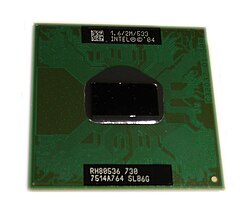
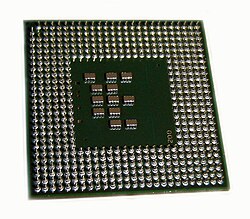
On September 17, 2003, Intel unveiled plans for releasing its then next-generation of Pentium M processors, codenamed "Dothan" by them. It was named after another ancient town in Israel, and it launched formally on May 10, 2004. Dothan Pentium M processors (product code 80536, CPUID 0x6DX) are among the first Intel processors to be identified using a "processor number" rather than a clockspeed rating; this allowed for more precise distinctions between different kinds of processors. The initial Dothan versions with the 400MT/s Front-Side-Bus (FSB) are known as Pentium M 710 (1.4 GHz), 715 (1.5 GHz), 725 (1.6 GHz), 735 (1.7 GHz), 745 (1.8 GHz), 755 (2.0 GHz), and 765 (2.1 GHz).[10][11] These initial Dothan models all have a TDP of 21 W and a 2 MB L2 cache.
These 700 series Dothan Pentium M processors retain the same basic design as the original Banias Pentium M, but are manufactured on a 90 nm process, with twice the secondary cache. Die size, at 87 mm2, remains in the same neighborhood as the original Pentium M, even though the 1000 series contains approximately 140 million transistors, most of which make up the 2 MB cache. TDP is also down to 21 watts with the 400 MT/s FSB (from 24.5 watts in Banias), though power use at lower clockspeeds has increased highly. However, tests conducted by third party hardware review sites show that Banias and Dothan equipped notebooks have roughly equivalent battery life. Additionally third party hardware review sites have benchmarked the Dothan at approx 10-20% better performance than the Banias in most situations.
Revisions of the Dothan core were released in the first quarter of 2005 with the Sonoma chipsets and supported a 533 MT/s FSB and XD (Intel's name for the NX bit); and the PAE support flag in the CPUID was enabled, unlike earlier Pentium Ms that showed PAE unavailable. This resolved boot errors in Linux distributions as well as with Windows 8 and later. These revised Dothan processors include the 730 (1.6 GHz), 740 (1.73 GHz), 750 (1.86 GHz), 760 (2.0 GHz), 770 (2.13 GHz) and 780 (2.26 GHz) and have a TDP of 27 W and a 2 MB L2 cache.
In July 2005, Intel released the 780 (2.26 GHz) and the low-voltage 778 (1.60 GHz).
โปรเซสเซอร์ตระกูลนี้มีรุ่นที่ทำงานด้วยความเร็วสัญญาณนาฬิกาตั้งแต่ 1.0 GHz ถึง 2.26 GHz รุ่นที่มีความถี่ต่ำกว่านั้นเป็นซีพียูแรงดันต่ำหรือแรงดันต่ำมากเป็นพิเศษ ซึ่งออกแบบมาเพื่อยืดอายุการใช้งานแบตเตอรี่และลดความร้อน รุ่น 718 (1.3 GHz), 738 (1.4 GHz) และ 758 (1.5 GHz) เป็นรุ่นแรงดันต่ำ (1.116 V) ที่มีค่า TDP 10 W ในขณะที่รุ่น 723 (1.0 GHz), 733 (1.1 GHz) และ 753 (1.2 GHz) เป็นรุ่นแรงดันต่ำมากเป็นพิเศษ (0.940 V) ที่มีค่า TDP 5 W
อินเทล เอ100 ซีรีส์
ไมโครโปรเซสเซอร์พลังงานต่ำพิเศษที่ใช้สถาปัตยกรรม Dothan ผลิตด้วย กระบวนการ 90 นาโนเมตร มีแคช L2 ขนาด 512 KB และบัสหน้า (FSB) ความเร็ว 400 MT/s
คอร์โซโลและคอร์ดูโอ
โปรเซสเซอร์รุ่นถัดไป ซึ่งมีชื่อรหัสว่าYonahนั้น ใช้ สถาปัตยกรรม Enhanced Pentium M เป็นพื้นฐาน และวางจำหน่ายภายใต้ แบรนด์ Intel Coreในชื่อCore DuoและCore Solo
ดูเพิ่มเติม
ลิงก์ภายนอก
- เว็บไซต์ของ Intel เกี่ยวกับ Pentium M (จาก Internet Archive)
- รายชื่อรุ่นต่างๆ ของ Pentium M จาก Intel
- ตารางเปรียบเทียบโปรเซสเซอร์ Intel
- หน้าแรกของซอฟต์แวร์ "ควบคุมฮาร์ดแวร์โน้ตบุ๊ก"
- หน้าแรกของซอฟต์แวร์ "Linux-PHC" สำหรับลดแรงดันไฟฟ้าของ Pentium M ด้วยระบบปฏิบัติการ Linux
- รายละเอียดเกี่ยวกับโยนาห์จาก X86-secret (ภาษาฝรั่งเศสแปลเป็นภาษาอังกฤษโดย Google)
- AnandTech: ตัวอย่างประสิทธิภาพของ Yonah
- SpeedswitchXP - ตัวควบคุมความถี่ CPU สำหรับโน้ตบุ๊ก