
Kartouwe
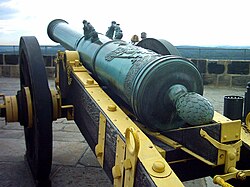
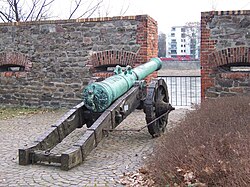


A kartouwe (plural: kartouwen) is a siege gun used in European warfare during the 16th and 17th centuries.[1] The name kartouwe is of Dutch origin,[2] a corruption of Latinquartana[3] (quarter cannon).[2] In the Holy Roman Empire the gun was called Kartaune in German or cartouwe in contemporary Latin usage,[4] in the Swedish EmpireKartow,[4] spelling variants include kartouw, kartouve,[5]cartow,[2]cartaun,[2]courtaun,[2] and others.
Characteristics
Kartouwen were developed from bombards.[1] A kartouwe has a caliber of 8 inches (200 mm), weighs about 8,000 pounds (3,600 kg), and is designed to fire cannonballs weighing up to 52 pounds (24 kg).[6] As a minimum, twenty horses or oxen were needed to move a kartouwe.[6]
นอกจากคาร์ทูเวนแบบ "เต็ม" (" hele ") แล้ว ยังมีคาร์ทูเวนแบบสองเท่า[ 7 ]ครึ่ง (" halve ") [ 8 ]และหนึ่งในสี่อีกด้วย[ 4 ]ลำกล้องของคาร์ทูเวนแบบเต็มมีความยาว 18 ถึง 19 เท่าของขนาดลำกล้อง มีน้ำหนัก3,000 กิโลกรัม (6,600 ปอนด์)ถึง3,500 กิโลกรัม (7,700 ปอนด์)และถูกขนส่งบนรถม้าพิเศษโดยใช้ม้า 20 ถึง 24 ตัว และต้องใช้ม้าอีก 4 ถึง 8 ตัวในการขนส่งแท่นยิง ( lafette ) [ 9 ]ความยาวลำกล้องของคาร์ทูเวนแบบครึ่งคือ 32 ถึง 34 เท่าของขนาดลำกล้อง ซึ่งมีช่วงระหว่าง105 มิลลิเมตร (4.1 นิ้ว)ถึง115 มิลลิเมตร (4.5 นิ้ว ) [ 9 ]ลำกล้องปืนมีน้ำหนัก1,100 กิโลกรัม (2,400 ปอนด์)ถึง1,500 กิโลกรัม (3,300 ปอนด์)ปืนทั้งกระบอกมี น้ำหนัก 1,700 กิโลกรัม (3,700 ปอนด์)ถึง2,400 กิโลกรัม (5,300 ปอนด์) [ 9 ] ปืน Half-kartouwen ยิงลูกกระสุนปืนใหญ่ที่มีน้ำหนักระหว่าง8 ปอนด์ (3.6 กิโลกรัม)ถึง10 ปอนด์ (4.5 กิโลกรัม)และสำหรับการขนส่งลำกล้องปืนนั้น ต้องใช้ม้า 10 ถึง 16 ตัว[ 9 ]
ขนาดอันใหญ่โตของปืนใหญ่และน้ำหนักของกระสุนขนาด 48 ปอนด์ (ค่ามาตรฐาน แม้ว่ากระสุนจริงอาจมีน้ำหนักตั้งแต่ 30 ถึง 60 ปอนด์) ทำให้การเคลื่อนย้ายและบรรจุกระสุนใหม่เป็นเรื่องยากลำบาก วิลเลียม พี. กัทรี ประมาณการว่าปืนใหญ่คาร์ทูว์หนึ่งกระบอกยิงได้เฉลี่ยเพียง 8 ถึง 10 นัดภายใต้สภาวะการต่อสู้ที่ต่อเนื่อง ซึ่งน้อยกว่าปืนใหญ่สนามขนาด 3 ถึง 6 ปอนด์ทั่วไปถึงครึ่งหรือหนึ่งในสาม แม้ว่าในทุกกรณี "ทหารที่ได้รับการฝึกฝนมาอย่างดีสามารถลดเวลาเหล่านี้ลงได้" [ 10 ]
การใช้งานและการรับรู้
ตัวอย่างเช่น Kartouwen ถูกใช้ในสงครามลิโวเนียโดยกองกำลังรัสเซีย[ 5 ]และสวีเดน[ 7 ]ในระหว่างยุทธการที่นาร์วา (1581)กองกำลังสวีเดนที่ล้อมเมืองได้ทำลายกำแพงเมืองนาร์วาซึ่ง มีความหนา 5.5 เมตร (18 ฟุต)ภายในสองวันโดยใช้ Kartouwen สองชั้นครึ่งจำนวน 24 ผืน[ 7 ]
Kartouwen were also the characteristic of the Thirty Years' War.[11] As such, they were featured in contemporary poems,[11] e.g. in Am liebsten bey der Liebsten by Sibylla Schwarz ("grausame Kartaune", "gruesome kartouwe") and Tränen des Vaterlandes, anno 1636 by Andreas Gryphius ("donnernde Karthaun'", "thundering kartouwe").[12][13] In his 1844 poem Die Tendenz, Heinrich Heine used kartouwen to symbolize loudness.[14]
Sources
References
- 12Meyers (1907), p. 682; Brockhaus (1911), p. 943
- 12345Llewellyn (1936), p. 24
- ↑Meyers (1907), p. 682; Brockhaus (1911), p. 943; Adelung (1796), p. 1506
- 123Adelung (1796), p. 1506
- 12Peterson (2007), p.95
- 12Kasekamp (1990); Peterson (2007), p. 95
- 123Kasekamp (1990)
- ↑Kasekamp (1990); Adelung (1796), p. 1506
- 1234Medick & Winnige, entry "Stück"
- ↑William P. Guthrie. "The Later Thirty Years War: From the Battle of Wittstock to the Treaty of Westphalia." Praeger. Feb 2003. Page 13.
- 12Hartung (1995), p. 329
- ↑Deutsche Gedichte Eine Auslese (in German). Tosa Verlag. 2003. p. 15.
- ↑Sibylla Schwarz, Am liebsten bey der Liebsten: "So schreckt mich die Posaune / das Spiel der Schwerdter nicht / die grausame Kartaune / kompt nie mir ins Gesicht."
- ↑Sørensen & Arndal (2002), p. 23
Bibliography
- Hartung, Harald (1995). Gedichte und Interpretationen. Vom Naturalismus bis zur Jahrhundertmitte. Reclam Universal-Bibliothek (in German). Vol. 7894. Reclam. ISBN 3-15-007894-6.
- Kasekamp, Andreas (1990). "Characteristics of warfare in the times of Henry of Livonia and Balthasar Russow". Lituanus. 36 (1). ISSN 0024-5089. Archived from the original on 14 May 2011. Retrieved 7 March 2010.
- Llewellyn, E.C. "The Influence of Low Dutch on the English Vocabulary. Oxford University Press, London 1936". De Digitale Bibliotheek voor de Nederlandse Letteren. Retrieved 7 March 2010.
- Medick, Hans; Winnige, Norbert. "Begriffsregister zum Selbstzeugnis des Hans Krafft" (in German). Thüringer Universitäts- und Landesbibliothek Jena. Retrieved 8 March 2010.
- Peterson, Gary Dean (2007). Warrior kings of Sweden. The rise of an empire in the sixteenth and seventeenth centuries. McFarland. ISBN 978-0-7864-2873-1.
- Sørensen, Bengt Algot; Arndal, Steffen (2002). Geschichte der deutschen Literatur (in German). Vol. 2 (2 ed.). C.H.Beck. ISBN 3-406-47589-2.
- "Meyers Großes Konversations-Lexikon, Band 10. Leipzig 1907, S. 682" (in German). zeno.org. Retrieved 7 March 2010.
- "Brockhaus' Kleines Konversations-Lexikon, fünfte Auflage, Band 1. Leipzig 1911, S. 943" (in German). zeno.org. Retrieved 7 March 2010.
- "Adelung, Grammatisch-kritisches Wörterbuch der Hochdeutschen Mundart, Band 2. Leipzig 1796, S. 1506" (in German). zeno.org. Retrieved 7 March 2010.