
Ta' Braxia Cemetery
Ta' Braxia Cemetery (Maltese: Iċ-Ċimiterju ta' Braxa) is a cemetery in Gwardamanġa, located near the boundary between Pietà and Ħamrun, Malta. It was built between 1855 and 1857 as a multi-denomination burial ground primarily intended for British servicemen, partially replacing a number of earlier 18th century cemeteries. The site also incorporates a Jewish cemetery which was established in around 1830. The cemetery's construction was controversial since the local ecclesiastical authorities were opposed to a multi-faith extra-mural cemetery.
The cemetery was designed by the Maltese architect Emanuele Luigi Galizia. It was expanded a number of times during the 19th century, and in 1893–94 a memorial chapel dedicated to Lady Rachel Hamilton-Gordon was added. The chapel was designed by the English architect John Loughborough Pearson in a combination of the Gothic Revival and Romanesque Revival styles.
History
Ta' Braxia Cemetery is located just outside the Floriana Lines, the outer fortifications of Malta's capital Valletta.[1] The first cemetery on this site was established in 1778, and it was known as the Cemetery of the Sacra Infermeria.[1] This was the first extra-mural cemetery in Malta.[2] The site also contained some other old cemeteries, including a plague cemetery[3] and a Jewish cemetery which was established in around 1830.[4] By the middle of the 19th century, the area had "become a heath, covered with a heap of rubbish, thorns and nettlebrushes... a common field laid waste without even a central cross or chapel as prescribed by the ritual of the Catholic Church."[2]
By 1850, the British wanted to establish a multi-faith cemetery for servicemen who died in Malta, after the Msida Bastion Cemetery became full.[3] The decision was taken to re-lay and extend the cemetery at Ta' Braxia, which was chosen due to its proximity to the main urban centres of Valletta and the Three Cities.[3] The cemetery was said to be meant for "all religions without distinction"[5] but this only referred to different Christian denominations, excluding other religions,[3] although the pre-existing Jewish cemetery would eventually be incorporated as a separate section into Ta' Braxia.[4] The construction of the cemetery was perceived as a move to establish a predominantly Protestant cemetery.[6]

The establishment of the cemetery was intended to promote extra-mural burial for the upper classes.[2] At the time, the concept of having an extra-mural cemetery was controversial since traditionally people were buried inside churches or chapels.[2] The local ecclesiastical authorities were particularly opposed to extra-mural cemeteries.[2] Further controversy arose since the church was strongly opposed to having a mixed-rite cemetery.[7]
The cemetery was designed by the Maltese architect Emanuele Luigi Galizia, and it was his first major government project.[7] Galizia would later design two other major cemeteries: the Catholic Addolorata Cemetery and the Muslim Turkish Military Cemetery.[8] Work on the cemetery commenced in 1855, with the construction of the boundary walls.[3] The military authorities had to approve its designs so as to ensure that the cemetery would not compromise the fortifications.[3] It officially opened in October 1857, and the opening was not reported in local media.[7] The alteration of an adjacent road in 1861 led to the relocation of a nearby Catholic burial ground and permitted the cemetery's expansion.[3] A southward expansion was undertaken in 1879, and another major expansion took place in 1889.[3]
สุสานแห่งนี้กลายเป็นสุสานหลักของกองทหารอังกฤษในช่วงครึ่งหลังของศตวรรษที่ 19 [ 3 ]ศพสามศพที่กู้ขึ้นมาจากเหตุการณ์ เรือ SS Sardinia อับปางในปี 1908 ถูกฝังไว้ที่ Ta' Braxia [ 9 ]คณะกรรมการสุสานสงครามเครือจักรภพดูแลหลุมฝังศพของทหารเครือจักรภพแปดนายที่ฝังอยู่ในสุสานแห่งนี้ โดยห้านายมาจากสงครามโลกครั้งที่ 1และสามนายมาจากสงครามโลกครั้งที่ 2 [ 10 ]
ในช่วงสงครามโลกครั้งที่สอง การทิ้งระเบิดทางอากาศทำให้ศิลาจารึกและอนุสรณ์สถานงานศพบางส่วนในสุสานเสียหายหรือถูกทำลาย[ 11 ]อนุสรณ์สถานอื่นๆ ได้รับความเสียหายเนื่องจากการกัดเซาะ[ 3 ] ในปี 2000 Din l-Art Ħelwaและรัฐบาลได้จัดตั้งคณะกรรมการเพื่อบูรณะสุสาน[ 11 ]สมาคมที่รู้จักกันในชื่อ Friends of Ta' Braxia ได้ก่อตั้งขึ้นในปี 2001 และมีหน้าที่รับผิดชอบในการบำรุงรักษาและบูรณะสุสาน โดยได้รับความช่วยเหลือจาก Din l-Art Ħelwa [ 11 ]ปัจจุบันสุสานเปิดให้ประชาชนเข้าชมได้ในวันธรรมดา[ 10 ]
สถาปัตยกรรม
สุสานมีผังแบบตาราง โดยมีประตูทางเข้าหลักวางตัวอยู่บนแกนกลาง[ 3 ]เดิมทีมีผังแบบสมมาตร แต่องค์ประกอบนี้ได้หายไปเนื่องจากการขยายสุสานในภายหลัง[ 3 ]ประตูภายในและกำแพงกั้นแบ่งส่วนต่างๆ ภายในสุสาน[ 3 ]สุสานประกอบด้วยส่วนของชาวกรีกและชาวยิว[ 11 ]และยังมีน้ำพุที่ออกแบบโดยกาลิเซียอยู่ภายในด้วย[ 3 ]
สถาปัตยกรรมของสุสานนั้นไม่ได้น่าประทับใจเป็นพิเศษ[ 5 ]แต่มีอนุสรณ์สถานงานศพที่ประณีตจำนวนมากซึ่งแกะสลักจากหินหรือหินอ่อน[ 3 ]รูปแบบของอนุสรณ์สถานเหล่านี้มีตั้งแต่แบบนีโอคลาสสิกไปจนถึงแบบหรูหราและผสมผสาน[ 3 ]อนุสรณ์สถานบางแห่งมีสัญลักษณ์ที่บ่งบอกถึงความเกี่ยวข้องกับเมสัน[ 3 ]
โบสถ์
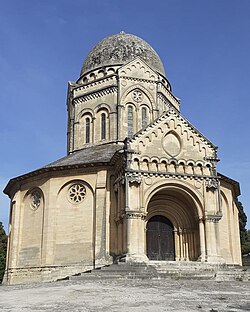
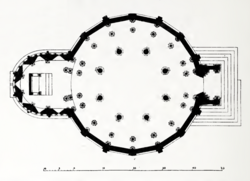
The main landmark at Ta' Braxia Cemetery is the Lady Rachel Hamilton-Gordon Memorial Chapel,[12] which was built to commemorate the wife of Sir Arthur Hamilton-Gordon, 1st Baron Stanmore. While en route from Ceylon to Britain, Lady Hamilton-Gordon fell ill and died in Malta, being buried at Ta' Braxia on 28 January 1889.[3] Sir Hamilton-Gordon commissioned a leading English architect, John Loughborough Pearson, to design a memorial chapel for his wife.[3] Pearson probably never visited Malta, but prepared the plans which were sent to the island.[3] The chapel's foundation stone was laid down on 28 May 1893[7] and it was completed in 1894.[6]
The chapel's architecture cannot be categorically classified as belonging to one particular style, since it combines elements from both the Gothic Revival and Romanesque Revival styles.[7] It has a centralized circular plan with a dome.[3] The external façades contain elaborate geometric decoration and ornamentation, which contrast with the relatively plain dome.[7]
See also
- Pietà Military Cemetery, which is located nearby
อ่านเพิ่มเติม
- ทาเค คอนราด; บูฮาเกียร์, เจนิกา (2018) สุสานตาบรักเซีย . หนังสือกลางทะเล. ไอเอสบีเอ็น 9789995711702.