
Lixheim
Lixheim | |
|---|---|
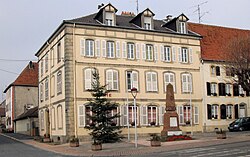 The town hall in Lixheim | |
 Coat of arms | |
 Location of Lixheim | |
  Lixheim  Lixheim | |
| Coordinates: 48°46′32″N7°08′34″E / 48.7756°N 7.1428°E / 48.7756; 7.1428 | |
| Country | France |
| Region | Grand Est |
| Department | Moselle |
| Arrondissement | Sarrebourg-Château-Salins |
| Canton | Phalsbourg |
| Intercommunality | CC du Pays de Phalsbourg |
| Government | |
| • Mayor (2020–2026) | Christian Untereiner[1] |
Area 1 | 3.96 km2 (1.53 sq mi) |
| Population (2023)[2] | 552 |
| • Density | 139/km2 (361/sq mi) |
| Time zone | UTC+01:00 (CET) |
| • Summer (DST) | UTC+02:00 (CEST) |
| INSEE/Postal code | 57407 /57635 |
| Elevation | 268–336 m (879–1,102 ft) (avg. 350 m or 1,150 ft) |
| 1 French Land Register data, which excludes lakes, ponds, glaciers > 1 km2 (0.386 sq mi or 247 acres) and river estuaries. | |
Lixheim is a commune of France in the northeastern Moselledepartment of Grand Est, a kilometre southeast of another commune, Vieux-Lixheim.
History
The first Lixheim (now Vieux-Lixheim) was founded by a Benedictine priory in the 12th century.
The new town was founded by Count PalatineGeorge Gustavus in 1608 to replace Phalsbourg, which his father Count Palatine George John I had had to cede. In their small principality of the county of Lutzelstein (La Petite-Pierre), the Counts Palatine wanted to create fortified towns capable of accommodating their Reformed co-religionists, who had been expelled from the Duchy of Lorraine.[3]
Nevertheless, Lixheim was sold to the Duke of Lorraine in 1623; despite his commitment to freedom of Protestant worship, Duke Henry II The Good did little to resist the pressures that drove many of the Reformed inhabitants into exodus.[4]
ในช่วงปี ค.ศ. 1629–1660 ลิกซ์ไฮม์และฟาลส์บูร์กได้ก่อตั้งอาณาจักรฟาลส์บูร์กและลิกซ์ไฮม์ซึ่งมีอายุสั้น เพื่อประโยชน์ของเฮนเรียตต์ เดอ ลอร์เรนและพระสวามีทั้งสามพระองค์ที่สืบต่อกันมา รวมถึงหลุยส์ เดอ กีส์ เจ้าหญิงได้สั่งให้ผลิตเหรียญกษาปณ์ที่ลิกซ์ไฮม์[ 3 ]
เมื่อเจ้าหญิงสิ้นพระชนม์ ดินแดนของราชรัฐจึงกลับคืนสู่ดัชชีแห่งลอร์เรน ดยุกเลโอโปลด์ได้ปฏิบัติตามความอดทนที่เฮนรีที่ 2 ทรงสัญญาไว้ในแบบของพระองค์เอง โดยอนุญาตให้ชาวรีฟอร์มสามารถประกอบพิธีกรรมทางศาสนาในเขตปกครองใกล้เคียงอย่างนัสเซา-ซาร์เรเวอร์เดน ( อัลซาส บอสซู ) ซึ่งเป็นการผ่อนปรนเล็กน้อยแต่น่ายกย่องจากพระมหากษัตริย์ผู้ซึ่งราชวงศ์ของพระองค์ปกป้องศาสนาคาทอลิกอย่างแข็งขันมาโดยตลอด[ 3 ]
ดูเพิ่มเติม
ลิงก์ภายนอก
 สื่อที่เกี่ยวข้องกับLixheim ใน Wikimedia Commons