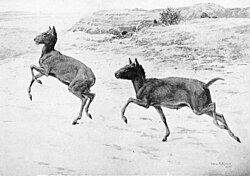
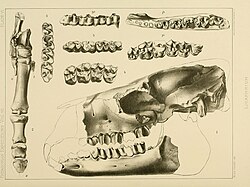
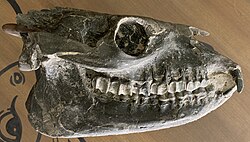
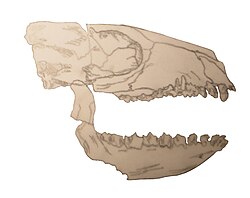
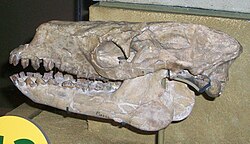
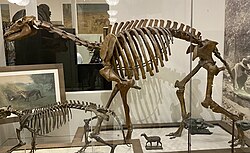
The body forms of many litopterns, notably in the limb and skull structure, are broadly similar to those of living ungulates, unlike other South American native ungulate groups, which are often strongly divergent from living ungulates.[3] Paleocene and Eocene litopterns generally had small body masses, with Protolipterna (Protolipternidae) estimated to have had a body mass of 0.5–1.5 kilograms (1.1–3.3lb), though the Eocene sparnotheriodontids were considerably larger, with estimated body masses of around 400 kilograms (880lb). Most proterotheriids had body masses of around 15 to 80 kilograms (33 to 176lb) while many macraucheniids had body masses of around 80–120 kilograms (180–260lb). Some of the last macraucheniids like Macrauchenia were considerably larger, with body masses around a ton.[1]Adianthidae generally had small body masses, with members of the genus Adianthus estimated to weigh 7.4–20 kilograms (16–44lb). Members of the proterotheriid subfamily Megadolodinae are noted for having bunodont (rounded cusp) molar teeth, which is largely unique to litopterns among South American native ungulates.[2][1] Litopterns of the mid-late Cenozoic had hinge-like limb joints and hooves similar to those of modern ungulates, with the weight being supported on three toes in macraucheniids and one in proterotheriids, with the protherotheriid Thoatherium developing greater toe reduction than that present in living horses.[1] Macraucheniids had long necks and limbs.[4]
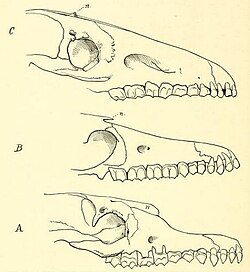
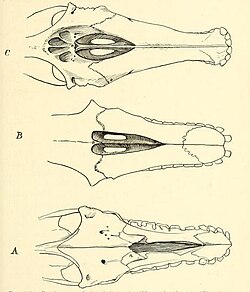
Members of the macraucheniid subfamily Macraucheniinae saw the progressive migration of the nasal opening to the top of the skull,[5] which was often historically suggested to indicate the presence of a trunk, though other authors have suggested that a moose-like prehensile lip,[6] or a saiga-like nose to filter dust[7] are more likely.
Skulls of the macraucheniids (A) Theosodon, (B) Scalabrinitherium, (C) Macrauchenia, portraying how the nasal bones shifted backwards on the skull, with the nasal opening following suit.
The body forms of many litopterns, notably in the limb and skull structure, are broadly similar to those of living ungulates , unlike other South American native ungulate groups, which are often strongly divergent from living ungulates.