
อ่าน 4 นาที
NGC 3312
NGC 3312 เป็น กาแล็กซีเกลียว ขนาดใหญ่ [ 2 ] และเอียงมาก [ 3 ] [ 4 ] ตั้งอยู่ ห่างออกไปประมาณ 194 ล้าน ปีแสง [ 5 ] ในกลุ่มดาวไฮดรา [ 6 ] กาแล็กซี นี้ถูกค้นพบโดยนักดาราศาสตร์ John...
NGC 3312

| NGC 3312 | |
|---|---|
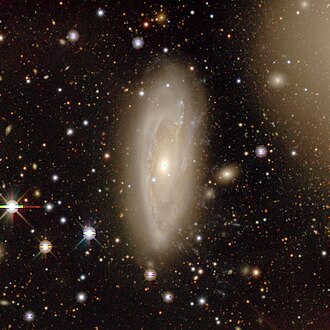 ภาพ จากแบบสำรวจดั้งเดิมของ NGC 3312 | |
| ข้อมูลการสังเกตการณ์ ( ยุคJ2000 ) | |
| กลุ่มดาว | ไฮดรา |
| สิทธิในการขึ้นสู่สวรรค์ | 10 ชั่วโมง 37 นาที 02.5 วินาที[ 1 ] |
| การลดลง | −27 ° 33 ′ 54 ″ [ 1 ] |
| การเลื่อนไปทางแดง | 0.009627 [ 1 ] |
| ความเร็วเชิงรัศมีจากจุดศูนย์กลางดวงอาทิตย์ | 2886 กม./วินาที[ 1 ] |
| ระยะทาง | 194 ล้านปี (59.4 ล้านพาร์เซก ) [ 1 ] |
| กลุ่มหรือคลัสเตอร์ | กลุ่มไฮดรา |
| ขนาดปรากฏ (V) | 12.68 [ 1 ] |
| ลักษณะเฉพาะ | |
| พิมพ์ | SA(s)b pec?, แมงกะพรุน , LINER [ 1 ] |
| ขนาด | 235,000 ปีแสง (72.12 กิโลพาร์เซก ) (โดยประมาณ) [ 1 ] |
| ขนาดที่ปรากฏ (V) | 3.3 x 1.3 [ 1 ] |
| ชื่อเรียกอื่นๆ | |
| IC 629, ESO 501-43, AM 1034-271, IRAS 10346-2718, MCG -4-25-39, PGC 31513 [ 1 ] | |
NGC 3312 เป็น กาแล็กซีเกลียวขนาดใหญ่[ 2 ]และเอียงมาก[ 3 ] [ 4 ] ตั้งอยู่ ห่างออกไปประมาณ 194 ล้านปีแสง[ 5 ]ในกลุ่มดาวไฮดรา[ 6 ] กาแล็กซีนี้ถูกค้นพบโดยนักดาราศาสตร์John Herschelเมื่อวันที่ 26 มีนาคม 1835 ต่อมาถูกค้นพบอีกครั้งโดยนักดาราศาสตร์Guillaume Bigourdanเมื่อวันที่ 26 กุมภาพันธ์ 1887 ต่อมา NGC 3312 ถูกจัดอยู่ในรายการและเทียบเท่ากับ IC 629 เนื่องจากวัตถุทั้งสองมีพิกัดท้องฟ้า ที่เหมือนกันโดยพื้นฐาน [ 7 ] [ 8 ] NGC 3312 เป็นกาแล็กซีเกลียว ที่ใหญ่ที่สุด [ 2 ]ในกระจุกดาวไฮดรา[ 2 ] [ 9 ]และยังถูกจัดประเภทเป็นกาแล็กซีLINER อีกด้วย [ 10 ] [ 3 ]
ลักษณะทางกายภาพ
NGC 3312 appears to be highly distorted with sharp dust lanes. There are sharp filamentary extensions to the north and an internal ringlike structure in the galaxy. The interstellar matter in the galaxy also appears highly disturbed. These features caused astronomer De Vaucouleurs to suggest that NGC 3312 was distorted by the giant elliptical galaxiesNGC 3309 and NGC 3311 which are the dominant ellipticals in the Hydra Cluster. However, NGC 3309 and NGC 3311 are too distant and their relative velocity differences too large for either elliptical to cause the filamentary extensions observed in NGC 3312. It is more likely that NGC 3312 is interacting with the intracluster medium causing ram-pressure stripping which is stripping the interstellar medium of the galaxy. This may have caused the filamentary extensions observed in NGC 3312 as evidenced by the location of the galaxy near the cluster core.[11] As a result, this galaxy can be considered part of a rare class of galaxies, known as jellyfish galaxies.
Star formation
Although NGC 3312's morphological structure resembles that of anemic galaxies, its mean surface-brightness profile hints that star formation may be quite active. The northwest filamentary extension from NGC 3312 has high surface brightness and has the knotted texture characteristic of active star-forming regions in spiral arms. Also, the internal dust lane of NGC 3312 is ringed with bright condensations.[11]
Radio source
NGC 3312 contains an unresolved strong radio source in its core with a strength of 27 mJy and radio emission in the disk with a strength of 24 mJy mostly being confined to the spiral arms of the galaxy or regions of star formation.[12]
See also
ลิงก์ภายนอก

- NGC 3312 บนWikiSky : DSS2 , SDSS , GALEX , IRAS , ไฮโดรเจนอั ลฟา , รังสีเอ็กซ์ , ภาพถ่ายดาราศาสตร์ , แผนที่ท้องฟ้า , บทความและรูปภาพ
สรุปเนื้อหา
ข้อมูลสำคัญจากบทความ
ข้อมูลสำคัญเกี่ยวกับ NGC 3312
NGC 3312 เป็น กาแล็กซีเกลียว ขนาดใหญ่ [ 2 ] และเอียงมาก [ 3 ] [ 4 ] ตั้งอยู่ ห่างออกไปประมาณ 194 ล้าน ปีแสง [ 5 ] ในกลุ่มดาวไฮดรา [ 6 ] กาแล็กซี นี้ถูกค้นพบโดยนักดาราศาสตร์ John...
ลักษณะทางกายภาพ
NGC 3312 appears to be highly distorted with sharp dust lanes. There are sharp filamentary extensions to the north and an internal ringlike structure in the galaxy. The interstellar matter in the galaxy also appears highly disturbed.
Star formation
Although NGC 3312's morphological structure resembles that of anemic galaxies , its mean surface-brightness profile hints that star formation may be quite active.
Radio source
NGC 3312 contains an unresolved strong radio source in its core with a strength of 27 mJy and radio emission in the disk with a strength of 24 mJy mostly being confined to the spiral arms of the galaxy or regions of star formation. [ 12 ]