
Nikon 1 series


The Nikon 1 series is a line of mirrorless interchangeable lens cameras from Nikon, originally announced on 21 September 2011.[1] The cameras utilized Nikon 1-mount lenses, and featured 1" CX format sensors. The FT-1 adapter was available, which allowed Nikon 1 users to mount nearly all Nikon F-mount lenses, with significant limitations on non-autofocus lenses and autofocus lenses without an internal focusing motor.
Nikon discontinued the Nikon 1 series in July 2018[2] and launched the mirrorless -series cameras later that year, using full-frame sensors and a new Nikon Z-mount line of lenses.

Cameras
The series included the Nikon 1 V1, J1, J2,[3] and S1 with a 10-megapixel image sensor, the V2, J3, S2 and AW1 with a 14-megapixelimage sensor and further increased autofocus speed to 15 frames per second (fps),[4] and the V3 and J4 with a new 18-megapixel image sensor, further increased autofocus speed to 20 fps, 120 fps HD slow-motion at 1280 x 720 and 1080/60p.[5] The J5 model added a 20.8MP sensor in 2015 and kept most other technical specifications the same as the J4 model.
At the time of announcement, Nikon claimed that the cameras featured the world's fastest autofocus, with 10 fps—even during videos—based on hybrid autofocus (phase detection/contrast-detect AF with AF-assist illuminator), as well as the world's fastest continuous shooting speed (60 fps) among all cameras with interchangeable lenses.[6]Slow-motion movies can be captured in up to 1200 fps with reduced resolution. Its inbuilt intervalometer enables time-lapse photography.
| Name | Image | Release | Res. (MP) | Video | EVF | Mech.[a] | Elec.[b] | ISO | Wi-Fi | W×H×D | Wgt. | Notes |
|---|---|---|---|---|---|---|---|---|---|---|---|---|
| V Series – advanced cameras with EVFs | ||||||||||||
| V1 |  | Sep 21, 2011 | 10.1 (3:2, 3872×2592) | 1080(60i/30p), 720(60p) |  Yes, 1440k-dot Yes, 1440k-dot | Yes | Yes | 100–3200 |  No No | 113×76×43.5 mm (4.4×3.0×1.7 in) | 383 g (13.5 oz) | [7][8] |
| V2 |  | Oct 24, 2012 | 14.2 (3:2, 4608×3072) | 1080(60i/30p), 720(60p/30p) | Yes, 1440k-dot | Yes | Yes | 160–6400 | WU-1b | 107.8×81.6×45.9 mm (4.2×3.2×1.8 in) | 337 g (11.9 oz) | [9][10] |
| V3 | 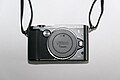 | Mar 13, 2014 | 18.4 (3:2, 5232×3488) | 1080(60p/30p), 720(60p/30p) | Opt., 1440k-dot | Yes | Yes | 160–12800 | Yes | 110.9×65.0×33.2 mm (4.4×2.6×1.3 in) | 324 g (11.4 oz) | [11][12] |
| AW Series – all-weather camera | ||||||||||||
| AW1 |  | Sep 19, 2013 | 14.2 (3:2, 4608×3072) | 1080(60i/30p), 720(60p/30p) | No | No | Yes | 160–6400 | WU-1b | 113.3×71.5×37.5 mm (4.5×2.8×1.5 in) | 356 g (12.6 oz) | [13][14] |
| J Series – for enthusiasts | ||||||||||||
| J1 |  | Sep 21, 2011 | 10.1 (3:2, 3872×2592) | 1080(60i/30p), 720(60p) | No | No | Yes | 100–3200 | No | 106.0×61.0×29.8 mm (4.2×2.4×1.2 in) | 277 g (9.8 oz) | [15][16] |
| J2 |  | Aug 9, 2012 | 10.1 (3:2, 3872×2592) | 1080(60i/30p), 720(60p) | No | No | Yes | 100–3200 | No | 106.0×61.0×29.8 mm (4.2×2.4×1.2 in) | 280 g (9.9 oz) | [17][18] |
| J3 | | Jan 8, 2013 | 14.2 (3:2, 4608×3072) | 1080(60i/30p), 720(60p/30p) | No | No | Yes | 160–6400 | WU-1b | 101.0×60.5×28.8 mm (4.0×2.4×1.1 in) | 244 g (8.6 oz) | [19][20] |
| J4 | | Apr 10, 2014 | 18.4 (3:2, 5232×3488) | 1080(60p/30p), 720(60p/30p) | No | No | Yes | 200–12800 | Yes | 99.5×60.0×28.5 mm (3.9×2.4×1.1 in) | 232 g (8.2 oz) | [21][22] |
| J5 | 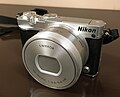 | Apr 2, 2015 | 20.8 (3:2, 5568×3712) | 4K(3840x2160 15p)[23], 1080(60p/30p), 720(60p/30p) | No | No | Yes | 160–12800 | Yes | 98.3×59.7×31.5 mm (3.9×2.4×1.2 in) | 265 g (9.3 oz) | [24][25] |
| S Series – introduction to interchangeable lenses | ||||||||||||
| S1 | 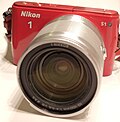 | Jan 8, 2013 | 10.1 (3:2, 3872×2592) | 1080(60i/30p), 720(60p/30p) | No | No | Yes | 100–6400 | WU-1b | 102.0×60.5×29.7 mm (4.0×2.4×1.2 in) | 240 g (8.5 oz) | [26][20] |
| S2 | 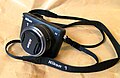 | May 14, 2014 | 14.2 (3:2, 4592×3072) | 1080(60p/30p), 720(60p/30p) | No | No | Yes | 200–12800 | WU-1a | 101.0×60.8×29.4 mm (4.0×2.4×1.2 in) | 230 g (8.1 oz) | [27][28] |
New technologies
- รูปแบบ Nikon CX ที่มี ตัวคูณระยะโฟกัส 2.7 เท่า[ 29 ]แม้ว่าพื้นที่เซ็นเซอร์ภาพขนาด 13.2 x 8.8 มม. จะมีขนาดประมาณครึ่งหนึ่งของระบบMicro Four Thirdsและหนึ่งในสี่ของรูปแบบ Nikon DXแต่ก็ให้ประสิทธิภาพที่ดีสำหรับขนาดที่เล็กนี้[ 30 ]เทียบได้กับเซ็นเซอร์ Four-Thirds รุ่นเก่า เช่นOlympus E-5 , Olympus PEN E-P3 , Panasonic Lumix DMC-G3 [ 31 ]หรือ DSLR รุ่นเก่า เช่นNikon D40 [ 32 ] [ 33 ] เซ็นเซอร์ขนาดเล็กช่วยเพิ่มความชัดลึก ได้อย่างมาก เมื่อเทียบกับ กล้อง FX 35 มม. ที่ มุมมองและค่า f เดียวกัน
- เซ็นเซอร์ภาพ CMOSพร้อมเซ็นเซอร์ตรวจจับเฟส ในตัว 73 ตัว ให้ระบบโฟกัสอัตโนมัติแบบไฮบริดทั้งการตรวจจับเฟสและการตรวจจับคอนทราสต์ AF 135 จุด ซึ่ง Nikon อ้างว่าเป็นระบบโฟกัสอัตโนมัติที่เร็วที่สุดในเชิงพาณิชย์[ 34 ] [ 35 ]

- อะแดปเตอร์ F-mountเป็น1-mount FT-1 ช่วยให้สามารถใช้เลนส์ F-mount ได้ทั้งหมด โดยเฉพาะเลนส์ที่มีมอเตอร์ออโตโฟกัสในตัว อะแดปเตอร์ FT-1 สามารถติดตั้งและวัดแสงได้กับเลนส์ AI-P, AF, AF-S, D และ G ทั้งหมด รวมถึงเลนส์ที่เข้ากันได้ โดยให้การโฟกัสอัตโนมัติกับเลนส์ทั้งหมดที่มีมอเตอร์ออโตโฟกัสในตัว[ 36 ]นอกจากนี้ยังสามารถติดตั้งเลนส์ Pre-AI, AI, AI-S และ E ที่ไม่มีการวัดแสงได้ เช่นเดียวกับเลนส์ที่ยื่นออกมาจาก F-mount (ซึ่งต้องใช้การล็อคกระจกบนกล้องที่มีกระจก) แม้ว่าจะไม่แนะนำ[ 37 ]แต่สามารถใช้ร่วมกับเทเลคอนเวอร์เตอร์สำหรับการถ่ายภาพระยะไกลมากได้[ 38 ] [ 39 ]
- เลนส์ที่มีระบบโฟกัสด้านหลัง (RF) พร้อมมวลเคลื่อนที่ ที่ลดลง และ มอเตอร์วอยซ์คอยล์ (VCM) หรือมอเตอร์สเต็ปปิ้ง (STM)ที่เงียบและเร็วที่สุดในโลกเพื่อเพิ่มความเร็วในการโฟกัสอัตโนมัติ
- มอเตอร์ซูม Power-Drive เงียบ 3 ระดับในเลนส์ Nikkor VR 10-100mm f/4.5-5.6 PD-Zoom ที่ได้รับการปรับแต่งมาเพื่อการถ่ายภาพยนตร์ HD [ 40 ]
- Nikon 1 Nikkor VR 10-100mm f/4.5-5.6 PD-Zoom integrates many technologies: 21 elements including 1 High Refractive Index (HRI, >2), 3 Extra-low Dispersion (ED) and 2 aspherical lenses,[41] Super Integrated Coating (SIC), internal focusing (IF) with world's fastest quiet Voice Coil motor, 3-speed silent PD-Zoom, Vibration Reduction (VR II), retractable lens mechanism and 7 rounded diaphragm blades.[42][43] Together with the Canon EF 28-300mm lens it is the only current superzoom with 20 elements or more.
- Fast electronic shutter (1/16 000) or additional electronically controlled mechanical focal-plane shutter.
- The V1 incorporates a 'multi accessory port' currently used for dedicated 1 Series flash and GPS units as well as AS-N1000 cold shoe adapter for mounting the ME-1 stereo microphone.
- High-speed dual multi-core image-processing pipelines with 600 megapixels per second speed using the Expeed 3 chip.[44]
- Smart Photo Selector Mode enables selection of the best candidates out of a high-speed sequence.[45]
- Advanced High-definition video recording allows uninterrupted filming while capturing high-resolution photos.
- Firmware updates of the Nikon 1 lenses are possible.
Other technologies
- As in all Nikon DSLRs with CMOS sensors, it integrates an active D-Lighting system, automatic correction of lateral chromatic aberration and vignetting.
- Autofocus modes include 3D subject-tracking, 41 points auto-area, manual focus and others.
- Built-in time-lapse photographyintervalometer
Lens system

Nikon developed an entirely new system of lenses and the Nikon 1-mountlens mount for the Nikon 1 series. These lenses are only compatible with 1-mount cameras. Nikon has not debuted a new lens mount since the F mount, which routine users of the Nikon D series are accustomed to. Although the F-mount adapter FT-1 enables the use of all F-mount compatible lenses, these lenses are meant to be portable and compact.[46] There are 13 Nikkor lenses specifically built to fit the Nikon 1-mount in addition to several manual focus lenses from Samyang.
- 1 Nikkor 10mm f/2.8[46]
- 1 Nikkor AW 10mm f/2.8
- 1 Nikkor 18.5mm f/1.8
- 1 Nikkor 32mm f/1.2
- 1 Nikkor VR 6.7-13mm f/3.5-5.6 [47]
- 1 Nikkor VR 10-30mm f/3.5-5.6[46]
- 1 Nikkor VR 10-30mm f/3.5-5.6 PD-Zoom
- 1 Nikkor VR 10-100mm f/4.5-5.6 PD-Zoom[48]
- 1 Nikkor VR 10-100mm f/4.0-5.6
- 1 Nikkor 11–27.5mm f/3.5-5.6
- 1 Nikkor VR 30-110mm f/3.8-5.6[48]
- 1 Nikkor VR 70-300mm f/4.5-5.6
| Focal length | 35mm EFL and equivalent aperture | Angle of view | Design | Features | Filter size | |||||
|---|---|---|---|---|---|---|---|---|---|---|
| Aperture | Const.[c] | Size[d] | Weight | VR[e] | Blades[f] | Min. focus[g] | ||||
| 6.7–13mm[50] | 18–35mm f/9.5-15 | 100–63° | f/3.5–5.6 to 16 | 11e/7g | 56.5×46 mm(2.22×1.81 in) | 125 g(4.4 oz) | Yes | 7 | 0.25 m(0.82 ft) | 52mm |
| 10mm[51] | 27mm f/7.7 | 77° | f/2.8 to 11 | 6e/5g | 55.5×22 mm(2.19×0.87 in) | 77 g(2.7 oz) | No | 7 | 0.2 m(0.66 ft) | 40.5mm |
| AW 10mm[h][52] | 6e/5g | 61×30 mm(2.4×1.2 in) | 118 g(4.2 oz) | No | ||||||
| 10–30mm[53] | 27–81mm f/9.5-15 | 77–29°40' | f/3.5–5.6 to 16 | 12e/9g | 57.5×42 mm(2.26×1.65 in) | 115 g(4.1 oz) | Yes | 7 | 0.2 m(0.66 ft) | 40.5mm |
| 10–30mm PD[i][54] | 9e/7g | 58×28 mm(2.3×1.1 in) | 85 g(3.0 oz) | Yes | none | |||||
| 10–100mm[55] | 27–270mm f/10.8-15 | 77–9°10' | f/4–5.6 to 16 | 19e/12g | 60.5×70.5 mm(2.38×2.78 in) | 298 g(10.5 oz) | Yes | 7 | 0.35–1.0 m(1.1–3.3 ft)(depending on focal length) | 55mm |
| 10–100mm PD[i][56] | f/4.5–5.6 to 16 | 21e/14g | 77×95 mm(3.0×3.7 in) | 530 g(19 oz) | Yes | 7 | 0.3–0.85 m(0.98–2.79 ft)(depending on focal length) | 72mm | ||
| 11–27.5mm[57] | 30–74mm f/9.5-15 | 72–32°20' | f/3.5–5.6 to 16 | 8e/6g | 57.5×31 mm(2.26×1.22 in) | 83 g(2.9 oz) | No | 7 | 0.3 m(0.98 ft) | 40.5mm |
| AW 11–27.5mm[h][58] | 63×56.5 mm(2.48×2.22 in) | 182 g(6.4 oz) | No | |||||||
| 18.5mm[59] | 50mm f/4.9 | 46°40 | f/1.8 to 16 | 8e/6g | 56×36 mm(2.2×1.4 in) | 70 g(2.5 oz) | No | 7 | 0.2 m(0.66 ft) | 40.5mm |
| 30–110mm[60] | 81–297mm f/10.3-15 | 29°40'–8°20' | f/3.8–5.6 to 16 | 18e/12g | 60×61 mm(2.4×2.4 in) | 180 g(6.3 oz) | Yes | 7 | 1.0 m(3.3 ft) | 40.5mm |
| 32mm[61] | 86mm f/3.2 | 28° | f/1.2 to 16 | 9e/7g | 65.5×47 mm(2.58×1.85 in) | 235 g(8.3 oz) | No | 7 | 0.45 m(1.5 ft) | 52mm |
| 70–300mm[62] | 189–810mm f/12.2-15 | 13–3° | f/4.5–5.6 to 16 | 16e/10g | 73×108 mm(2.9×4.3 in) | 550 g(19 oz) | Yes | 7 | 1.0–1.6 m(3.3–5.2 ft)(depends on focal length) | 62mm |
Accessories
Nikon presented at PDN PhotoPlus International Conference + Expo 2011 many forthcoming lenses, LED video and macro lights and video kits.[63] With the 1 series cameras having a non-standard hot shoe, the SB-N5 flashgun, which drew power from the camera itself, was made available.[64] Every lens shown at the 2011 PDN PhotoPlus trade show (except the macro lens of unknown focal length) were eventually released before the system was discontinued.
| Name | Camera(s) | Bounce | Guide Number[j] | Duration[k] | Covers | W×H×D | Wgt. | Notes |
|---|---|---|---|---|---|---|---|---|
| SB-N5 | V-series | Yes0–90° (V) / ±180° (H) | 8.5 m (28 ft) | 1⁄4000s | ? | 50×70.5×40.5 mm (2.0×2.8×1.6 in) | 70 g (2.5 oz) | [65] |
| SB-N7 | V-series | Yes0–120° (V) | 18 m (59 ft) | 1⁄1650s | 10 mm (6.7 mm with adapter) | 57.4×68.4×62.3 mm (2.3×2.7×2.5 in) | 115 g (4.1 oz) | [66] |
| SB-N10 | AW1 | No | 28 m (92 ft) | ? | 80° (120° with adapter) | 87×133×140 mm (3.4×5.2×5.5 in) | 627 g (22.1 oz) | Waterproof to 100 m (330 ft)[67] |
| LD-1000 | Any with tripod socket | No | 65/130 lux | ? | ±55°(V) × ±72°(H) | 31.7×95.0×38.5 mm (1.2×3.7×1.5 in) | 180 g (6.3 oz) | [68] |
| Name | Camera(s) | Lens(es) | Max. depth | W×H×D | Wgt. | Notes |
|---|---|---|---|---|---|---|
| WP-N1 | J1, J2 | 10–30mm | 40 m (130 ft) | 156.4×123.5×140.5 mm (6.2×4.9×5.5 in) | 790 g (28 oz) | [69] |
| WP-N2 | J3, S1 | 10–30mm | 40 m (130 ft) | 156×116×128 mm (6.1×4.6×5.0 in) | 750 g (26 oz) | [70] |
| WP-N3 | J4, S2 | 10–30mm, 11–27.5mm | 45 m (148 ft) | 156.4×115.8×113.0 mm (6.2×4.6×4.4 in) | 735 g (25.9 oz) | [71] |
Other accessories
- FT-1
- This lens adapter allows many Nikon F-mount lenses to be used with a Nikon 1 series camera; the J5 has additional restrictions on compatibility. Autofocus is supported with AF-S lenses, and VR lenses support image stabilization. AF lenses without an internal motor are supported in manual focus mode, with a focus indicator available, and AI-type manual focus lenses are supported with limitations on metering and autoexposure modes.[72]
- GP-N100
- This GPS unit, designed for the Nikon 1 V-series cameras (V1/V2/V3), draws its power from the body and writes the current position to the file EXIF after the location has been acquired.[73]
- N1-CL1
- This single-element diopter attaches to lenses with a 40.5 mm filter thread and shortens the minimum focus distance. With the 10–30 mm lens, the minimum focus distance is 0.09 m (3.5 in), and with the 30–110 mm, the minimum focus distance is 0.24 m (9.4 in).[74]
- WU-1a and WU-1b
- These wireless adapters allow the user to download images directly from the camera to a smartphone or tablet connected wirelessly through 802.11b or 802.11g using WPA2-PSK security. It also allows the connected phone/tablet to act as a remote shutter release with some mode limitations. The 1a is compatible with the S2 along with some Nikon D-series DSLRs and advanced Coolpix cameras; the 1b is compatible with the AW1, J3, S1, and V2 in addition to the D600 and D610 DSLRs.[75]
Reception
Independent reviews[76][77][78] and image comparisons at all ISO speeds in JPEG[33] and additionally Raw[79] are available. Both of the initially released 1 series cameras were criticized for having DSLR-like prices.[80]DxO Labs awarded the J1 sensor an overall score of 56.[30][32]
Notes
- ↑Mechanical shutter, speeds from 30–1⁄4000s in 1⁄3EV steps; flash sync at 1⁄250s.
- ↑Electronic shutter, speeds from 30–1⁄16000s in 1⁄3EV steps; flash sync at 1⁄60s.
- ↑Lens construction, elements / groups, with special features including:[49]
- A: number of aspherical elements
- ED: number of "extra-low dispersion" elements
- HRI: number of "high refractive index" elements
- ↑Listed as maximum diameter × length
- ↑"Vibration reduction" (moving-element type optical image stabilization)
- ↑Number of diaphragm blades
- ↑Minimum focusing distance
- 12For Nikon 1 AW1 camera only
- 12"Power Driven" zoom (motorized zoom feature)
- ↑At ISO 100
- ↑At full power
See also
External links

- Nikon 1 Lineup BrochureArchived 2011-10-14 at the Wayback Machine Nikon (PDF)
- Advanced Camera with Interchangeable LensArchived 2011-09-29 at the Wayback Machine Nikon
- Nikon 1 Nikkor lenses & Nikon 1 accessories
- Nikon 1 Camera Accessories