
Narodnoe Opolcheniye

กองกำลังประชาชน ( รัสเซีย: Народное ополчение , โรมาไนซ์ : Narodnoe opolcheniye , แปลตรงตัวว่า ' กองกำลังประชาชน' , IPA: [ nɐˈrodnəjə ɐpɐlˈtɕenʲɪjə ] ) คือ กองกำลังที่ไม่เป็นทางการซึ่งก่อตั้งขึ้นจากประชาชนในจักรวรรดิรัสเซียและต่อมาในสหภาพโซเวียตพวกเขาต่อสู้อยู่เบื้องหลังแนวหน้าและเคียงข้างกองทัพประจำการในสงครามหลายครั้งตลอดประวัติศาสตร์
กองกำลังประชาชนเป็นประเภทที่รู้จักกันในชื่อ "กองกำลังแห่งชาติ" เช่นLandwehr ของเยอรมัน และถึงแม้จะมักถูกแปลว่า "กองกำลังประชาชน" [ 1 ] "กองกำลังรักษาบ้านเกิด" [ 2 ] "ประชาชนติดอาวุธ" [ 3 ]หรือ "กองทัพประชาชนแห่งชาติ" [ 4 ]แต่สมาชิกไม่เคยเป็นส่วนหนึ่งของกองกำลังทหารที่จัดตั้งขึ้น แต่ในทุกกรณีจะได้รับการคัดเลือกจากกลุ่มอาสาสมัครในช่วงภาวะฉุกเฉินของชาติ
The People's Militia features prominently in early Russian history, for example in The Tale of Igor's Campaign when it refers to the entire force led on a campaign. It was used for political purposes when the Grand Duchy of Moscow assumed the leading role in the 16th-century Russia. It sought to emphasise the tsar as the "father" of all of Russians, which included other principalities which sought to remain independent. Before the unification of Russians under the leadership of Moscow, each city and town had its own Opolcheniye not named Narodnoe, but named after the city or town, so Novgorodskoye Opolcheniye, Suzdalskoye Opolcheniye, Vladimirskoye Opolcheniye, etc. These were not militia as such, but armed crowds that, when attacked, would arm themselves and gather into a polk, which is translated in its modern meaning as a regiment. Dal'[4] gives other usages such as rat', voisko, opolcheniye, tolpa and vataga.
Before 19th century
Time of Trouble
Although formed into regiments, divisions and even armies during their existence, the Opolcheniye never had their own permanent units, and it was only during their last creation in 1941 that they were transferred to the regular units and formations en masse.
- First Narodnoe Opolcheniye, was formed in 1611 during the Russo-Polish War of 1605–1618.
- Second Narodnoe Opolcheniye, was formed in 1611–1612 during the Russo-Polish War of 1605–1618.
19th and 20th century

- During the War of the Fourth Coalition (1806–1807), the Narodnoe Opolcheniye was raise numbering some 612,000, but not used in combat.
- ในปี พ.ศ. 2355 กอง ทหารนารอดโนเอ โอโปลเชนิเยจำนวน 420,000 นายถูกก่อตั้งขึ้นระหว่างการรุกรานรัสเซียของฝรั่งเศสและถูกใช้งานอย่างกว้างขวางในช่วงสงคราม[ 5 ]และต่อเนื่องไปจนถึงการรณรงค์ในปี พ.ศ. 2456ในช่วงเวลานี้ กองทหาร คอสแซ็กโอโปลเชนิเยก็ถูกสร้างขึ้นเช่นกัน ซึ่งรวมถึงการใช้ปืนใหญ่ตุรกีที่ยึดมาได้ในศตวรรษที่ 18 หรือแม้แต่ศตวรรษที่ 17 ซึ่งเก็บไว้เป็นของที่ระลึก[ 6 ]
- ในระหว่างสงครามไครเมีย (พ.ศ. 2496–2499) กองกำลัง Narodnoe Opolcheniyeใหม่ที่มีสมาชิกประมาณ 360,000 นายถูกเรียกตัวออกมา[ 7 ]แต่ไม่ได้ถูกนำมาใช้ในการรบ แม้ว่าสมาชิก 7,132 คนของMorskoye Opolcheniyeซึ่งก่อตั้งขึ้นจากอดีตเจ้าหน้าที่กองทัพเรือและนายทหารเรือพาณิชย์และลูกเรือจะปฏิบัติหน้าที่อยู่ก็ตาม
- ในรัชสมัยของพระเจ้าอเล็กซานเดอร์ที่ 2 แห่งรัสเซียตั้งแต่ปี 1874 ได้มีการจัดตั้ง Gosudarstvennoye Opolcheniye ขึ้น ซึ่งดำรงอยู่จนถึงปี 1917 จุดประสงค์หลักของรัฐบาลคือการจัดตั้งกรอบการบริหารเพื่อรองรับการก่อตั้งกลุ่ม opolcheniye ที่เกิดขึ้นเองตามธรรมชาติก่อนหน้านี้ เนื่องจากการสิ้นสุดของระบบทาสเมื่อสิบปีก่อน และกิจกรรมปฏิวัติสังคมนิยม ที่เพิ่มมากขึ้น กลุ่มนี้ถูกนำไปใช้ในไซบีเรียระหว่างสงครามรัสเซีย-ญี่ปุ่น
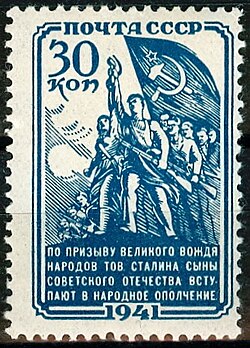
- Narodnoe Opolcheniye ก่อตั้งขึ้นอีกครั้งในปี พ.ศ. 2484 ในช่วงสงครามรักชาติครั้งยิ่งใหญ่ด้วยจำนวนมาก[ 8 ]มีการจัดตั้งกองพล 16 กองพลในมอสโก และอีก 18 กองพลในเลนินกราด ซึ่งในจำนวนนี้ 5 กองพลกลายเป็นกองพลปืนไรเฟิลประจำการ[ 9 ]
ดูเพิ่มเติม
แหล่งที่มา
- Stephen Summerfield, กางเขนทองแดงแห่งความกล้าหาญ: กองกำลังรัสเซีย Opolchenie, Partizans และ Freikorps ในช่วงสงครามนโปเลียน , สำนักพิมพ์ Partizan Press, 2007 ISBN 1-85818-555-6
- Roger Chickering, Stig Förster, Bernd Greiner, โลกในสงครามเบ็ดเสร็จ: ความขัดแย้งระดับโลกและการเมืองแห่งการทำลายล้าง, 1937-1945 , สถาบันประวัติศาสตร์เยอรมัน, สำนักพิมพ์มหาวิทยาลัยเคมบริดจ์, 2005 ISBN 0-511-08213-4
- Kirschenbaum, Lisa, มรดกจากการปิดล้อมเลนินกราด ค.ศ. 1941-1995: ตำนาน ความทรงจำ และอนุสรณ์สถาน , สำนักพิมพ์มหาวิทยาลัยเคมบริดจ์, 2006 ISBN 0-521-86326-0
- ทหารอาสาสมัครชาวนารัสเซียในช่วงเริ่มต้นสงครามไครเมีย, เดวิด มูน, สลาวิก รีวิว, เล่มที่ 51, ฉบับที่ 4, ฤดูหนาว, 1992
- กลานซ์, เดวิด, โคลอสซัสเกิดใหม่: กองทัพแดงในสงคราม ค.ศ. 1941-1943 , สำนักพิมพ์มหาวิทยาลัยแคนซัส, 2005 ISBN 0-7006-1353-6
- ดาห์ล, วลาดิมีร์ , พจนานุกรมอธิบายภาษารัสเซียฉบับสมบูรณ์ , เล่มที่ 3 (П), ไดอาแมนต์, เซนต์ปีเตอร์สเบิร์ก , 1998 (พิมพ์ซ้ำจากฉบับปี 1882 โดยสำนักพิมพ์ MOWolf Publisher Booksellers-Typesetters)