
อ่าน 4 นาที
Otto Scherzer
การเกิด พ.ศ. 2452/เสียชีวิต พ.ศ. 2525/นักฟิสิกส์ชาวเยอรมันในศตวรรษที่ 20/กล้องจุลทรรศน์/บุคคลจากเมืองพัสเซา/ศิษย์เก่ามหาวิทยาลัยเทคนิคแห่งมิวนิค/ลิงก์ย้อนกลับเทมเพลต Webarchive
Otto Scherzer (9 March 1909 – 15 November 1982) was a German theoretical physicist who made contributions to electron microscopy, including the Scherzer's theorem for the...
Otto Scherzer
Otto Scherzer | |
|---|---|
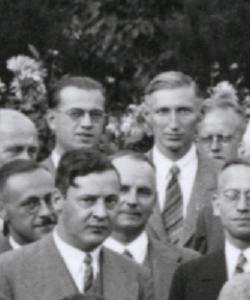 Above Rudolf Hilsch and Otto Scherzer, in front Erich Hückel at Stuttgart in 1935 | |
| Born | May 9, 1909 Passau, Germany |
| Died | November 15, 1982 (aged 73) Darmstadt, Germany |
| Alma mater | LMU Munich (PhD) |
| Known for | Scherzer's theorem |
| Scientific career | |
| Fields | PhysicsElectron microscopy |
| Thesis | Über die Ausstrahlung bei der Bremsung von Protonen und schnellen Elektronen (1931) |
Otto Scherzer (9 March 1909 – 15 November 1982) was a German theoretical physicist who made contributions to electron microscopy, including the Scherzer's theorem for the spherical aberration of electronic lenses.
Education
Scherzer studied physics at the Technical University of Munich[1] and the LMU Munich from 1927 to 1931. His thesis advisor at LMU was Arnold Sommerfeld, and he was granted his doctorate in 1931. His thesis was on the quantum theory of Bremsstrahlung, titled "Über die Ausstrahlung bei der Bremsung von Protonen und schnellen Elektronen".[2][3] From 1932 to 1933, Scherzer was an assistant to Carl Ramsauer at the Allgemeine Elektrizitäts-Gesellschaft, an electric combine with headquarters in Berlin and Frankfurt-on-Main. There, he did research on electron optics.[4] He completed his Habilitation in 1934, and he then became a Privatdozent at LMU and an assistant to Sommerfeld.[5][6]
Career
In 1935, Scherzer moved to the Technische Hochschule Darmstadt.[7] In 1936, he became an extraordinarius professor and director of the theoretical physics department.[8] In a landmark 1936 paper, Scherzer proved that the spherical and chromatic aberrations of a rotationally symmetric, static, space-charge-free, dioptric lens for electron beams cannot be eliminated by skillful design, in contrast to the case for glass lenses.[9] This was later called Scherzer's theorem and is the only named and well-established theorem in the field of charged particle optics.[10] In 1947, Scherzer published a sequel to this paper proposing various corrected lenses, dependent upon abandoning one or other requirements as set forth in the 1936 paper.[11] Scherzer’s derivations contributed to the development of electron microscopy.
From 1939 to 1945, Scherzer worked on radar at the communications research headquarters of the Kriegsmarine.[8] In a communication with Sommerfeld, dated 2 December 1944, Scherzer reported war damage in Darmstadt and commented on his work on radar.[12] From 1944 to 1945, Scherzer was head of radar finding research (Arbeitsbereich Funkmesstechnik) for the Reich Research Council (Reichsforschungsrat),[13] which was the coordinating agency in the Reich Education Ministry (German: Reichsziehungsministerium) for the centralized planning of basic and applied research.[14]
In 1954, Scherzer became ordinarius professor at the Technische Hochschule Darmstadt, where he helped found the Society for Heavy Ion Research.[8] A literature citation places Scherzer at Darmstadt as late as 1978.[15] Scherzer died in Darmstadt.
Awards
- 1983 – Microscopy Society of America, Distinguished Scientist Award, Physical Sciences[16]
Selected bibliography
- เชอร์เซอร์, ออตโต (1936) "Über einige Fehler von Elektronenlinsen" [ เกี่ยวกับความคลาดเคลื่อนบางประการของเลนส์อิเล็กตรอน] Zeitschrift für Physik 101 (9): 593– 603. Bibcode : 1936ZPhy..101..593S . ดอย : 10.1007/BF01349606 . S2CID 120073021 . - ฉบับแปลภาษาอังกฤษตีพิมพ์ในชื่อPeter W. Hawkes, ed. (1994). "On Some Aberrations of Electron Lenses". Selected Papers on Electron Optics . SPIE . pp. 340– 351. ISBN 9780819415721. OCLC 29910978 .
- O. Scherzer, Sphärische und chromatische Korrektur von Elektronenlinsen , Optik 2 114–132 (1947) ตามที่อ้างในPeter Hawkes - ความก้าวหน้าล่าสุดในเลนส์อิเล็กตรอนและกล้องจุลทรรศน์อิเล็กตรอน
- O. Scherzer (ห้องปฏิบัติการวิศวกรรมหน่วยสัญญาณ, ฟอร์ตมอนมัธ, นิวเจอร์ซีย์) ขีดจำกัดความละเอียดเชิงทฤษฎีของกล้องจุลทรรศน์อิเล็กตรอนวารสารฟิสิกส์ประยุกต์เล่มที่ 20 ฉบับที่ 1 หน้า 20–29 (1948) ได้รับเมื่อวันที่ 14 มิถุนายน 1948
- O. Scherzer, "ข้อจำกัดของกำลังการแยกภาพของกล้องจุลทรรศน์อิเล็กตรอน", Proceedings ICEM-9 Volume 3, 123–9 (1978) ตามที่อ้างถึงในPeter Hawkes - The Long Road to Spherical Aberration Correction
หนังสือ
- E. Brüche และ O. Scherzer Geometrische Elektronenoptik: Grundlagen und Anwendungen (สปริงเกอร์, 1934)
หมายเหตุ
- ↑ Technische Universität Münchenเมื่อเชอร์เซอร์เข้าร่วม เป็นที่รู้จักในชื่อ Technische Hochschule München
- ↑ออตโต เชอร์เซอร์ – โครงการลำดับวงศ์ตระกูลคณิตศาสตร์ ดร.ฟิล. Ludwig-Maximilians-Universität München, 1931. ชื่อวิทยานิพนธ์: Über die Ausstrahlung bei der Bremsung von Protonen und schnellen Elektronen .
- ↑อ็อตโต เชอร์เซอร์เก็บถาวรเมื่อ 2001-03-08 ที่Wayback Machine – โครงการ Sommerfeld: ปริญญาเอกสำหรับเชอร์เซอร์, 1931
- ↑ Hentschel, 1966, ภาคผนวก F, หน้า XLV และ ภาคผนวก D, หน้า XII.
- ↑ชีวประวัติของซอมเมอร์เฟลด์เก็บถาวรเมื่อ 27 กันยายน 2006 ที่Wayback Machine – American Philosophical Society
- ↑ Paul Kirkpatrickคำกล่าวแนะนำโดยศาสตราจารย์ Paul Kirkpatrick ประธานคณะกรรมการรางวัล American Journal of Physics 17 (5) 312-314 (1949) ในบทความนี้ มีการกล่าวถึงนักศึกษาของ Arnold Sommerfeld ดังต่อไปนี้: William V. Houston , Karl Bechert , Otto Scherzer, Otto Laporte , Linus Pauling , Carl Eckart , Gregor Wentzel , Peter Debyeและ Philip M. Morse
- ↑ต่อมาเป็นที่รู้จักในชื่อ Technische Universität Darmstadtหลังจากการเปลี่ยนแบบแผนการตั้งชื่อในเยอรมนี
- 1 2 3 Hentschel, 1966, ภาคผนวก F, หน้า. XLV.
- ↑ O. Scherzer Über einige Fehler von Elektronenlinsen , Zeitschrift für Physik Volume 101, Numbers 9-10, Pages 593-603 (1936) ตามที่อ้างใน Peter Hawkes Archived 2014-11-01 ที่Wayback Machine - The Long Road to Spherical Aberration Correction
- ↑ Rose, Harald (2012). Geometrical Charged-Particle Optics . Heidelberg New York Dordrecht London: Springer. หน้า303. ISBN 978-3-642-32118-4.
- ↑ O. Scherzer, Sphärische und chromatische Korrektur von Elektronenlinsen , Optik 2 114–132 (1947) ตามที่อ้างถึงใน Peter Hawkes Archived 2005-01-24 ที่Wayback Machine - Recent Advances in Electron Optics and Electron Microscopy และยังอ้างถึงใน Peter Hawkes Archived 2014-11-01 ที่Wayback Machine - The Long Road to Spherical Aberration Correction
- ↑ข้อมูลบุคลากรถูกเก็บถาวรเมื่อวันที่ 27 เมษายน 2548 ที่Wayback Machine – โครงการ Sommerfeld
- ↑สภาวิจัยแห่งไรช์ก่อตั้งขึ้นในเดือนมีนาคม ค.ศ. 1937 โดยเบอร์นาร์ด รัสต์รัฐมนตรีแห่งไรช์ในกระทรวงศึกษาธิการแห่งไรช์ ดู Hentschel, 1966, ภาคผนวก B, หน้า VII และภาคผนวก F, หน้า XLIV
- ↑ Hentschel, 1966, ภาคผนวก F, หน้า XLV, ภาคผนวก B, หน้า V-VII.
- ↑ปีเตอร์ ฮอว์กส์เก็บถาวรเมื่อ 2014-11-01 ที่Wayback Machine - เส้นทางอันยาวไกลสู่การแก้ไขความคลาดเคลื่อนทรงกลม
- ↑ Otto Scherzer เก็บถาวรเมื่อ 17 กุมภาพันธ์ 2012 ที่Wayback Machine - สมาคมจุลทัศน์แห่งอเมริกา
เอกสารอ้างอิง


- Klaus Hentschel (บรรณาธิการ) และ Ann M. Hentschel (ผู้ช่วยบรรณาธิการและผู้แปล) ฟิสิกส์และลัทธินาซี: บทความรวบรวมจากแหล่งข้อมูลปฐมภูมิ (Birkhäuser, 1996)
สรุปเนื้อหา
ข้อมูลสำคัญจากบทความ
ข้อมูลสำคัญเกี่ยวกับ Otto Scherzer
Otto Scherzer (9 March 1909 – 15 November 1982) was a German theoretical physicist who made contributions to electron microscopy, including the Scherzer's theorem for the...
Education
Scherzer studied physics at the Technical University of Munich[1] and the LMU Munich from 1927 to 1931. His thesis advisor at LMU was Arnold Sommerfeld, and he was granted his doctorate in 1931. His thesis was on the quantum theory of Bremsstrahlung, titled...
Career
In 1935, Scherzer moved to the Technische Hochschule Darmstadt.[7] In 1936, he became an extraordinarius professor and director of the theoretical physics department.[8] In a landmark 1936 paper, Scherzer proved that the spherical and chromatic aberrations of...
Awards
1983 – Microscopy Society of America, Distinguished Scientist Award, Physical Sciences[16]