
วงควartet ปารีส
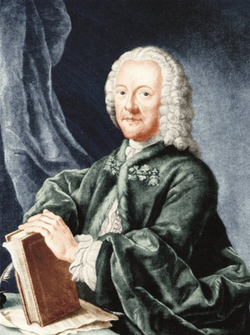
" ปารีสควอเต็ต"เป็นชื่อเรียกโดยรวมของ บทเพลงสำหรับ ดนตรีห้อง สองชุด แต่ละชุดประกอบด้วยผลงานหกชิ้นสำหรับฟลุต ไวโอลินวิโอลา ดา กัมบา (หรือเชลโล ) และคอนตินูโอโดยเกออร์ก ฟิลิปป์ เทเลมันน์ซึ่งตีพิมพ์ครั้งแรกในปี 1730 และ 1738 ตามลำดับ เทเลมันน์เรียกชุดผลงานทั้งสองของเขาว่าQuadriและNouveaux Quatuorsชื่อเรียกโดยรวม "ปารีสควอเต็ต" เพิ่งได้รับการตั้งขึ้นในครึ่งหลังของศตวรรษที่ 20 โดยบรรณาธิการของ Telemann Musikalische Werkeเนื่องจากมีความเกี่ยวข้องกับการเยือนปารีสของเทเลมันน์ในฐานะบุคคลที่มีชื่อเสียงในปี 1737–38 [ 1 ]พวกมันมีหมายเลข 43:D1, 43:D3, 43:e1, 43:e4, 43:G1, 43:G4, 43:g1, 43:A1, 43:A3, 43:a2, 43:h1, 43:h2 ในTWV (แคตตาล็อกผลงานของ Telemann)
ประวัติศาสตร์
At Michaelmas (29 September) 1737, Telemann finally left Hamburg for a long-delayed journey to Paris, where he had been invited at least seven years earlier by four prominent French musicians: flautist Michel Blavet, violinist Jean-Pierre Guignon, gambist Jean-Baptiste Forqueray, and a cellist/harpsichordist called Prince Édouard, whose precise identity is not known.[2][3][4] By 1730 Telemann's fame had spread across Europe, thanks in large part to dissemination of his music in printed form, which had been the main source of appreciation by his French hosts. It was in preparation for this visit (and for these four musicians) that Telemann composed the first set of six Paris quartets, which he published in Hamburg under the (Italian) title Quadri a violino, flauto traversiere, viola da gamba o violoncello, e fondamento: ripartiti in 2. concerti, 2. balletti, 2. suonate in 1730. In anticipation of his arrival the Paris publisher Le Clerc reprinted them in 1736, as Six quatuors a violon, flute, viole ou violoncelle et basse continue. In the meantime, Telemann had composed a second set of six quartets. These, too, were printed by Le Clerc, in 1738 during Telemann's stay in Paris, under the title Nouveaux quatuors en six suites: à une flûte traversiere, un violon, une basse de viole, où violoncel, et basse continuë. All twelve quartets were played during the composer's visit, by the four musicians who had invited him and doubtless accompanied by Telemann himself on the harpsichord. So that Forqueray and Edouard could take turns playing the solo and continuo bass lines, Telemann composed separate versions of the obbligato part, one for viola da gamba and the other for cello—"a cunning diplomatic gesture, which is typical of Telemann's practical mind".[5]
Analysis
Quadri
The six Quadri, for flute, violin, viola da gamba or cello, and basso continuo constitute a réunion des goûts, in that they represent three national styles in pairs of (Italian) concertos in G major and D major, (German) sonatas in A major and G minor), and (French) suites in E minor and B minor.[6] It is possible that this mixture of styles is a deliberate nod toward François Couperin, who in 1724 had published a series of chamber works under the general title le goûts réunis (prefaced by an "Essai de la réunion des Goûts François et Italien"), and two years later a set of four trio sonatas titled Les nations, in which French, Spanish, Imperial, and Piedmontese national traits are represented. The multisectional, quasi-improvisational construction of the first quartet suggests a function as prelude to the rest of the collection, similar to the "sonades" that introduce each suite in Les nations.[7] Despite their designation as "Paris" quartets, "the Quadri are no more 'Parisian' than other Hamburg publications that were known in the French capital".[1]
The combination of instruments chosen by Telemann allows a great deal of flexibility in grouping, since the obbligato gamba part (which is entirely independent of the continuo bass) can function in bass, tenor, or alto register. Although he supplied separate versions for viola da gamba and cello, it appears from the indication "Violoncello, in luogo della Viola" on Telemann's title page and on the separate part for the cello that his first choice was the viola da gamba. The three obbligato instruments participate equally in the thematic working out of the quartets, frequently exhibiting kaleidoscopic textures with rapidly shifting pairings of instruments. Although there is an emphasis on technical virtuosity, Telemann's progressive approach to form applies the emerging galant style that contributed to the quartets' popularity.[8]
Nouveaux quatuors
Nouveaux quatuors en six suitesตามที่ชื่อบ่งบอกนั้น ล้วนอยู่ในรูปแบบสวีท (ตรงข้ามกับชุดควอเต็ตชุดแรก) คีย์ที่ใช้คือ ดีเมเจอร์, เอไมเนอร์, จีเมเจอร์, บีไมเนอร์, เอเมเจอร์ และอีไมเนอร์ ชุดที่สองนี้ยังคงรักษามาตรฐานอันสูงส่งสำหรับการแต่งควอเต็ตที่เทเลมันน์ได้กำหนดไว้ในQuadri ไว้ และในบางแง่มุมก็เหนือกว่าด้วย ซ้ำ แม้จะมีชื่อและรูปแบบเป็นภาษาฝรั่งเศส แต่ควอเต็ตเหล่านี้เป็นเหมือนการสานต่อréunion des goûtsมากกว่าการเลียนแบบสไตล์ฝรั่งเศส และคุณลักษณะที่ทันสมัยนี้เป็นปัจจัยสำคัญที่ทำให้ควอเต็ตเหล่านี้ได้รับความนิยมในปารีส อีกปัจจัยหนึ่งอาจเป็นการมีส่วนร่วมอย่างเท่าเทียมกันของส่วน obbligato ทั้งสามส่วน ซึ่งมีเสียงสะท้อนทางวัฒนธรรมอย่างมากในสังคมที่หลงใหลในศิลปะแห่งการสนทนา[ 9 ]
ควอเต็ตเพิ่มเติม
ต่อมามีการตีพิมพ์ผลงานอีกสองชุดในปารีส โดยแต่ละชุดประกอบด้วยควartet หกชิ้นของเทเลมันน์ ซึ่งมีการเรียบเรียงดนตรีที่แตกต่างออกไปเล็กน้อยจากควartet ที่เกี่ยวข้องกับการเยือนปารีสของเทเลมันน์ในปี 1737–38 ในช่วงประมาณปี 1746 ถึง 1748 เลอ แคลร์ ได้ตีพิมพ์ผลงานชุดSix quatuors ou trios à 2 flûtes traversières ou 2 violons et à 2 violoncells ou 2 bassons, dont le second peut être entierement retranché, ou se joüer sur le clavessin (ควartet หรือ trio หกชิ้นสำหรับฟลุตหรือไวโอลินสองตัวและเชลโลหรือบาสซูนสองตัว โดยตัวที่สองอาจละเว้นทั้งหมดหรือแทนที่ด้วยฮาร์ปซิคอร์ด) เช่นเดียวกับQuadriเหล่านี้เป็นการนำชุดสะสมที่ตีพิมพ์ครั้งแรกในฮัมบูร์กในปี 1733 มาพิมพ์ซ้ำ[ 10 ]ดังนั้นนี่จึงเป็นชุดสะสมควอเต็ตของ Telemann ชุดที่สามที่ตีพิมพ์ในปารีส ในช่วงเวลาระหว่างปี 1752 ถึง 1760 Le Clerc ได้ออกQuatrième livre de quatuorsซึ่งประกอบด้วยฟลุต ไวโอลิน วิโอลา และเบสคอนตินูโอ ฉบับนี้เกือบจะแน่นอนว่าไม่ได้รับอนุญาตจากผู้ประพันธ์เพลง เนื่องจากประกอบด้วยการเรียบเรียงผลงานยุคแรกๆ ที่ค่อนข้างไม่ลงตัว ซึ่งเดิมทีประพันธ์ขึ้นสำหรับเครื่องสายทั้งหมด เวอร์ชันดั้งเดิมพบได้ในต้นฉบับที่ดาร์มสตัดท์และเดรสเดนซึ่งคัดลอกระหว่างปี 1710 ถึง 1735 ซึ่งอยู่ในรูปแบบอิตาเลียนของ Telemann ในช่วงปี 1709–1715 [ 11 ]
แผนกต้อนรับ
สองปีหลังจากกลับมายังฮัมบูร์ก เทเลมันน์ได้รายงานด้วยตนเองถึงผลกระทบที่วงควartetของเขามีต่อปารีส:
การแสดงอันน่าชื่นชมของวงควartet เหล่านี้โดย Messrs Blavet (ฟลุต), Guignon (ไวโอลิน), Forcroyผู้เยาว์[เช่น Forqueray] (วิโอลา ดา กัมบา) และEdouard (เชลโล) นั้นคุ้มค่าที่จะบรรยายหากเป็นไปได้ที่จะหาคำพูดมาอธิบายได้ ในระยะสั้น พวกเขาได้รับความสนใจจากราชสำนักและเมือง และทำให้ข้าพเจ้าได้รับชื่อเสียงและความเคารพนับถือเพิ่มขึ้นเกือบจะทั่วทุกสารทิศในเวลาอันสั้น[ 12 ]
Telemann was famous in his lifetime for the composition of quartets, of which he wrote at least 40.[13][14] However, only two contemporary writers offer detailed discussion of quartet writing in general, and of Telemann's quartets in particular, Johann Adolph Scheibe and Johann Joachim Quantz.[15]
In the issue for Tuesday, 26 January 1740 of his weekly music magazine, Der Critische Musikus, Scheibe wrote an article explaining that quartet writing presented the composer with special challenges. According to Scheibe, they could be written in the French manner, or in a style unique to themselves; formally, they may be sonatas, or else in concerto form. It seems clear from these remarks that Scheibe had Telemann's Paris quartets in mind, and especially when he observed, "it is generally best to use four different instruments together; above all, a transverse flute, a violin, a viola da gamba and a bass sound best together".[16]
In his Versuch,[17] Quantz seems tacitly to criticise Telemann's later style by praising only the earlier quartets, written before 1734. Upon publication of Quantz's book in 1752, Telemann wrote to the author. Though his letter does not survive, to judge from Quantz's reply he evidently demanded to know why Quantz had referred only to his early, unpublished trios and quartets. Quantz answered that "these very quartets are the ones that first made me personally most clearly aware of the characteristics of good quartets and inspired me some years ago to venture into just this field. Would you blame me if, without slighting the others, I have a special love for these?"[18] It seems apparent from this response as well as from his own quartets that Quantz was not so much thinking of the compositional details of Telemann's works as he was nostalgically remembering his fondness for those pieces he had studied in his youth.[19]
Editions
- Telemann, Georg Philipp. 1730. Quadri a violino, flauto traversiere, viola da gamba o violoncello, e fondamento: ripartiti in 2. concerti, 2. balletti, 2. suonate. Hamburg: Telemann. Reprinted, Shumilov Facsimile Collection SH 01. [Gustavsberg]: Musici Segreti; [Magdeburg]: Edition Walhall, 2004.
- เทเลมันน์, จอร์จ ฟิลิปป์. พ.ศ. 2279 (ค.ศ. 1736) ไวโอลิน 6 quatuors ต่อ 1 ไวโอลิน ฟลุต ไวโอลิน ou violoncelle et basse continuëฉบับนูแวล Gravée par De Gland หลุมฝังศพ du roy ปารีส: มิสเตอร์เลอ แคลร์ เลอ กาเดต์, เลอ เซอร์ เลอ แคลร์, ลา วีเยอ บัวแว็ง พิมพ์ซ้ำจากสำเนาในหอสมุดแห่งชาติ บาเซิล: Musica Musica, Mark A. Meadow, 1981.
- เทเลมันน์, จอร์จ ฟิลิปป์. 1738. Nouveaux quatuors en six suites: à une flûte traversiere, un violon, une basse de viole, où violoncel, et basse continuëปารีส: L'auteur, Vater, Boivin และ Le Clerc พิมพ์ซ้ำจากสำเนาในหอสมุดแห่งชาติ โทรสารของนักแสดง 98224 นิวยอร์ก: โทรสารของนักแสดง 1998