
Phosphuga
| Phosphuga | |
|---|---|
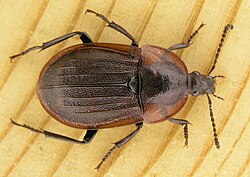 | |
| Young adult | |
Scientific classification | |
| Kingdom: | Animalia |
| Phylum: | Arthropoda |
| Clade: | Pancrustacea |
| Class: | Insecta |
| Order: | Coleoptera |
| Suborder: | Polyphaga |
| Infraorder: | Staphyliniformia |
| Family: | Staphylinidae |
| Subfamily: | Silphinae |
| Tribe: | Silphini |
| Genus: | PhosphugaLeach, 1817 |
| Species: | P. atrata |
| Binomial name | |
| Phosphuga atrata | |
| Synonyms | |
See main text | |
Phosphuga is a Eurasiangenus of flightless carrion beetle, whose sole member is the speciesPhosphuga atrata, commonly known as black snail beetle. Up to 15mm long, they have an oval shape as adults and are brownish in color when newly moulted, becoming black as their exoskeleton hardens. Black snail beetles resemble (and are presumably closely related to and sometimes even included in) the type genus Silpha of the carrion beetle subfamily Silphinae, and are thus placed in tribeSilphini. Although they range widely, they are seldom encountered by people, because they hunt at night and hide during the day, often under bark.
Ecology
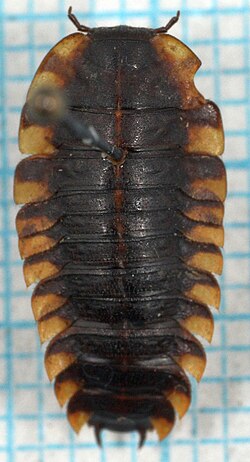
Adults are flightless, lacking flight muscles, and feed on live snails, insects and earthworms, as well as on carrion. This beetle has an elongated neck that it uses to reach into snail shells, which it sprays with a digestive fluid. When disturbed, they excrete a yellow fluid and retract their head under the shield. The larvae are flattened, black with brown edges to their armor plates, and feed on snails as well. They pupate in the ground.[1]
Range: Europe (including UK), Russia (European, Siberia, Far East, Kuriles), Turkey, Armenia, Azerbaijan, Georgia, Iran, Afghanistan, Kyrgyzstan, Kazakhstan, Tajikistan, Turkmenistan, Uzbekistan, Mongolia, Korea (N,S), Japan, India (Kashmir), China (Heilongjiang+); intro Iceland
Synonyms
Initially described and sometimes still placed in genus Silpha, the black snail beetle was occasionally even allied with the unrelated polyphagan genus Peltis of the vegetarian cleroidsuperfamily. Throughout the centuries, specimens from across its vast range have been described numerous times as supposedly distinct species, and at least two subtaxa have been named; none of these are considered distinct today:
- Peltis (Phosphuga) atrata var. rostrataReitter, 1888
- Peltis subparalellaReitter, 1884
- Phosphuga atrata subrotundata กรอง, 1817
- Phosphuga cassidea Kraatz, 1876
- Silpha atrata Linnaeus, 1758
- Silpha fusca Herbst, 1793
- ศิลปนิติดา ฟัล เดอร์มานน์, 2378
- ศิลปา เปเดมอนทานา ฟาบริซิอุส, 2318
- Silpha punctata De Geer, 1774
- ซิลฟา ชาโกตานาโคโน, 1929
ลิงก์ภายนอก
 ข้อมูลที่เกี่ยวข้องกับPhosphuga atrata ใน Wikispecies
 สื่อที่เกี่ยวข้องกับPhosphuga atrata ใน Wikimedia Commons
- ภาพถ่ายของตัวเต็มวัยและตัวอ่อน
- ด้วงอังกฤษ Phosphuga atrata Linnaeus, 1758 เก็บถาวรเมื่อ 2021-01-19 ที่Wayback Machine