
ฟิลโลโดซิดา
| ฟิลโลโดซิดา ช่วงเวลา: | |
|---|---|
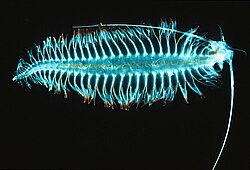 | |
| หนอนทะเลแพลงก์ตอนTomopteris | |
การจำแนกทางวิทยาศาสตร์ | |
| อาณาจักร: | แอนิมอลเลีย |
| ไฟลัม: | แอนเนลิดา |
| กลุ่มสายพันธุ์ : | เพลสโตแอนเนลิดา |
| คลาสย่อย: | เออร์แรนเทีย |
| กลุ่มสายพันธุ์ : | อะซิคุลาตา |
| คำสั่ง: | ฟิลโลโดซิดา |
| คำสั่งย่อย | |
| |
Phyllodocidaเป็นอันดับของ หนอน โพลีคีตในชั้นย่อยErrantia [ 1 ]หนอนเหล่านี้ส่วนใหญ่เป็นสัตว์ทะเล แม้ว่าบางชนิดจะพบในน้ำกร่อยก็ตามส่วนใหญ่เป็นสิ่งมีชีวิตที่อาศัยอยู่บนพื้นทะเล เคลื่อนที่ไปบนผิวน้ำหรือขุดลงไปในตะกอน หรืออาศัยอยู่ในรอยแตกและร่องในหินแข็ง บางชนิดสร้างท่อเพื่ออาศัยอยู่ และบางชนิดเป็นสัตว์ที่อาศัยอยู่ในน้ำเปิด ว่ายน้ำผ่านมวลน้ำมีการประมาณว่ามีมากกว่า 4,600 ชนิด ที่ได้รับการยอมรับ ในอันดับนี้[ 2 ]
ลักษณะเฉพาะ
Phyllodocida เป็น หนอน ปล้องที่มีขนาดตั้งแต่ไม่กี่มิลลิเมตรไปจนถึงมากกว่าหนึ่งเมตร แต่ละปล้องมีพาราโพเดีย รูปใบพายคู่หนึ่ง ส่วนหัว (prostomium ) โดยทั่วไปจะมีตาหนึ่งหรือสองคู่หนวด คู่หนึ่งอยู่ด้านบน หนวดรับความรู้สึกคู่หนึ่งอยู่ด้านล่างและอวัยวะคู่หนึ่งอยู่ที่คอ ปาก(peristomium)เป็นวงแหวน มักจะซ่อนอยู่ด้านบนโดยส่วนหัวและปล้องแรก มีงวง กล้ามเนื้อที่ มีขากรรไกรหนึ่งคู่หรือมากกว่า ปล้องถัดไปมักจะแตกต่างจากปล้องที่อยู่ด้านหลังตรงที่มีหนวด (ระยางค์ละเอียด) ขนาดใหญ่ขึ้นทั้งด้านบนและด้านล่าง และมีกลีบพาราโพเดียและ ขน ( chaetae ) ที่ลดลง บางชนิดมีระยางค์ที่มีหน้าที่เฉพาะ แต่ส่วนใหญ่มีหลายปล้องที่คล้ายคลึงกัน แต่มีขนาดและรูปร่างแตกต่างกันไปตามความยาวของลำตัวโดยไม่มีการเปลี่ยนแปลงอย่างฉับพลันในขนและพาราโพเดียจากปล้องหนึ่งไปยังอีกปล้องหนึ่ง[ 3 ]
ชีววิทยา
โดยทั่วไปหนอนในอันดับนี้มักเป็นสัตว์นักล่าหรือสัตว์กินซาก[ 4 ]
ความสัมพันธ์ทางวิวัฒนาการ
The three main subgroups are Aphroditiformia, Glyceriformia and Nereidiformia. The Aphroditiformia are characterised by the presence of elytrae or scales on alternating segments. The Glyceriformia are characterised by the presence of unique cone-shaped and ringed prostomiums. The Nereidiformia are more problematic, having no universally distinguishing common features. There is agreement on the monophyly of a group including the Hesionidae, Nereididae and Chrysopetalidae families but opinions differ about Pilargidae, and molecular and morphological studies continue.[5][6][7]
Families
Recognised families:[1]
Suborder Aphroditiformia
- Superfamily Aphroditoidea
- Superfamily Chrysopetalacea
- Clade †Machaeridia[8]
- Superfamily Pisionacea
Suborder Glyceriformia
Suborder Nereidiformia
Suborder Phyllodocida incertae sedis
Suborder Phyllodociformia
- 12World Register of Marine Species
- ↑Martin D, Aguado MT, Fernández Álamo M-A, Britayev TA, Böggemann M, Capa M, Faulwetter S, Fukuda MV, Helm C, Petti MAV, Ravara A, Teixeira MAL (2021). "On the Diversity of Phyllodocida (Annelida: Errantia), with a Focus on Glyceridae, Goniadidae, Nephtyidae, Polynoidae, Sphaerodoridae, Syllidae, and the Holoplanktonic Families". Diversity. 13 (3): 131. Bibcode:2021Diver..13..131M. doi:10.3390/d13030131. hdl:10261/235472.
- ↑Tree of Life Web Project
- ↑Encyclopedia of Life
- ↑Glasby, C.J. 1993. Family revision and cladistic analysis of the Nereidoidea (Polychaeta: Phyllodocida). Invertebr. Taxon. 7:1551-1573.
- ↑Pleijel, F., and Dahlgren, T.G. 1998. Position and delineation of Chrysopetalidae and Hesionidae (Annelida, Polychaeta, Phyllodocida). Cladistics 14:129-150.
- ↑Dahlgren, T.G., Lundberg, J., Pleijel, F., and Sundberg, P. 2000. Morphological and molecular evidence of the phylogeny of Nereidiform polychaetes (Annelida). J. zool. Syst. evol. Res. 38:249-253.
- ↑Parry, Luke A.; Edgecombe, Gregory D.; Sykes, Dan; Vinther, Jakob (24 July 2019). "Jaw elements in Plumulites bengtsoni confirm that machaeridians are extinct armoured scaleworms". Proceedings of the Royal Society B: Biological Sciences. 286 (1907) 20191247. doi:10.1098/rspb.2019.1247. PMC 6661337. PMID 31337310.
- ↑Farrell, Úna C; Briggs, Derek E.G (22 February 2007). "A pyritized polychaete from the Devonian of Ontario". Proceedings of the Royal Society B: Biological Sciences. 274 (1609): 499–504. doi:10.1098/rspb.2006.0063. PMC 1766378. PMID 17476769.