
Win–loss record (pitching)
In baseball and softball, a win–loss record (also referred to simply as a record) is a statistic that indicates the number of wins (denoted "W") and losses (denoted "L") credited to a pitcher. For example, a 20–10 win–loss record would represent 20 wins and 10 losses.
In each game, one pitcher on the winning team is awarded a win (the "winning pitcher") and one pitcher on the losing team is given a loss (the "losing pitcher") in their respective statistics. These pitchers are collectively known as the pitchers of record. The designation of win or loss for a pitcher is known as a decision, and only one pitcher for each team receives a decision. A starting pitcher who does not receive credit for a win or loss is said to have no decision. In certain situations, another pitcher on the winning team who pitched in relief of the winning pitcher can be credited with a save, and holds can be awarded to relief pitchers on both sides, but these are never awarded to the pitcher who is awarded the win.
The decisions are awarded by the official scorer of the game in accordance with the league's rules. The official scorer does not assign a winning or losing pitcher in some games which are forfeited, such as those that are tied at the time of forfeiture. If the game is tied (a rare event), no pitcher is awarded any decision. A pitcher's winning percentage is calculated by dividing the number of wins by the number of decisions (wins plus losses), and it is commonly expressed to three decimal places.
Winning pitcher
A pitcher is awarded with a win if he pitches prior to the half-inning when his team maintains the lead that it never relinquishes.
There are two exceptions to this rule. The first is that a starting pitcher must complete a minimum of five innings, the length of an official game, to earn a win. Failure to do so results in the ineligibility to be the winning pitcher, even if he last pitched prior to the half-inning when he maintains his team's lead. The official scorer awards the win to the relief pitcher who, in the official scorer's judgment, was the most effective.
ข้อยกเว้นที่สองจะใช้ได้ก็ต่อเมื่อผู้ขว้างสำรองที่ขว้างครั้งสุดท้ายก่อนครึ่งอินนิ่งเมื่อทีมที่ชนะขึ้นนำครั้งสุดท้ายนั้น "ไม่มีประสิทธิภาพในการลงสนามช่วงสั้นๆ" ตามการตัดสินของผู้บันทึกคะแนนอย่างเป็นทางการ ในกรณีนี้ชัยชนะจะมอบให้แก่ผู้ขว้างสำรองคนถัดไปซึ่งตามการตัดสินของผู้บันทึกคะแนนอย่างเป็นทางการนั้นมีประสิทธิภาพมากที่สุด[ 1 ]
ในการแข่งขันออลสตาร์ของเมเจอร์ลีกเบสบอลผู้ขว้างทุกคนจะถือว่าเป็นผู้ขว้างสำรองตามกฎนี้ ตัวอย่างเช่นโชเฮ โอทานิผู้ขว้างตัวจริงของลีกอเมริกัน ได้รับชัยชนะในการแข่งขันออลสตาร์ปี 2021แม้ว่าจะขว้างเพียง 14 ลูกในอินนิ่งเดียวก็ตาม[ 2 ]
ผู้ขว้างที่แพ้
หากผู้ขว้างลูกเป็นผู้เสียแต้มที่ทำให้ฝ่ายตรงข้ามทำแต้มขึ้นนำและกลายเป็นแต้มที่ทำให้ทีมของเขาชนะ ซึ่งหมายความว่าทีมของเขาไม่สามารถตีเสมอหรือกลับมาเป็นผู้นำได้ในภายหลัง ผู้ขว้างลูกจะถูกบันทึกว่าแพ้
หากผู้ขว้างลูกทำแต้มให้ทีมตรงข้ามขึ้นนำ แล้วทีมของเขากลับมาขึ้นนำหรือตีเสมอได้ และต่อมาทีมตรงข้ามกลับมาขึ้นนำอีกครั้งโดยผู้ขว้างลูกคนถัดไป ผู้ขว้างลูกคนก่อนหน้าจะไม่ถูกบันทึกว่าเป็นผู้แพ้
หากผู้ขว้างออกจากเกมขณะที่ทีมนำอยู่หรือเสมอกัน แต่มีผู้เล่นที่สามารถทำคะแนนขึ้นนำได้อยู่บนฐาน และผู้เล่นคนนั้นทำคะแนนขึ้นนำได้สำเร็จ ผู้ขว้างที่ปล่อยให้ผู้เล่นคนนั้นขึ้นฐานได้จะต้องรับผิดชอบต่อความพ่ายแพ้ ไม่ว่าผู้เล่นคนนั้นจะขึ้นฐานได้ด้วยวิธีใด และทำคะแนนได้อย่างไรก็ตาม หากผู้ขว้างสำรองสามารถจบครึ่งอินนิ่งได้โดยไม่เสียคะแนนขึ้นนำ ผู้ขว้างที่ออกจากเกมจะไม่ได้รับความพ่ายแพ้
ตัวอย่างเช่น ในวันที่ 13 เมษายน พ.ศ. 2550 คาร์ลอส ซัมบราโนแห่งชิคาโก คับส์กำลังเผชิญหน้ากับซินซินเนติ เรดส์ในช่วงต้นอินนิ่งที่ 5 เขาถูกเปลี่ยนตัวออกจากเกมในขณะที่คับส์นำอยู่ 5–4 และมีผู้เล่นอยู่เต็มเบสวิล โอห์ มัน ผู้ขว้าง ที่เข้ามาแทนเขาปล่อยให้ผู้เล่นที่วิ่งอยู่บนเบส สองคน ทำคะแนนได้ ทำให้เรดส์นำ 6–5 แม้ว่าซัมบราโนจะไม่ได้ขว้างในขณะที่ทำคะแนนได้ แต่เขาก็ถูกบันทึกว่าเป็นผู้แพ้ เนื่องจากผู้เล่นที่วิ่งอยู่บนเบสที่ทำคะแนนได้นั้นเป็นความรับผิดชอบของเขา[ 3 ]
พื้นหลัง
ผู้ขว้างที่ได้รับชัยชนะและผู้ขว้างที่แพ้จะถูกเรียกรวมกันว่า ผู้ขว้างที่มีสถิติ ส่วนผู้ขว้างที่เริ่มเกมแต่ไม่ได้ชัยชนะหรือแพ้ (กล่าวคือ ก่อนที่ทีมใดทีมหนึ่งจะได้รับหรือเสียความเป็นผู้นำในที่สุด) จะถือว่าได้รับผลเสมอไม่ว่าผลงานส่วนตัวของเขาจะเป็นอย่างไรก็ตาม โดยทั่วไปแล้ว จำนวนชัยชนะและแพ้ทั้งหมดของผู้ขว้างจะถูกบันทึกไว้ด้วยกัน ตัวอย่างเช่น สถิติการขว้าง 12–10 หมายถึง ชนะ 12 ครั้งและแพ้ 10 ครั้ง
In the early years of Major League Baseball before 1900, top pitchers regularly had 30 or more wins in one season, with Old Hoss Radbourn of the Providence Grays holding the record with 60 wins in 1884.[4][5][6] Since 1900, however, pitchers have made fewer and fewer starts, and the standard has changed. Gradually, as hitting improved, better pitching was needed. This meant, among other things, throwing the ball much harder, and it became unrealistic to ask a pitcher to throw nearly as hard as he could for over 100 pitches a game without giving him several days to recover.
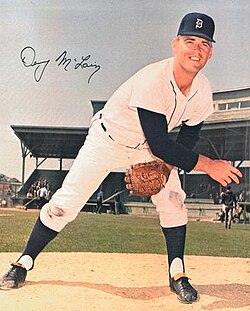
In the first third of the 20th century (especially after the live-ball era), winning 30 games became the rare mark of excellent achievement; this standard diminished to 25 games during the 1940s through 1980s. The only pitcher to win 30 or more games during that time was Denny McLain in 1968, in what was an anomalous pitching-dominated season.[7]
Since 1990, this has changed even further, with winning 20 or more games in a single season achieved by only a handful of pitchers each season. For example, in 2004 only three of the more than 500 major league pitchers did so. In 2006 and again in 2009, no pitcher in either league won 20 games.[8] The last pitcher to win 25 games was Bob Welch in 1990. Since 2013, only 15 pitchers have won 20 games in a season, most recently Kyle Wright in 2022.[9]
The New York Times wrote in 2011 that as advanced statistics have expanded, a pitcher's win–loss record has decreased in importance. Many times, a win is substantially out of the pitcher's control; even a dominant pitcher cannot record a win if his team does not score any runs for him. For example, Félix Hernández won the Cy Young Award in 2010 in spite of a 13–12 record.[10] Hernández's Mariners scored the fewest runs in the majors that season, while he had an ERA of 2.27 and pitched a league-high 249+2⁄3 innings.[11] Similarly, in 2004, Milwaukee Brewers starter Ben Sheets had a losing record of 12–14, despite displaying a league-best 8.25 strikeout-to-walk ratio and was among the top 5 pitchers in ERA (2.70) and WHIP (0.98).[12] Later, Jacob deGrom won consecutive Cy Young Awards despite recording 10 wins in 2018 and 11 wins in 2019.[13][14]
In addition to their dependence on run support, wins for a starting pitcher are also dependent on bullpen support. A starting pitcher can pitch well, leaving the game with the lead, and then watch helplessly from the dugout as relievers gives up the lead. That would entitle the starting pitcher to a no-decision instead of a win despite the strong performances, regardless of whether or not the team ends up winning. Starting pitchers on teams with a weak bullpen tend to have fewer wins because of this. Likewise, a pitcher can give a poor performance and give up many runs and leave the game earlier than desired, but still win because his team scored even more runs. Some prefer the quality start statistic as an indication of how many times a starting pitcher gave his team a realistic chance to win.[15]
Decision records
Pud Galvin (1883) holds the major league record for most decisions (75) in a season.[16] During the 1908 season, Ed Walsh had 55 decisions, which remains the most in a season since 1900.[17]Wilbur Wood holds the season record for the live-ball era (1920–present), recording 44 decisions in 1973.[18]As of 2024รอยฮัลลาเดย์และอดัม เวนไรต์ (31 การตัดสินใจในปี 2010) เป็นนักขว้างคนสุดท้ายที่มีการตัดสินใจ 30 ครั้งขึ้นไปในหนึ่งฤดูกาล[ 19 ]สถิติสูงสุดตลอดกาลเป็นของไซ ยังซึ่งมีการตัดสินใจ 826 ครั้งระหว่างปี 1890 ถึง 1911 [ 20 ] [ 21 ]
ดูเพิ่มเติม
ลิงก์ภายนอก
- นับตั้งแต่ปี 1957 ชนะโดยไม่ต้องเผชิญหน้ากับผู้ตีลูกเลย