
Quercus libani
| ต้นโอ๊กเลบานอน | |
|---|---|
 | |
การจำแนกทางวิทยาศาสตร์ | |
| อาณาจักร: | พืช |
| กลุ่มสายพันธุ์ : | เอ็มบริโอไฟต์ |
| กลุ่มสายพันธุ์ : | พืชมีท่อลำเลียง |
| กลุ่มสายพันธุ์ : | สเปอร์มาโตไฟต์ |
| กลุ่มสายพันธุ์ : | พืชดอก |
| กลุ่มสายพันธุ์ : | ยูไดคอต |
| กลุ่มสายพันธุ์ : | โรซิดส์ |
| คำสั่ง: | ฟากาเลส |
| ตระกูล: | แฟกกาซี |
| ประเภท: | ต้นโอ๊ค |
| สกุลย่อย: | Quercus subg. Cerris |
| ส่วน: | Quercus sect. Cerris |
| สายพันธุ์: | คิว. ลิบานี |
| ชื่อทวินาม | |
| Quercus libani | |
| คำพ้องความหมาย[ 3 ] | |
รายการ
| |
Quercus libaniหรือต้นโอ๊กเลบานอนเป็นสายพันธุ์ของต้นโอ๊กที่มีถิ่นกำเนิดในแถบเมดิเตอร์เรเนียนตะวันออกในเอเชียตะวันตก รวมถึงทางตะวันตกของซีเรีย เลบานอน ทางตะวันออกของตุรกี และทางเหนือของอิรักและอิหร่าน [ 1 ] [ 4 ]
คำอธิบาย
Quercus libaniเป็น ไม้ ผลัดใบที่สูงถึง8 เมตร (26 ฟุต) [ 5 ] ใบผลัดใบมีลักษณะเรียวยาวและมักไม่สมมาตร โคนใบกลมและปลายใบแหลมเล็กน้อย เมื่อโตเต็มที่ ด้านบนของใบจะมีสีเขียวเข้มและด้านล่างมีสีเขียวอ่อน[ 6 ]
The flowers are monoecious, meaning that flowers from both sexes can be found on the same tree. They are pollinated by wind. The tree produces acorns that grow to about 2 to 3.6 centimetres (3⁄4 to 1+3⁄8 inches) in diameter.[5] Its length is half covered by the cupule.[6]
Habitat
The Lebanon oak can grow in medium loamy to heavy clay soils, with no preference to soil acidity. The tree can grow in direct sunlight to semi-shade. It can endure strong winds, but not salty maritime exposures.
Cultivation
Ornamental tree
Quercus libani is cultivated and planted as an ornamental tree in gardens, parks, and habitat restoration projects. It is successful in drought-tolerant landscape gardens.
The tree does not tolerate root disturbance well, therefore landscape trees should not be moved once planted, or transplanted from native habitats. Acorns sown in situ will produce the best trees, in growth rate and deep-rooted drought tolerance. The acorns are sown as they ripen. Acorns lose their viability if they dry out and so need to be kept in a moist and cool place away from rodents until planting.[5]
Biological pest control
The leaf litter of the Lebanon oak is used as a biological pest control, herbivore insect repellent for protecting other plants. Its leaves placed as a mulch layer around vulnerable plants effectively repels snails, slugs, and grubs. Fresh leaves can inhibit plant growth and so are not used directly from the tree. Being deciduous, much beneficial leaf litter is produced in the autumn.[7]
Uses
Lebanon oak wood is very hard and resistant to insect and fungal attack and is used in construction.
Food
The acorns are very bitter due to high concentrations of tannins. This bitter taste can be leached out by washing the acorns in running water, but this causes the loss of many beneficial minerals. The acorns can be dried and ground it into a powder and used to thicken stews and may be mixed with cereals for making bread. The roasted bitter acorns may be used as a coffee substitute.[5]
Medicinal
ปุ่มที่เกิดจากตัวอ่อนของแมลงชนิดต่างๆ ที่อาจพบได้บนต้นไม้มีปริมาณแทนนินสูงเป็นพิเศษ มีฤทธิ์ฝาด มาก และใช้ในการรักษาอาการตกเลือดและท้องเสีย [ 5 ]แทนนินจากปุ่มยังใช้เป็นสีย้อมอีก ด้วย [ 8 ]
แกลเลอรี่
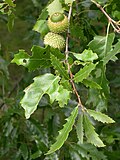 ใบโอ๊คเลบานอน
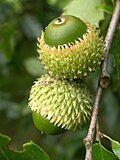 ลูกโอ๊กสีเขียวของต้นโอ๊กเลบานอนที่มีเปลือกหุ้มเป็นหนาม
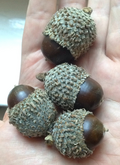 ลูกโอ๊กสุกของต้นโอ๊กเลบานอน