
Radio-controlled car
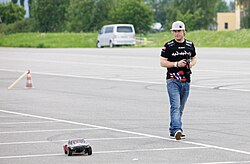
Radio-controlled cars, or RC cars for short,[1] are miniature vehicles controlled via radio.
History
Radio-controlled cars have existed since the 1940s.[1] A streamlined radio-controlled vehicle won a third prize in Ford Motor Company's 1954 Industrial Arts Awards program. David Swinder of Warren, Ohio used a large control console to demonstrate the operation of the six-foot vehicle to Al Esper, Ford's chief test driver.[2][3]
Automobile manufacturer studios used scale models to reduce new design development lead times and save money. Among Ford designs executed were the LaTosca, a futuristic bubble-top dream car, and the Mexico, an aerodynamic reskin of the 1955 Thunderbird that was designed to top 200 mph. For these two models the designers constructed radio control systems, adapting six-volt car batteries, convertible top motors, and other full-size components from the Ford parts bins. Along with motive power, braking, and turning, the radio control system also reportedly operated the headlights, brake lights, and turn signals.[4][5]
In the 1970s, Tamiya released its first radio-controlled car, a model of the Porsche 934.[6] In the 1980s, Shunsaku Tamiya led the company through a surge in the popularity of radio-controlled car racing as a competitive motorsport.[6] In 1982, the company developed its first Mini 4WD models, which became very popular in Japan.[6] Tamiya's Mini 4WD models continue to be popular throughout Asia.[7]
Types
There are multiple types of radio-controlled cars that are suited for different purposes. On-road RC cars are designed for flattened ground, such as floors or paved concrete, while off-road RC cars can be used on uneven and rocky terrain. Ready-to-run RC cars are sold pre-assembled and are able to be used with minimum complications, while almost-ready-to-run RC cars can be customized and reassembled.[8]
รถบังคับวิทยุแบบใช้ไฟฟ้าจะใช้ตัวควบคุมความเร็วอิเล็กทรอนิกส์ (ESC) เพื่อปรับปริมาณพลังงานที่ส่งไปยังมอเตอร์ไฟฟ้า[ 9 ]รถบังคับวิทยุแบบไม่ใช้ไฟฟ้าอาจใช้ เครื่องยนต์ ไนโตรมีเทน ( หรือที่เรียกว่าไนโตร) เป็นแหล่งพลังงาน มอเตอร์ไฟฟ้าให้การทำงานที่สะอาดกว่าและใช้งานง่ายกว่า ในขณะที่เครื่องยนต์ไนโตรให้ความรู้สึกเหมือนการเผาไหม้ภายในที่สมจริงกว่า[ 10 ]
ดูเพิ่มเติม
- สหพันธ์การแข่งรถโมเดลนานาชาติ
- การแข่งขันชิงแชมป์โลก IFMAR 1:10 รถออฟโรดไฟฟ้า
- รถบั๊กกี้ออฟโรดบังคับวิทยุขนาด 1:10