
อ่าน 5 นาที
ความมั่นคงที่ผ่อนคลาย
ในด้าน การบิน เครื่องบินจะถือว่ามี เสถียรภาพที่ผ่อนคลาย หากมี เสถียรภาพ ต่ำหรือ ติดลบ [ 1 ] [ 2 ]
ความมั่นคงที่ผ่อนคลาย
ในด้านการบินเครื่องบินจะถือว่ามีเสถียรภาพที่ผ่อนคลายหากมีเสถียรภาพ ต่ำหรือ ติดลบ[ 1 ] [ 2 ]
เครื่องบินที่มีเสถียรภาพติดลบจะมีแนวโน้มที่จะเปลี่ยนมุมเงยและมุมเอียงเองโดยธรรมชาติ เครื่องบินที่มีเสถียรภาพติดลบไม่สามารถปรับแต่งเพื่อรักษาระดับการบิน ที่ต้องการได้ และเมื่อถูกรบกวนในมุมเงยหรือมุมเอียง เครื่องบินจะยังคงเงยหรือเอียงไปในทิศทางของการรบกวนด้วยอัตราที่เพิ่มขึ้นเรื่อยๆ
สิ่งนี้สามารถเปรียบเทียบได้กับพฤติกรรมของเครื่องบินที่มีเสถียรภาพเชิงบวก ซึ่งสามารถปรับแต่งให้บินในท่าทางที่กำหนดได้ และจะรักษาท่าทางนั้นไว้ได้หากไม่มีการควบคุม และหากถูกรบกวน จะแกว่งไปมาใน ลักษณะ การเคลื่อนที่แบบฮาร์มอนิกอย่างง่ายในระดับที่ลดลงรอบๆ และในที่สุดก็จะกลับคืนสู่ท่าทางที่ปรับแต่งไว้ เครื่องบินที่มีเสถียรภาพเชิงบวกจะต้านทานการเอียงใดๆ ด้วย เครื่องบินเซสนา 152เป็นตัวอย่างของเครื่องบินที่มีเสถียรภาพ ในทำนองเดียวกัน เครื่องบินที่มีเสถียรภาพเป็นกลางจะไม่กลับคืนสู่ท่าทางเดิมหากไม่มีการควบคุม แต่จะยังคงหมุนหรือเอียงในอัตราคงที่ (ไม่เพิ่มขึ้นหรือลดลง)
เครื่องบินรุ่นแรกๆ
ความพยายามในช่วงแรกในการบินที่หนักกว่าอากาศนั้นมีแนวคิดเรื่องเสถียรภาพที่แตกต่างจากที่ใช้ในปัจจุบัน นักวิจัยด้านการบินส่วนใหญ่มองว่าการบินนั้นไม่ต่างจากการเคลื่อนที่บนพื้นผิวโลกมากนัก เพียงแต่พื้นผิวโลกนั้นสูงขึ้น พวกเขาคิดถึงการเปลี่ยนทิศทางในแง่ของหางเสือ เรือ ดังนั้นเครื่องบินจึงยังคงอยู่ในระดับเดียวกันในอากาศ เช่นเดียวกับรถยนต์หรือเรือที่อยู่บนผิวน้ำ แนวคิดเรื่องการเอียงหรือกลิ้งไปด้านใดด้านหนึ่งโดยเจตนานั้นดูเหมือนจะไม่พึงประสงค์หรือไม่ก็ไม่ได้อยู่ในความคิดของพวกเขา[ 3 ]
Some of these early investigators, including Langley, Chanute, and later Santos-Dumont and the Voisin brothers, sought the ideal of "inherent stability" in a very strong sense, believing a flying machine should be built to automatically roll to a horizontal (lateral) position after any disturbance. They achieved this with the help of Hargrave cellular wings (wings with a box kite structure, including the vertical panels) and strongly dihedral wings. In most cases they did not include any means for a pilot to control the aircraft roll[4]—they could control only the elevator and rudder. The unpredicted effect of this was that it was very hard to turn the aircraft without rolling.[4][5] They were also strongly affected by side gusts and side winds upon landing.
The Wright brothers designed their 1903 first powered Flyer with anhedral (drooping) wings, which are inherently unstable. They showed that a pilot can maintain control of lateral roll and it was a good way for a flying machine to turn—to "bank" or "lean" into the turn just like a bird or just like a person riding a bicycle.[6] Equally important, this method would enable recovery when the wind tilted the machine to one side. Although used in 1903, it would not become widely known in Europe until August 1908, when Wilbur Wright demonstrated to European aviators the importance of the coordinated use of elevator, rudder and roll control for making effective turns.
Vertical wing position
The vertical positioning of the wing changes the roll stability of an aircraft.
- An aircraft with a "high" wing position (i.e., set on top of the fuselage) has a higher roll stability. For example, the Cessna 152.
- An aircraft with a "low" wing (i.e., underneath the fuselage) has less roll stability. The Piper Pawnee uses a "low" wing.
Unstable aircraft
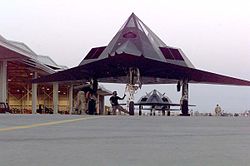
Modern military aircraft, particularly low observable ("stealth") designs, often exhibit instability as a result of their shape. The LockheedF-117 Nighthawk, for instance, employs a highly non-traditional fuselage and wing shape in order to reduce its radar cross section and enable it to penetrate air defenses with relative impunity. However, the flat facets of the design reduce its stability to the point where a computerized fly-by-wire system is required for it to fly.[7]
Relaxed stability designs are not limited to military jets. The McDonnell Douglas MD-11 has a neutral stability design which was implemented to save fuel. To ensure stability for safe flight, an LSAS (Longitudinal Stability Augmentation System) was introduced to compensate for the MD-11's rather short horizontal stabilizer and ensure that the aircraft would remain stable.[8] However, there have been incidents in which the MD-11's relaxed stability caused an "inflight upset".[9]
Intentional instability
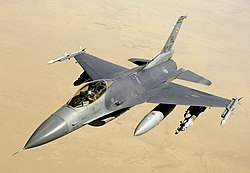
Many modern fighter aircraft often employ design elements that reduce stability to increase maneuverability. Greater stability leads to lesser control surface authority; therefore, a less stable design will have a faster response to control inputs. This is highly sought after in fighter aircraft design.
A less stable aircraft requires smaller control deflections to initiate maneuvering; consequently, drag and control surface imposed stresses will be reduced and aircraft responsiveness will be enhanced. Since these characteristics will typically make control by the pilot difficult or impossible, artificial stability will typically be imposed using computers, servos, and sensors as parts of a fly-by-wire control system.
See also
Citations
- ^Nguyen, L. T.; Ogburn, M. E.; Gilbert, W. P.; Kibler, K. S.; Brown, P. W.; Deal, P. L. (1 December 1979). "Simulator study of stall/post-stall characteristics of a fighter airplane with relaxed longitudinal static stability. NASA Technical Paper 1538". NASA Technical Publications (19800005879). NASA: 1. Retrieved 6 July 2022.
- ^ Wilhelm, Knut; Schafranek, Dieter (ตุลาคม 1986). "คุณสมบัติการควบคุมการลงจอดของเครื่องบินขนส่งที่มีความเสถียรสถิตที่ผ่อนคลาย"วารสารเครื่องบิน 23 ( 10): 756– 762. doi : 10.2514/3.45377 . ISSN 0021-8669 . สืบค้นเมื่อ6 กรกฎาคม 2022 .
- ^ Crouch 2003 , หน้า 167–168.
- ^ a b c Villard, Henry Serrano (2002). Contact!: the story of the early aviators . Mineola, NY: Dover Publications. หน้า 39–53 . ISBN 978-0-486-42327-2.
- ^ a b Letcher, Piers (2003). Eccentric France: the Bradt guide to mad, magical and marvellous France . Chalfont St. Peter, England: Bradt Travel Guides. pp. 38 –39. ISBN 978-1-84162-068-8.
- ^โทบิน 2004 , หน้า 70.
- ^ Abzug, Malcolm; Larrabee, E. Eugene (2002). เสถียรภาพและการควบคุมเครื่องบิน: ประวัติศาสตร์ของเทคโนโลยีที่ทำให้การบินเป็นไปได้ (ฉบับที่ 2). เคมบริดจ์ [ua]: สำนักพิมพ์มหาวิทยาลัยเคมบริดจ์ หน้า 335–337 . ISBN 978-0-521-80992-4.
- ^ "ผลกระทบของระดับความสูงและจุดศูนย์ถ่วงต่อลักษณะการควบคุมของเครื่องบินพาณิชย์ปีกกวาด"นิตยสารAero 1 ( 2) โบอิ้งสืบค้นเมื่อ 29 มิถุนายน 2022
- ^ Pasztor, Andy (24 มีนาคม 2552). "เครื่องบินเจ็ตของ FedEx มีปัญหาด้านการควบคุม" . WSJ . สืบค้นเมื่อ1 ตุลาคม 2558 .
เอกสารอ้างอิงทั่วไปและเอกสารอ้างอิงที่อ้างถึง
สรุปเนื้อหา
ข้อมูลสำคัญจากบทความ
ข้อมูลสำคัญเกี่ยวกับ ความมั่นคงที่ผ่อนคลาย
ในด้าน การบิน เครื่องบินจะถือว่ามี เสถียรภาพที่ผ่อนคลาย หากมี เสถียรภาพ ต่ำหรือ ติดลบ [ 1 ] [ 2 ]
เครื่องบินรุ่นแรกๆ
ความพยายามในช่วงแรกในการบินที่หนักกว่าอากาศนั้นมีแนวคิดเรื่องเสถียรภาพที่แตกต่างจากที่ใช้ในปัจจุบัน นักวิจัยด้านการบินส่วนใหญ่มองว่าการบินนั้นไม่ต่างจากการเคลื่อนที่บนพื้นผิวโลกมากนัก เพียงแต่พื้นผิวโลกนั้นสูงขึ้น พวกเขาคิดถึงการเปลี่ยนทิศทางในแง่ของ หางเสือ...
Vertical wing position
The vertical positioning of the wing changes the roll stability of an aircraft.
Unstable aircraft
Modern military aircraft, particularly low observable (" stealth ") designs, often exhibit instability as a result of their shape.