
Sheshui
| She River Sheshui | |
|---|---|
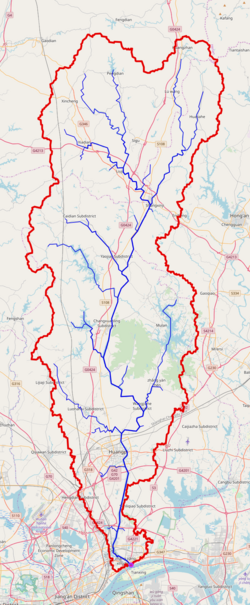 She river basin | |
| Native name | 滠水 |
| Location | |
| Country | China |
| Region | Hubei |
| District | Wuhan |
| Cities | Dawu County, Hubei, Xiaogan, Huanggang, Wuhan |
| Physical characteristics | |
| Source | Mount Sanjiao ('Triangle Mountain') |
| • location | Dawu County, border area of Hubei and Henan |
| Mouth | Yangtze River |
• location | Wuhan, Hubei |
• coordinates | 30°40′N114°22′E / 30.66°N 114.36°E |
| Length | 112 km (70 mi), North-south |
Basin size | 2,312 km2 (893 sq mi) |
| Basin features | |
| River system | Yangtze River basin |
| Sheshui | |||||||
|---|---|---|---|---|---|---|---|
| Traditional Chinese | 灄水 | ||||||
| Simplified Chinese | 滠水 | ||||||
| Literal meaning | She River | ||||||
| |||||||
The She River (She pronounced like "shuh"), also known by its Chinese name Sheshui, is a left tributary of the Yangtze in central China. It has a length of 112 km.[1] The route of the She River was noted in the Commentary on the Water Classic.[2]
It is the namesake of Shekou in Huangpi District, Wuhan. Shekouxincheng Station is located near the mouth of the She River.
Geography
The headwaters of the She River flow from Mount Sanjiao ('Triangle Mountain')[1] in Dawu County, Hubei in Xiaogan. The river then travels east across Hong'an County in Huanggang, then entering the Huangpi District of Wuhan. Its watershed area is roughly rectangular in shape. On the lower reaches of the She River, there are several archaeological sites including the Masai archaeological site dating from the Warring States period, the Chengmentan archaeological site (New Stone Age), and the Sangujing archaeological site.[3]
Warm Winter on the She River
The Warm Winter on the She River (滠水冬温) is one of the ten important aspects of Huangpi District, as recognized from the Qing dynasty.[3]
หวงหลง หนึ่งในแปดเซียนมีชื่อว่าฉีเทียนหลง และแต่งงานกับโฮเซียนกู่ พวกเขาอาศัยอยู่บนเรือและมักช่วยเหลือผู้อื่น ปีหนึ่งฝนตกหนักมาก ภูเขาพังทลาย ทุ่งนาที่อุดมสมบูรณ์ถูกน้ำท่วม และสัตว์เลี้ยงถูกฆ่าตาย ฉีเทียนหลงและภรรยาได้ช่วยเหลือชาวบ้านจำนวนมากจากภัยพิบัติ แต่ทั้งสองเหนื่อยล้ามากและถูกกระแสน้ำพัดพาไป ร่างของพวกเขาถูกพบในอำเภอทางเหนือ และทั้งคู่ถูกฝังไว้ริมฝั่งแม่น้ำเช่อ เพื่อเป็นเกียรติแก่คู่รักที่ช่วยชีวิตพวกเขา ชาวบ้านได้สร้างถ้ำเซียนโย่วไท่และถ้ำเซียนโย่วไว้หน้าสุสานของทั้งคู่เพื่อระลึกถึงพวกเขา สิ่งนี้ทำให้แปดเซียนประทับใจ และทุกๆ ฤดูหนาวหลังจากที่ทั้งคู่เสียชีวิต กลุ่มจะมารวมตัวกันที่นี่และถวายเหล้าเป็นเครื่องบูชา[ 3 ]