
Summitville mine
| Summitville mine | |
|---|---|
| Superfund site | |
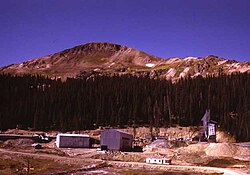 Summitville mine site in 1980 | |
| Geography | |
| Town | Del Norte |
| County | Rio Grande |
| State | Colorado |
| Coordinates | 37°26′10″N106°35′52″W / 37.43611°N 106.59778°W / 37.43611; -106.59778 |
  Summitville mine Summitville mine's location in Colorado[1] | |
| Information | |
| CERCLIS ID | COD983778432[2] |
| Contaminants | Heavy metals[3] |
| Responsibleparties | EPA[2] |
| Progress | |
| Proposed | 05/10/1993[2] |
| Listed | 05/31/1994[2] |
| List of Superfund sites | |

The Summitville mine was a gold mining site in the United States, located in Rio Grande County, Colorado25 miles (40 km) south of Del Norte. It is remembered for the environmental damage caused in the 1980s by the leakage of mining by-products into local waterways and then the Alamosa River.
History
Charles Baker's group of prospectors found traces of placer gold in the San Juan Mountains in 1860 at Eureka, Colorado. The group was forced out in 1861 by the Ute Tribe, who had been awarded the area in a US treaty. Gold was discovered in Wightman Fork, on South Mountain, which is the same location of present-day Summitville. More prospectors returned in 1871, when lode gold was found in the Little Giant vein at Arrasta Gulch, near Silverton, Colorado. The miners were allowed to stay after the Brunot Treaty of 13 Sept. 1873. In exchange for giving up 4 million acres, the Southern Ute Indian Reservation received $25,000 per year. Gold veins were found at 11,500 feet on South Mountain in 1873 and the town was founded when stamp and amalgamation mills were built.[4]:49–50
By 1885 there were more than 250 individual claims in operation. The site was soon mined out, with the weather of the 3,500 m high site adding to difficulties. The site was re-opened on a number of occasions for gold or other metals but with little success, and prior to the site's acquisition in 1984 the last survey was in the early 1970s for copper. The total amount of gold extracted from the site from 1873 until 1959 was around 257,600 troy ounces (8,010 kg).
In 1984 an area of 1,230 acres (5.0 km2) was acquired by the Canadian-based Galactic Resources Ltd. subsidiary Summitville Consolidated Mining Company, Inc. (SCMCI). They began a new large-scale open pit operation covering 550 acres (2.2 km2). New techniques were used to extract gold from otherwise uneconomic ore.
The mining involved the treatment of pyritic ore with a sodium cyanide solution to leach the gold out of the ore—heap leaching (see also cyanide process). The solution (leachate) was then removed from the ore and the valuable metals extracted using activated carbon. SCMCI leached around 10 million tons of ore on a 73-acre (0.3 km2) heap leach pad. The mining operations were finished in October 1991 with the leaching continuing until March 1992, when Galactic Resources filed for bankruptcy. A total of 294,365 troy ounces (9,155.8 kg) of gold and 319,814 troy ounces (9,947.3 kg) of silver were recovered. SCMCI then closed the site and converted on-site equipment for the detoxification process, with around 160 million U.S. gallons (610,000 m3) of stored water needing treatment. After the company insolvency proceedings were completed in a British Columbia court, the US Government declared the site a superfund cleanup site and spent $155,000,000 of public funds cleaning up the site.
Cease-and-desist order and aftermath
ในปี 1991 บริษัท SCMCI ได้รับคำ สั่ง ให้หยุดดำเนินการจากรัฐบาล เนื่องจากมีความกังวลเกี่ยวกับระดับโลหะในน้ำใกล้เคียง อันเนื่องมาจากน้ำส่วนเกินที่ไหลบ่าจากลานบำบัดแร่และผ่านแผ่นรองลานที่ชำรุด อาจมีน้ำปนเปื้อนรั่วไหลลงสู่ลำธารใกล้เคียงมากถึง 85,000 แกลลอนสหรัฐ (320 ลูกบาศก์เมตร)ในเดือนธันวาคม 1992 บริษัท Galactic Resources Ltd. ประกาศล้มละลายและประกาศว่าจะหยุดการดำเนินการทำความสะอาดพื้นที่ทันที การทำความสะอาดพื้นที่จึงดำเนินการโดยสำนักงานคุ้มครองสิ่งแวดล้อมแห่งสหรัฐอเมริกา (EPA) ตั้งแต่ปี 1994 ภายใต้โครงการSuperfund Emergency Responseปัญหาหลักคือ น้ำปนเปื้อนที่กักเก็บไว้ในระบบบ่อที่ไม่เหมาะสม แหล่งปนเปื้อนอีกแหล่งหนึ่งคือ น้ำที่รั่วไหลจากเหมืองใต้ดินเก่า EPA ประมาณการว่า น้ำรั่วไหลจากพื้นที่ประมาณ 3,000 แกลลอนสหรัฐ (11 ลูกบาศก์เมตร) ทุกนาทีอย่างไรก็ตาม แม้ว่าน้ำจะมีค่า pHประมาณ 3 ( เป็นกรด ) แต่ การศึกษา ของ USGSระบุว่าน้ำที่ไหลบ่าลงมานั้นไม่ได้เป็นภัยคุกคามร้ายแรง
มีการใช้เงิน 155 ล้านดอลลาร์สหรัฐในพื้นที่เพื่อกำจัดสารพิษและลดการรั่วไหลโรเบิร์ต ฟรีดแลนด์ประธานบริษัท Galactic Resources Ltd. จ่ายเงินชดเชยประมาณ 30 ล้านดอลลาร์สหรัฐ โลหะหนักและกรดจากเหมืองคาดว่าเป็นสาเหตุให้ปลาที่ปล่อยลงในอ่างเก็บน้ำปลายน้ำของแม่น้ำอะลาโมซาตายในปี 1990 แม้ว่าไซยาไนด์จากกองแร่ที่รั่วไหลลงสู่แหล่งน้ำด้วย แต่เชื่อว่าไซยาไนด์ระเหยไปในชั้นบรรยากาศอย่างรวดเร็วโดยไม่เป็นอันตรายต่อสิ่งมีชีวิตในน้ำปลายน้ำ[ 5 ]
มลพิษจากธรรมชาติเทียบกับมลพิษที่เกิดจากมนุษย์
หินในบริเวณซัมมิทวิลล์เมื่อหลายล้านปีก่อนเคยถูกเปลี่ยนแปลงด้วยกรดซัลเฟต ซึ่งทำให้ลำธารที่ไหลผ่านบริเวณนั้นมีสภาพเป็นกรดและมีโลหะหนักในปริมาณสูงตามธรรมชาติ ชื่อของลำธารใกล้เคียงเองก็เป็นหลักฐานแสดงถึงคุณภาพน้ำตามธรรมชาติที่ย่ำแย่ เช่น ไอรอนครีก อลัมครีก และบิตเตอร์ครีก การทำเหมืองที่ซัมมิทวิลล์ โดยการเปิดเผยพื้นผิวหินให้ผุกร่อนมากขึ้น ทำให้ความเป็นกรดและความเข้มข้นของโลหะที่ละลายในน้ำที่ไหลจากพื้นที่เหมืองเพิ่มขึ้น ความเสื่อมโทรมของคุณภาพน้ำที่ไหลจากซัมมิทวิลล์มีต้นกำเนิดมาจากทั้งโครงสร้างการทำเหมืองที่มีอายุหลายสิบปี เช่น อุโมงค์เรย์โนลด์ และการทำเหมืองแบบเปิดในช่วงปี 1985–1992
น้ำที่ไหลจากเหมืองซัมมิทวิลล์ไหลลงสู่แม่น้ำไวท์แมนฟอร์ก ผสมกับน้ำเสียที่เป็นกรดตามธรรมชาติจากพื้นที่ที่ไม่ได้ทำเหมือง ไหลลงสู่แม่น้ำอะลาโมซาและไหลลงจากภูเขาไปยังหุบเขาซานลุยส์ซึ่งใช้ในการชลประทานพืช ผล การตรวจสอบ ของสำนักงานสำรวจทางธรณีวิทยาแห่งสหรัฐอเมริกาได้ข้อสรุปที่สำคัญสามประการ:
ปัญหาการระบายน้ำเสียที่เป็นกรดรุนแรงเป็นปัญหาด้านสิ่งแวดล้อมระยะยาวที่สำคัญที่สุดของเหมืองซัมมิทวิลล์ และสามารถคาดการณ์ได้ล่วงหน้าจากลักษณะทางธรณีวิทยาของแหล่งแร่ จำเป็นต้องมีการดำเนินการแก้ไขอย่างกว้างขวางเพื่อแยกแร่ซัลไฟด์ที่ไม่ผุกร่อนและเกลือโลหะที่ละลายได้ในบริเวณเหมืองเปิดและกองเศษแร่จากการผุกร่อนและการละลาย
มีความเป็นไปได้ว่ามลพิษตามธรรมชาติส่งผลเสียต่อคุณภาพน้ำและแหล่งที่อยู่อาศัยของปลาในแม่น้ำอะลาโมซามานานแล้ว และจะยังคงส่งผลเสียต่อไปแม้ว่าจะมีการแก้ไขปัญหาน้ำเสียที่เป็นกรดจากซัมมิทวิลล์แล้วก็ตาม ดังนั้น จึงจำเป็นต้องสร้างสภาวะธรรมชาติที่เหมาะสมสำหรับแม่น้ำอะลาโมซา เพื่อกำหนดเงื่อนไขการแก้ไขปัญหาที่สมจริงสำหรับพื้นที่ซัมมิทวิลล์
ผลการศึกษาเมื่อปลายปี 1993 ระบุว่าการทำเหมืองที่ซัมมิทวิลล์ไม่มีผลกระทบเชิงลบในระยะสั้นที่สังเกตได้ต่อพืชข้าวบาร์เลย์หรืออัลฟัลฟาที่ชลประทานด้วยน้ำจากแม่น้ำอะลาโมซา การฟื้นฟูพื้นที่จะช่วยให้มั่นใจได้ว่าจะไม่มีผลกระทบเชิงลบเกิดขึ้นในระยะยาว[ 6 ]