
ดาวแฟลร์

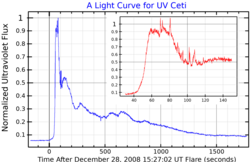
ดาวแปรแสงแบบ แฟลร์ คือดาวแปรแสงที่สามารถมีความสว่างเพิ่มขึ้นอย่างรวดเร็วและคาดเดาไม่ได้เป็นเวลาสองสามนาที เชื่อกันว่าแฟลร์บนดาวแปรแสงแบบแฟลร์นั้นคล้ายคลึงกับแฟลร์ของดวงอาทิตย์ตรงที่เกิดจากพลังงานแม่เหล็กที่สะสมอยู่ใน ชั้นบรรยากาศของ ดาวความสว่างที่เพิ่มขึ้นนั้นครอบคลุมสเปกตรัมตั้งแต่รังสีเอ็กซ์ไปจนถึงคลื่นวิทยุกิจกรรมแฟลร์ในดาวประเภทปลายได้รับการรายงานครั้งแรกโดยA. van Maanenในปี 1945 สำหรับWX Ursae MajorisและYZ Canis Minoris [ 2 ] อย่างไรก็ตามดาวแปรแสงแบบแฟลร์ที่รู้จักกันดีที่สุดคือUV Cetiซึ่งถูกสังเกตว่าเกิดแฟลร์ครั้งแรกในปี 1948 ปัจจุบันดาวแปรแสงแบบแฟลร์ที่คล้ายกันถูกจัดประเภทเป็นดาวแปรแสงประเภท UV Ceti (ใช้ตัวย่อUV ) ในแคตตาล็อกดาวแปรแสง เช่นGeneral Catalogue of Variable Stars
ดาวฤกษ์ที่เกิดเปลวสุริยะส่วนใหญ่เป็นดาวแคระแดง ที่สลัว แม้ว่างานวิจัยล่าสุดจะบ่งชี้ว่าดาวแคระน้ำตาล ที่มีมวลน้อยกว่า ก็อาจเกิดเปลว สุริยะได้เช่นกัน ดาวแปรแสง RS Canum Venaticorum (RS CVn) ที่มีมวลมากกว่าก็ทราบกันว่าเกิดเปลวสุริยะเช่นกัน แต่เป็นที่เข้าใจกันว่าเปลวสุริยะเหล่านี้ถูกเหนี่ยวนำโดยดาวคู่ในระบบดาวคู่ซึ่งทำให้สนามแม่เหล็กพันกัน นอกจากนี้ ดาวฤกษ์เก้าดวงที่คล้ายกับดวงอาทิตย์ก็เคยเกิดเหตุการณ์เปลวสุริยะ[ 3 ]ก่อนที่จะมี ข้อมูล ซูเปอร์เปลวสุริยะจำนวนมากจาก หอดูดาว เคปเลอร์ มีการเสนอว่ากลไกสำหรับเรื่องนี้คล้ายกับของดาวแปรแสง RS CVn ตรงที่เปลวสุริยะถูกเหนี่ยวนำโดยดาวคู่ ซึ่งก็คือดาวเคราะห์คล้ายดาวพฤหัสบดีที่มองไม่เห็นซึ่งโคจรอยู่ใกล้[ 4 ]
แบบจำลองเปลวสุริยะ
The Sun is known to flare and solar flares have been extensively studied over all the spectrum. Even though the Sun on average shows less variability and weaker flares compared with other stars that are similar to the Sun in spectral type, rotation period and age, it is generally thought that other stellar flares and the solar flares share the same or similar processes.[5] Thus the solar flare model has been used as the framework for understanding other stellar flares.
The general idea is that flares are generated through the reconnection of the magnetic field lines in the corona.[6] There are several phases for the flare: preflare phase, impulsive phase, flash phase and decay phase. Those phases have different timescales and different emissions across the spectrum. During the preflare phase, which usually lasts for a few minutes, the coronal plasmas slowly heats up to temperatures of tens of millions Kelvin. This phase is mostly visible to soft X-rays and EUV. During the impulsive phase, which lasts for three to ten minutes, a large number of electrons and sometimes also ions are accelerated to extremely high energies ranging from keV to MeV. The radiation can be seen as gyrosynchrotron radiation in the radio wavelengths and bremsstrahlung radiation in the hard X-rays wavelengths. This is the phase where most of the energy is released.[7] The later flash phase is defined by the rapid increase in Hα emissions. The free streaming particles travel along the magnetic lines, propagating energy from the corona to the lower chromosphere. The material in the chromosphere is then heated up and expands to the corona. Emission in the flash phase is primarily due to thermal radiation from the heated stellar atmosphere. As the material reaches the corona, the intensive release of energy slows down and cooling starts. During the decay phase which lasts for one to several hours, the corona returns back to its original state.
This is the model for how an isolated star generates flares but this is not the only way. Interactions between a star and the companion or sometimes the environment can also produce flares. In binary systems such as RS Canum Venaticorum variable stars (RS CVn), flares can be produced through the interactions between the magnetic fields of the two bodies in the systems. For stars that have an accretion disk, which most of the time are protostars or pre-main sequence stars, the interactions of magnetic fields between the stars and the disk can also cause flares.[8]
Nearby flare stars

Flare stars are intrinsically faint, but have been found to distances of 1,000 light years from Earth.[9] On April 23, 2014, NASA's Swift satellite detected the strongest, hottest, and longest-lasting sequence of stellar flares ever seen from a nearby red dwarf, DG Canum Venaticorum. The initial blast from this record-setting series of explosions was as much as 10,000 times more powerful than the largest solar flare ever recorded.[10]
Proxima Centauri
The Sun's nearest stellar neighbor Proxima Centauri is a flare star that undergoes occasional increases in brightness because of magnetic activity.[11] The star's magnetic field is created by convection throughout the stellar body, and the resulting flare activity generates a total X-ray emission similar to that produced by the Sun.[12]
Wolf 359
The flare star Wolf 359 is another near neighbor (2.39 ± 0.01 parsecs). This star, also known as Gliese 406 and CN Leo, is a red dwarf of spectral class M6.5 that emits X-rays.[13] It is a UV Ceti flare star,[14] and has a relatively high flare rate.
The mean magnetic field has a strength of about 2.2 kG (0.2 T), but this varies significantly on time scales as short as six hours.[15] By comparison, the magnetic field of the Sun averages 1 G (100 μT), although it can rise as high as 3 kG (0.3 T) in active sunspot regions.[16]
Barnard's Star
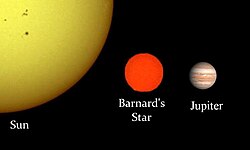
Barnard's Star is the fourth nearest star to the Sun. At 7–12 billion years of age, Barnard's Star is considerably older than the Sun. It was long assumed to be quiescent in terms of stellar activity. However, in 1998, astronomers observed an intense stellar flare, showing that Barnard's Star is a flare star.[17][18]
EV Lacertae
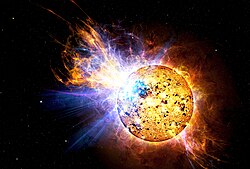
EV Lacertaeตั้งอยู่ห่างออกไป 16.5 ปีแสง และเป็นดาวฤกษ์ที่อยู่ใกล้ที่สุดในกลุ่มดาวนี้ เป็นดาวฤกษ์อายุน้อย ประมาณ 300 ล้านปี และมีสนามแม่เหล็ก ที่แข็งแกร่ง ในปี 2551 มันได้ก่อให้เกิดเปลวสุริยะที่ทำลายสถิติ ซึ่งมีพลังงานมากกว่าเปลวสุริยะที่ใหญ่ที่สุดที่เคยสังเกตได้หลายพันเท่า[ 19 ]
ทีวีแอลเอ็ม513-46546
TVLM 513-46546เป็นดาวฤกษ์ประเภท M9 ที่มีมวลต่ำมาก อยู่ที่ขอบเขตระหว่างดาวแคระแดงและดาวแคระน้ำตาลข้อมูลจากหอดูดาว Areciboที่ความยาวคลื่นวิทยุระบุว่าดาวฤกษ์ดวงนี้เกิดการปะทุทุกๆ 7054 วินาที ด้วยความแม่นยำหนึ่งในร้อยของวินาที[ 20 ]
2MASS J18352154-3123385 A
ดาวฤกษ์ที่มีมวลมากกว่าในระบบดาวคู่2MASS J1835ซึ่งเป็นดาวประเภท M6.5 มีการปล่อยรังสีเอ็กซ์ที่รุนแรง ซึ่งบ่งชี้ว่าเป็นดาวฤกษ์ที่อาจเกิดการปะทุได้ แม้ว่าจะไม่เคยมีการสังเกตการณ์การปะทุโดยตรงของดาวดวงนี้มาก่อนก็ตาม
พลุไฟทำลายสถิติ
การปะทุของดาวฤกษ์ที่ทรงพลังที่สุดที่ตรวจพบ ณ เดือนธันวาคม พ.ศ. 2548 อาจมาจากดาวคู่ที่มีกิจกรรมII Peg [ 21 ] การสังเกตการณ์โดยSwiftชี้ให้เห็นถึงการมีอยู่ของรังสีเอ็กซ์แข็งในปรากฏการณ์ Neupert ที่ได้รับการยอมรับอย่างดี ดังที่เห็นในเปลวสุริยะ
ลิงก์ภายนอก
- ดาวแปรแสง UV Ceti และดาวฤกษ์ที่เกิดเปลวสุริยะ ฤดูใบไม้ร่วงปี 2003จัดทำโดย Matthew Templeton, AAVSO (www.aavso.org)
- เปลวสุริยะ - ดี. มอนเตส, มหาวิทยาลัยแคลิฟอร์เนีย แมนเชสเตอร์