
Maximum and minimum
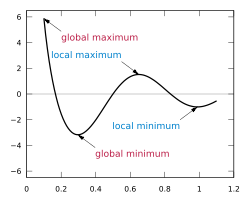
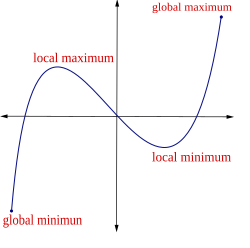
In mathematical analysis, the maximum and minimum[a] of a function are, respectively, the greatest and least value taken by the function. Known generically as extrema,[b] they may be defined either within a given range (the local or relative extrema) or on the entire domain (the global or absolute extrema) of a function.[1][2][3]Pierre de Fermat was one of the first mathematicians to propose a general technique, adequality, for finding the maxima and minima of functions.
As defined in set theory, the maximum and minimum of a set are the greatest and least elements in the set, respectively. Unbounded infinite sets, such as the set of real numbers, have no minimum or maximum.
In statistics, the corresponding concept is the sample maximum and minimum.
Definition
A real-valued functionf defined on a domainX has a global (or absolute) maximum point at x∗, if f(x∗) ≥ f(x) for all x in X. Similarly, the function has a global (or absolute) minimum point at x∗, if f(x∗) ≤ f(x) for all x in X. The value of the function at a maximum point is called the maximum value of the function, denoted , and the value of the function at a minimum point is called the minimum value of the function, (denoted for clarity). Symbolically, this can be written as follows:


- is a global maximum point of function if



The definition of global minimum point also proceeds similarly.
ถ้าโดเมนXเป็นปริภูมิเมตริก ฟังก์ชัน f จะมี จุดสูงสุด เฉพาะที่ (หรือจุดสูงสุดสัมพัทธ์ )ณ จุดx ∗ถ้ามีค่าε > 0 บางค่าที่ทำให้f ( x ∗ ) ≥ f ( x )สำหรับทุกxในXที่อยู่ภายในระยะεจากx ∗ในทำนองเดียวกัน ฟังก์ชันนี้จะมีจุดต่ำสุดเฉพาะที่ที่x ∗ถ้าf ( x ∗ ) ≤ f ( x ) สำหรับทุกxในXภายในระยะεจากx ∗สามารถใช้นิยามที่คล้ายกันได้เมื่อXเป็นปริภูมิเชิงทอพอโลยีเนื่องจากนิยามที่กล่าวมาข้างต้นสามารถเขียนใหม่ได้ในแง่ของย่านใกล้เคียง ในทางคณิตศาสตร์ นิยามที่ให้มานั้นเขียนได้ดังนี้:
- อนุญาตเป็นปริภูมิเมตริกและฟังก์ชัน. แล้วเป็นจุดสูงสุดเฉพาะที่ของฟังก์ชันถ้าโดยที่



การกำหนดจุดต่ำสุดเฉพาะที่ก็สามารถดำเนินการได้ในลักษณะเดียวกัน
ทั้งในระดับโลกและระดับท้องถิ่น แนวคิดเรื่องสามารถกำหนดค่า สุดขั้วที่เข้มงวดได้ ตัวอย่างเช่นx∗คือค่าสุดจุดสูงสุดทั่วโลกที่เข้มงวดถ้าสำหรับทุกxในXที่ x ≠ x ∗เรามี f ( x ∗ ) > f ( x )และx∗เป็นจุดสูงสุดเฉพาะที่แบบเข้มงวด (strict local maximum point) คือจุดที่มีค่า ε > 0อยู่จริงโดยที่สำหรับทุกxในXที่อยู่ภายในระยะεจากx∗และ x ≠ x ∗เราจะได้ ว่า f ( x ∗ ) > f ( x )โปรดทราบว่า จุดจะเป็นจุดสูงสุดทั่วโลกแบบเข้มงวด (strict global maximum point) ก็ต่อเมื่อเป็นจุดสูงสุดทั่วโลกเพียงจุดเดียว และในทำนองเดียวกันสำหรับจุดต่ำสุด
ฟังก์ชันค่าจริงต่อเนื่อง ที่มีโดเมน กระชับจะมีจุดสูงสุดและจุดต่ำสุดเสมอ ตัวอย่างที่สำคัญคือฟังก์ชันที่มีโดเมนเป็นช่วง ปิดและมีขอบเขต ของจำนวนจริง (ดูแผนภาพด้านบน)
ค้นหา
เป้าหมายของการหาค่าสูงสุดและต่ำสุดทั่วโลกคือเป้าหมายของการหาค่าที่เหมาะสมที่สุดทางคณิตศาสตร์ถ้าฟังก์ชันมีความต่อเนื่องบนช่วงปิด ตามทฤษฎีบทค่าสุดขีด ค่าสูงสุดและต่ำสุดทั่วโลกจะมีอยู่จริง ยิ่งไปกว่านั้น ค่าสูงสุด (หรือต่ำสุด) ทั่วโลกจะต้องเป็นค่าสูงสุด (หรือต่ำสุด) เฉพาะที่ภายในโดเมน หรือต้องอยู่บนขอบของโดเมน ดังนั้น วิธีการค้นหาค่าสูงสุด (หรือต่ำสุด) ทั่วโลกคือการพิจารณาค่าสูงสุด (หรือต่ำสุด) เฉพาะที่ทั้งหมดภายในโดเมน และพิจารณาค่าสูงสุด (หรือต่ำสุด) ของจุดบนขอบ แล้วเลือกค่าที่มากที่สุด (หรือน้อยที่สุด)
สำหรับฟังก์ชันที่หาอนุพันธ์ได้ทฤษฎีบทของแฟร์มาต์ระบุว่าค่าสุดขีดเฉพาะที่ภายในโดเมนจะต้องเกิดขึ้นที่จุดวิกฤต (หรือจุดที่อนุพันธ์เท่ากับศูนย์) [ 4 ]อย่างไรก็ตาม จุดวิกฤตทั้งหมดไม่ได้เป็นค่าสุดขีดเสมอไป บ่อยครั้งที่เราสามารถแยกแยะได้ว่าจุดวิกฤตเป็นค่าสูงสุดเฉพาะที่ ค่าต่ำสุดเฉพาะที่ หรือไม่ใช่ทั้งสองอย่าง โดยใช้การทดสอบอนุพันธ์อันดับแรกการทดสอบอนุพันธ์อันดับสองหรือการทดสอบอนุพันธ์อันดับสูงกว่าหากฟังก์ชันนั้นสามารถหาอนุพันธ์ได้เพียงพอ[ 5 ]
สำหรับฟังก์ชันใดๆ ที่กำหนดแบบเป็นช่วงๆเราสามารถหาค่าสูงสุด (หรือต่ำสุด) ได้โดยการหาค่าสูงสุด (หรือต่ำสุด) ของแต่ละช่วงแยกกัน แล้วจึงดูว่าค่าใดมากที่สุด (หรือน้อยที่สุด)
ตัวอย่าง
| การทำงาน | ค่าสูงสุดและค่าต่ำสุด |
|---|---|
| x 2 | จุดต่ำสุดทั่วโลกที่ไม่ซ้ำกันอยู่ที่x = 0 |
| x 3 | ไม่มีค่าต่ำสุดหรือสูงสุดทั่วโลก แม้ว่าอนุพันธ์อันดับแรก (3 x 2 ) จะเป็น 0 ที่x = 0 แต่จุดนี้เป็นจุดเปลี่ยนเว้า (อนุพันธ์อันดับสองเป็น 0 ที่จุดนั้น) |
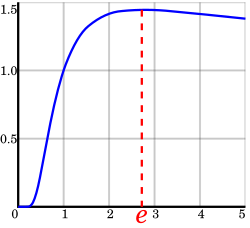
| ค่าสูงสุดทั่วโลกที่ไม่ซ้ำกันอยู่ที่x = e (ดูรูปด้านขวา) (ดูโจทย์แคลคูลัสของสไตเนอร์ ด้วย ) | |
| x − x | ค่าสูงสุดทั่วโลกที่ไม่ซ้ำกันเหนือจำนวนจริงบวกที่x = 1/ e |
| x 3 /3 − x | อนุพันธ์อันดับแรกคือx² - 1 และอนุพันธ์อันดับสองคือ 2xเมื่อกำหนดให้อนุพันธ์อันดับแรกเท่ากับ 0 แล้วแก้หาค่าxจะได้จุดวิเคราะห์ที่ −1 และ +1 จากเครื่องหมายของอนุพันธ์อันดับสอง เราจะเห็นว่า −1 เป็นค่าสูงสุดเฉพาะที่ และ +1 เป็นค่าต่ำสุดเฉพาะที่ ฟังก์ชันนี้ไม่มีค่าสูงสุดหรือต่ำสุดโดยรวม |
| | x | | Global minimum at x = 0 that cannot be found by taking derivatives, because the derivative does not exist at x = 0. |
| cos(x) | Infinitely many global maxima at 0, ±2π, ±4π, ..., and infinitely many global minima at ±π, ±3π, ±5π, .... |
| 2 cos(x) − x | Infinitely many local maxima and minima, but no global maximum or minimum. |
| cos(3πx)/x with 0.1 ≤ x ≤ 1.1 | Global maximum at x = 0.1 (a boundary), a global minimum near x = 0.3, a local maximum near x = 0.6, and a local minimum near x = 1.0. (See figure at top of page.) |
| x3 + 3x2 − 2x + 1 defined over the closed interval (segment) [−4,2] | Local maximum at x = −1−√15/3, local minimum at x = −1+√15/3, global maximum at x = 2 and global minimum at x = −4. |
![{\displaystyle {\sqrt[{x}]{x}}}](https://wikimedia.org/api/rest_v1/media/math/render/svg/61b4a0a76158849854a302fc639dfc882ec16008)
For a practical example,[6] assume a situation where someone has feet of fencing and is trying to maximize the square footage of a rectangular enclosure, where is the length, is the width, and is the area:




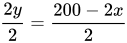


The derivative with respect to is:
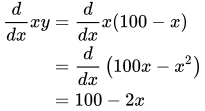
Setting this equal to




reveals that is our only critical point. Now retrieve the endpoints by determining the interval to which is restricted. Since width is positive, then , and since , that implies that . Plug in critical point , as well as endpoints and , into , and the results are and respectively.


Therefore, the greatest area attainable with a rectangle of feet of fencing is .[6]

Functions of more than one variable

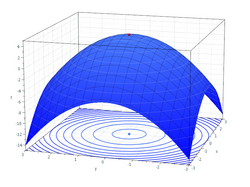
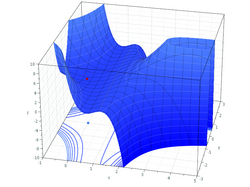
For functions of more than one variable, similar conditions apply. For example, in the (enlargeable) figure on the right, the necessary conditions for a local maximum are similar to those of a function with only one variable. The first partial derivatives as to z (the variable to be maximized) are zero at the maximum (the glowing dot on top in the figure). The second partial derivatives are negative. These are only necessary, not sufficient, conditions for a local maximum, because of the possibility of a saddle point. For use of these conditions to solve for a maximum, the function z must also be differentiable throughout. The second partial derivative test can help classify the point as a relative maximum or relative minimum. In contrast, there are substantial differences between functions of one variable and functions of more than one variable in the identification of global extrema. For example, if a bounded differentiable function f defined on a closed interval in the real line has a single critical point, which is a local minimum, then it is also a global minimum (use the intermediate value theorem and Rolle's theorem to prove this by contradiction). In two and more dimensions, this argument fails. This is illustrated by the function

whose only critical point is at (0,0), which is a local minimum with f(0,0) = 0. However, it cannot be a global one, because f(2,3) = −5.
Maxima or minima of a functional
If the domain of a function for which an extremum is to be found consists itself of functions (i.e. if an extremum is to be found of a functional), then the extremum is found using the calculus of variations.
In relation to sets
Maxima and minima can also be defined for sets. In general, if an ordered setS has a greatest elementm, then m is a maximal element of the set, also denoted as นอกจากนี้ ถ้าSเป็นเซตย่อยของเซตที่มีลำดับTและmเป็นสมาชิกที่ใหญ่ที่สุดของS (โดยสัมพันธ์กับลำดับที่กำหนดโดยT ) แล้วmจะเป็นขอบเขตบนที่น้อยที่สุดของSในTผลลัพธ์ที่คล้ายกันนี้ใช้ได้กับสมาชิกที่น้อยที่สุดสมาชิกที่น้อยที่สุดและขอบเขตล่างที่มากที่สุดฟังก์ชันค่าสูงสุดและค่าต่ำสุดสำหรับเซตถูกใช้ในฐานข้อมูลและสามารถคำนวณได้อย่างรวดเร็ว เนื่องจากค่าสูงสุด (หรือค่าต่ำสุด) ของเซตสามารถคำนวณได้จากค่าสูงสุดของพาร์ติชัน กล่าวคือ ฟังก์ชันเหล่านี้เป็นฟังก์ชันการรวมที่สามารถแยกส่วนได้ด้วย ตนเอง

ในกรณีของลำดับบางส่วน ทั่วไป สมาชิกที่เล็กที่สุด (กล่าวคือ สมาชิกที่น้อยกว่าสมาชิกอื่นๆ ทั้งหมด) ไม่ควรสับสนกับสมาชิกที่เล็กที่สุด (ไม่มีสมาชิกใดเล็กกว่า) ในทำนองเดียวกันสมาชิกที่ใหญ่ที่สุดของเซตที่มีลำดับบางส่วน (poset) คือขอบเขตบนของเซตซึ่งบรรจุอยู่ภายในเซตนั้น ในขณะที่สมาชิกสูงสุดmของ poset AคือสมาชิกของAที่ถ้าm ≤ b (สำหรับb ใดๆ ในA ) แล้วm = bสมาชิกที่เล็กที่สุดหรือสมาชิกที่ใหญ่ที่สุดของ poset นั้นมีเอกลักษณ์เฉพาะ แต่ poset สามารถมีสมาชิกที่เล็กที่สุดหรือสมาชิกสูงสุดได้หลายตัว หาก poset มีสมาชิกสูงสุดมากกว่าหนึ่งตัว สมาชิกเหล่านั้นจะไม่สามารถเปรียบเทียบกันได้
ใน เซต ที่มีลำดับสมบูรณ์หรือลำดับ ต่อเนื่อง นั้น สมาชิกทุกตัวสามารถเปรียบเทียบกันได้ ดังนั้นเซตดังกล่าวจะมีสมาชิกที่เล็กที่สุดได้มากที่สุดหนึ่งตัว และสมาชิกที่ใหญ่ที่สุดได้มากที่สุดหนึ่งตัว เนื่องจากการเปรียบเทียบกันได้ สมาชิกที่เล็กที่สุดจึงจะเป็นสมาชิกที่น้อยที่สุด และสมาชิกที่ใหญ่ที่สุดก็จะเป็นสมาชิกที่มากที่สุดเช่นกัน ดังนั้นในเซตที่มีลำดับสมบูรณ์ เราจึงสามารถใช้คำว่าเล็กที่สุดและใหญ่ที่สุด ได้โดยตรง
ถ้าสายโซ่จำกัด จะมีค่าสูงสุดและค่าต่ำสุดเสมอ แต่ถ้าสายโซ่ไม่จำกัด อาจไม่มีค่าสูงสุดหรือค่าต่ำสุดก็ได้ ตัวอย่างเช่น เซตของจำนวนธรรมชาติไม่มีค่าสูงสุด แต่มีค่าต่ำสุด ถ้าสายโซ่ไม่จำกัดSมีขอบเขตส่วนปิดCl ( S ) ของเซตนั้น อาจมีค่าต่ำสุดและค่าสูงสุด ซึ่งในกรณีนี้เรียกว่าขอบเขตล่างที่มากที่สุดและขอบเขตบนที่น้อยที่สุดของเซตSตามลำดับ
อาร์กิวเมนต์ของค่าสูงสุด
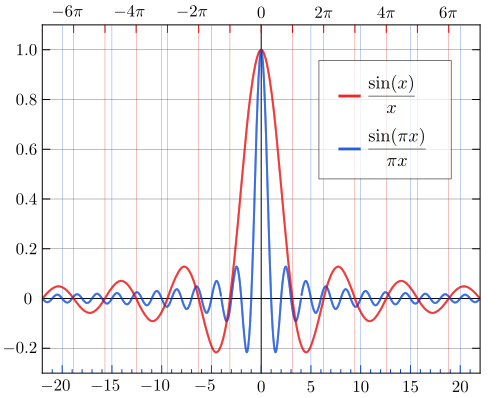

In mathematics, the arguments of the maxima (abbreviated arg max or argmax) and arguments of the minima (abbreviated arg min or argmin) are the input points at which a function output value is maximized and minimized, respectively.[8] While the arguments are defined over the domain of a function, the output is part of its codomain.
See also
Notes
External links


- Thomas Simpson's work on Maxima and Minima at Convergence
- Application of Maxima and Minima with sub pages of solved problems
- Jolliffe, Arthur Ernest (1911). . Encyclopædia Britannica. Vol. 17 (11th ed.). pp. 918–920.