
Acylium ions
In organic chemistry, acylium ions are cations with the formula RCO+, where R = alkyl or aryl.[1] They are a kind of carbocation.
Structure, bonding, synthesis
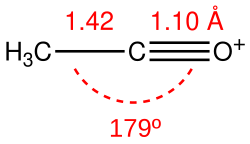
In acylium ions, the C-C-O linkage is linear. The oxygen and the central carbon can be described as sp hybridized. A triple bond exists between C and O.[3] Acylium ions can be viewed as C-alkylated derivatives of carbon monoxide (which also has a C-O triple bond). They are typically prepared by removal of chloride from acyl chlorides using strong Lewis acids such as antimony pentachloride.
Several acylium salts have been characterized by X-ray crystallography, including the propionyl and mesityl derivatives. Because acylium cation is highly electrophilic, its salts can only be isolated with weakly coordinating anions.[2]
- CHCOCl + GaCl → CHCO+ + GaCl−4
Acetyl hexafluoroantimonate and hexachloroantimonate are other early examples.[4][5]
The strength of the C≡O bond is indicated by the frequency of its vibration (ν). These values are 2300 and 2200 cm−1, respectively for the aryl and alkyl acylium ions. For comparison, the same vibration for carbon monoxide is 2143 cm−1.[2]
Reactivity
Acylium ions are potent electrophiles as evidenced by their ability to attack arenes. Acylium ions are intermediates in several reactions, such as the Friedel-Crafts acylation of arenes by acetyl chloride in the presence of aluminium trichloride:
- CHR + CHCO+ + AlCl−4 → CHCOCHR + HCl + AlCl
Such depictions may be simplistic because of ion-pairing between the acetyl cation (an acylium cation) and the tetrachloroaluminate.
The acylium ion derived from pivaloyl chloride is unusual because it exists in equilibrium with the tert-butyl cation:
- (CH)CCO+ ⇌ (CH)C+ + CO
Likewise 1-adamantylcarbonylium decomposes to 1-adamantanium and carbon monoxide.[6]
Central to the Koch carbonylation is the hydrolysis of acylium ions to carboxylic acids:
- RCCO+ + HO → RCCOH + H+