
Aztekium ritteri
Aztekium ritteri is a species of cactus native to the Mexican state of Nuevo León.[3]
Description
Aztekium ritteri initially grows singly globe-shaped, flattened stem, 2-6 cm in diameter and 3 cm high, with grayish green to olive-green, almost spherical to spherical bodies, somewhat sunken apex, which later sprout and form clumps. Ribs 6 to 11, to 9 millimeters high and 3 to 10 millimeters wide, with numerous triangular tubercles very compressed from top to bottom. Between the grooves that separate one rib from another, the bases of these tubercles, by lateral compression, form folds that look like narrower secondary ribs. Triangular tubercles. Areoles very close, with some felt, the apical ones very woolly. Spines 1 to 3 per areola, only on young areolas, 3 to 4 mm long, flattened, soft, non-pungent, whitish and somewhat curved.
Aztekium ritteri blooms throughout the summer, from the young areoles at the apex, producing an abundance of white and pink flowers measuring less than 10 mm in diameter. The main pollinators are likely bees native to the same area of Mexico. The white flowers have a more or less pink central stripe and reach a diameter of 7 to 14 millimeters . These flowers are followed by small pink fruit that open when ripe and release tiny black seeds. Fruit small, pink almost white, membranous; It is included in the wool at the apex, where it bursts. Seeds pyriform, 0.5 mm long, with thickly tuberculated, black testa; broad basal thread, with very large arils.[4]
There are usually two blooms each year, the first taking place in early summer and the other in midsummer (August in the Northern Hemisphere).
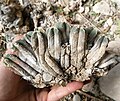 Plant side view
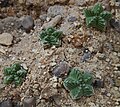 Plant
Plant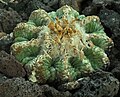 Plant top
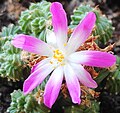 Flower
Distribution
It is a cactus endemic to the Sierra Madre Oriental, in the state of Nuevo León, Mexico. It is distributed in the Rayones valley, between 850 and 1,045 m above sea level. It is located on Jurassic gypsum, middle and lower Cretaceous limestone, as well as Tertiary conglomerates. Plants grow with associated with Selaginella sp., there is an important relationship between Aztekium ritteri and Selaginella lepidophylla, which most likely plays a predominant role in promoting the germination of its tiny seeds. Where the average annual precipitation ranges between 300 and 800 mm. The types of vegetation surrounding their populations are submontane scrub (or subinermet scrub) and rosetophilous desert scrub. The habitat of this species is characterized by having slopes of nearly 90 degrees, in areas occupied by intermittent streams.
พืชชนิดนี้ไวต่อความเย็น ไม่ทนต่อน้ำค้างแข็ง เมื่อปลูกเลี้ยงจะขยายพันธุ์ด้วยเมล็ด การเจริญเติบโตช้ามาก จึงมักใช้วิธีการต่อกิ่งเพื่อเร่งการเจริญเติบโตเต็มที่ ปริมาณน้ำที่รดน้อยกว่าแคคตัสทั่วไป รดน้ำเฉพาะในสภาพอากาศอบอุ่นเท่านั้น
กระบองเพชรชนิดอื่นๆ ที่พบในถิ่นที่อยู่เดียวกับสายพันธุ์นี้ ได้แก่Neolloydia conoidea , Mammillaria candida , Mammillaria pilispina , Epithelantha micromeris , Opuntia stenopetala , Opuntia stricta , Thelocactus buekii ssp. matudae , Echinocereus viereckii ssp. huastescensis , Echinocereus pentalophus ssp. leonensisและอื่นๆ
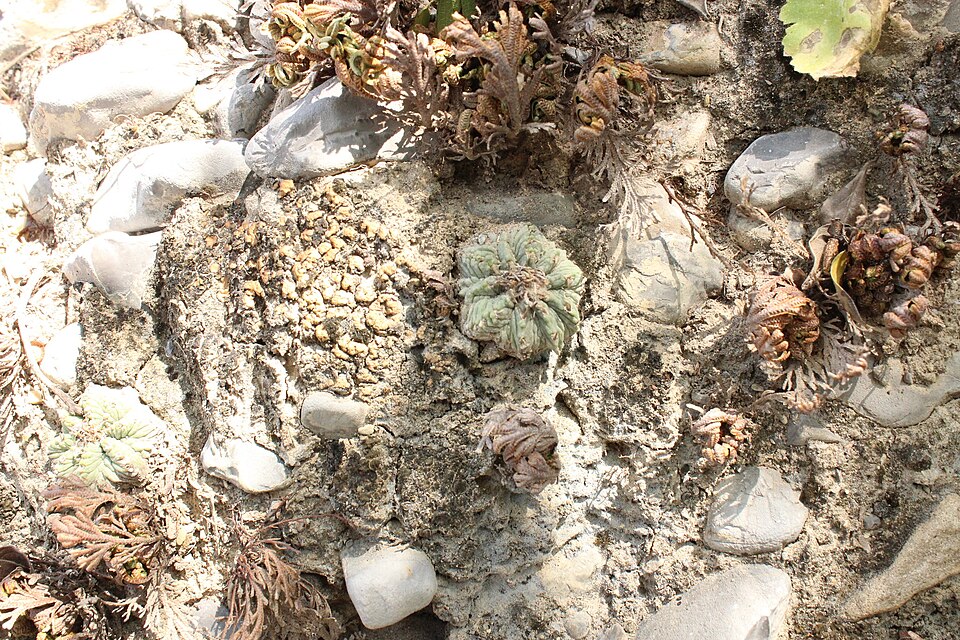 ที่อยู่อาศัยใน Ignacio Zaragoza, Nuevo Leon, เม็กซิโก
 พืชที่ปลูกในJosé María Morelos, Nuevo Leon, เม็กซิโก
อนุกรมวิธาน
คำอธิบายแรกในชื่อEchinocactus ritteriโดยFriedrich Bödekerได้รับการตีพิมพ์ในปี พ.ศ. 2461 [ 5 ]หนึ่งปีต่อมา Bödeker ได้จัดให้อยู่ในสกุลAztekiumซึ่งเขาเพิ่งตั้งขึ้นใหม่[ 6 ]
การใช้งาน
ในเม็กซิโก บางครั้ง Aztekium ritteriถูกเรียกว่า “peyotillo” อย่างไรก็ตาม ชื่อนี้อาจตั้งให้กับพืชชนิดนี้ไม่ใช่เพราะคุณสมบัติทางจิตประสาท แต่เป็นเพราะความคล้ายคลึงกับเปโยเต้ ( Lophophora williamsii ) ที่มีลักษณะเป็นปุ่ม แม้ว่าจะมีสารประกอบ N -methyltyramine , hordenine , anhalidine , mescaline , pellotineและ3-methoxytyramine อยู่ก็ตาม แต่ก็ไม่มีรายงานทางด้านพฤกษศาสตร์พื้นบ้านใดที่ระบุว่าชนพื้นเมืองในพื้นที่นั้นเคยใช้พืชชนิดนี้มาก่อน
ลิงก์ภายนอก
 สื่อที่เกี่ยวข้องกับAztekium ritteriใน Wikimedia Commons
 ข้อมูลที่เกี่ยวข้องกับAztekium ritteriใน Wikispecies