
Bandenbekämpfung
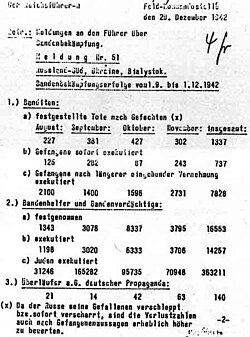
In German military history, Bandenbekämpfung (lit.'"bandit-fighting" or "combating of bandits"; English equivalent of "anti-partisan operations"'), also referred to as Nazi security warfare during World War II, refers to the concept and military doctrine of counteringresistance or insurrection in the rear area during wartime with extreme brutality. The doctrine provided a rationale for disregarding the established laws of war and for targeting any number of groups, from armed guerrillas to civilians, as "bandits" or "members of gangs". As applied by the German Empire and later Nazi Germany, it became instrumental in the crimes against humanity committed by the two regimes, including the Herero and Nama genocide and the Holocaust.
Historian Alex J. Kay estimates that around one million civilians died as a result of German anti-partisan warfare—excluding actual partisans—among the 13 to 14 million people murdered by the Nazis during World War II.[1]
Background
ตามที่นักประวัติศาสตร์และผู้ผลิตสารคดีโทรทัศน์ คริสโตเฟอร์ เฮล กล่าว มีข้อบ่งชี้ว่าคำว่าBandenbekämpfungอาจมีมาตั้งแต่สมัยสงครามสามสิบปี[ 2 ]พลเรือนและเจ้าหน้าที่ทหารในปรัสเซียระหว่างการรณรงค์ของนโปเลียนเองก็คุ้นเคยกับการปฏิบัติการรบแบบ "กองโจร" เนื่องจากจอมพลออกัสต์ ไนดฮาร์ดต์ ฟอน กไนเซเนาและนักทฤษฎีการทหารคาร์ล ฟอน คลอเซวิตซ์สนับสนุนการต่อต้านของพลเรือนจำนวนมาก และสั่งให้กองกำลังแลนด์สตูร์มโจมตีด้านหลังของศัตรูฝรั่งเศส ขัดขวางการเคลื่อนไหว และตัดเส้นทางส่งเสบียงเพื่อระดมพล[ 3 ]ต่อมาชาวปรัสเซียเรียกพฤติกรรมเดียวกันนี้ว่า "การปล้นสะดม" เมื่อฝรั่งเศสนำมาใช้กับกองกำลังปรัสเซียในปี 1870 [ 4 ]สำหรับชาวปรัสเซีย ความชอบธรรมของการต่อต้านแบบไม่เป็นทางการนั้นเห็นได้ชัดว่าไม่ได้ขึ้นอยู่กับลักษณะของมัน แต่ขึ้นอยู่กับว่ามันถูกคุกคามโดยกองทัพใด[ 4 ]
ภายใต้จักรวรรดิเยอรมันที่ก่อตั้งโดยออตโต ฟอน บิสมาร์คในปี 1871 หลังสงครามฝรั่งเศส - ปรัสเซีย ซึ่งก่อตั้งขึ้นเป็นสหภาพของรัฐเยอรมัน 25 รัฐภายใต้ กษัตริย์โฮเฮนโซลเลิร์น แห่งปรัสเซีย ลัทธิทหารนิยมของปรัสเซียเฟื่องฟู ประเพณีการทหารซึ่งรวมถึงหลักคำสอนทางทหารของ บทความ สรุปศิลปะแห่งสงครามของอองตวน-อองรี โจมินี ในปี 1837 ได้ถูกนำมาใช้[ 5 ]ทฤษฎีบางส่วนที่โจมินีวางไว้ประกอบด้วยคำแนะนำสำหรับปฏิบัติการโจมตีอย่างเข้มข้นและความจำเป็นในการรักษา "แนวปฏิบัติการ" ของตน[ 5 ]เจ้าหน้าที่ทหารเยอรมันตีความสิ่งนี้ว่าควรให้ความสนใจกับปฏิบัติการด้านโลจิสติกส์ที่ใช้ในการทำสงครามในแนวหลังมากพอๆ กับในแนวหน้า และแน่นอนว่ารวมถึงปฏิบัติการรักษาความปลอดภัยด้วย[ 5 ]ตามรอยของ Jomini พันโท Albrecht von Boguslawski ได้ตีพิมพ์บทบรรยายชื่อDer Kleine Krieg ("สงครามเล็ก" ซึ่งเป็นการแปลตรงตัวของคำว่ากองโจร ) ซึ่งได้อธิบายรายละเอียดเกี่ยวกับขั้นตอนทางยุทธวิธีที่เกี่ยวข้องกับสงครามกองโจรและสงครามต่อต้านกองโจร—ซึ่งน่าจะเขียนขึ้นโดยเจตนาโดยไม่มีการแบ่งแยกที่ชัดเจนระหว่างนักรบและผู้ที่ไม่ใช่นักรบ[ 6 ]ไม่สามารถทราบได้อย่างแน่ชัดว่าการสอนของนายทหารและนักทฤษฎีชาวปรัสเซียเหล่านี้มีส่วนทำให้สงครามที่ไร้ขอบเขตทวีความรุนแรงขึ้นมากน้อยเพียงใด แต่นายทหารอย่างAlfred von Schlieffenได้สนับสนุนให้ทหารอาชีพยึดถือหลักการที่ว่า "สำหรับทุกปัญหา มีทางออกทางการทหาร" [ 7 ] Helmuth von Moltke the Elderหัวหน้าเสนาธิการทหารปรัสเซีย ได้เพิ่มการจับตัวประกันเป็นวิธีการป้องปรามในการก่อวินาศกรรมและการใช้มาตรการร่วมกันต่อชุมชนทั้งหมด ซึ่งกลายเป็นพื้นฐานของนโยบายต่อต้านพรรคพวกของเยอรมนีตั้งแต่ปี 1870 และยังคงเป็นเช่นนั้นจนถึงปี 1945 [ 8 ]
สงครามฝรั่งเศส-ปรัสเซีย
Prussian security operations during the Franco-Prussian War included the use of Landwehr reservists, whose duties ranged from guarding railroad lines, to taking hostages, and carrying out reprisals to deter activities of francs-tireurs.[9] Bismarck wanted all francs-tireurs hanged or shot, and encouraged his military commanders to burn down villages that housed them.[10][a] More formal structures like Chief of the Field Railway, a Military Railway Corps, District Commanders, Special Military Courts, intelligence units, and military police of varying duties and nomenclature were integrated into the Prussian system to bolster security operations all along the military's operational lines.[12]
Boxer Rebellion and Herero Wars
Operationally, the first use of tactics later associated with Bandenbekämpfung occurred in China following the Boxer Rebellion (1899–1901), after two German officers went missing. German troops conducted over fifty operations, including burning a village and taking prisoners. Soon after, the infantry received a handbook for "operations against Chinese bandits" (Banden).[13] Inside a German military manual from 1902, one finds the characterization of mass shootings as a "humane" act, since such expedients allegedly shortened wars and reduced German casualties.[14] The first full application of Bandenbekämpfung in practice, was the Herero and Nama genocide (1904–1908), a campaign of racial extermination and collective punishment that the German Empire undertook in German South West Africa (modern-day Namibia) against the Herero and Nama people.[15] The genocidal campaign against the Herero people was so extreme that an estimated 66–75 percent of the population perished.[16]
World War I

During World War I, the Imperial German Army ignored many of the commonly-understood European conventions of war when between August and October 1914,[b] they murdered some 6,500 French and Belgian citizens.[17][c] In 1914, German troops, outraged by alleged civilian "resistance", responded with mass reprisals. Though some incidents stemmed from panic, many were the result of explicit orders. Soldiers even admitted to killing civilians—including women and children—based on vague suspicions of gunfire.[19] On some occasions, attacks against German infantry positions and patrols that may have actually been attributable to "friendly fire" were blamed on potential francs-tireurs, who were regarded as bandits and outside the rules of war, eliciting ruthless measures by German forces against civilians and villages suspected of harboring them.[20] These German units "had received orders to show no mercy" and as a result laid waste to towns such as Andenne, Dinant, Tamines, Aarschot, and Rossignol.[21]
Throughout the war, Germany's integrated intelligence, perimeter police, guard network, and border control measures coalesced to define the German military's security operations.[22] Along the Eastern Front sometime in August 1915, Field Marshal Erich von Falkenhayn established the Government General of Warsaw over former Congress Poland under General Hans von Beseler and created an infrastructure to support ongoing military operations, including guard posts, patrols, and a security network. Maintaining security meant dealing with Russian prisoners, many of whom tried to sabotage German plans and kill German soldiers, so harsh pacification measures and terror actions were carried out, including brutal reprisals against civilians, who were subsequently labeled as bandits.[23] Before long, similar practices were instituted throughout the Eastern and Western areas of German occupied territory.[24] Repression intensified under Ludendorff and Hindenburg’s “silent dictatorship” beginning in 1916; they interpreted Clausewitz as justifying total subjugation of enemy nations.[25]
World War II
ในช่วงสงครามโลกครั้งที่สอง นโยบาย ของกองทัพเยอรมันในการยับยั้งกิจกรรมของกองกำลังพลพรรคหรือ "โจร" ต่อกองกำลังของตนคือการ "สร้างความหวาดกลัวให้กับประชาชนจนหมดสิ้นความตั้งใจที่จะต่อต้าน" [ 26 ]แม้กระทั่งก่อนที่การรณรงค์ของนาซีในภาคตะวันออกจะเริ่มต้นขึ้น อดอล์ฟ ฮิตเลอร์ก็ได้ยกเว้นความรับผิดชอบของทหารและตำรวจของเขาต่อการกระทำที่โหดร้ายต่อพลเรือน โดยคาดหวังให้พวกเขาฆ่าทุกคนที่แม้แต่ "มองอย่างดูถูก" กองกำลังเยอรมัน[ 26 ]สงครามของกองกำลังพลพรรคส่วนใหญ่กลายเป็นการแสดงออกถึงการต่อต้านชาวยิว ดังที่ผู้บัญชาการทหารอย่างนายพลแอนตัน ฟอน เบชโทลส์ไฮม์กล่าวว่าเมื่อใดก็ตามที่มีการก่อวินาศกรรมและมีการฆ่าชาวยิวจากหมู่บ้านนั้น "เราสามารถมั่นใจได้ว่าเราได้ทำลายผู้กระทำความผิด หรืออย่างน้อยก็ผู้ที่อยู่เบื้องหลังพวกเขา" [ 26 ] [ d ]นักประวัติศาสตร์ Jonathan Dimbleby โต้แย้งว่าสมาชิกของกองพลทหารราบที่ 707 ปฏิบัติการตามหลักคำสอนที่ชัดเจนว่า "โดยไม่มีข้อยกเว้นแม้แต่น้อย ชาวยิวและพลพรรคถือเป็นแนวคิดเดียวกัน" และด้วยเหตุนี้จึงต้องถูกประหารชีวิตโดยไม่แยกแยะ[ 28 ]ผู้บัญชาการEinsatzgruppe B , Arthur Nebeแสดงความคิดเห็นที่คล้ายกันเมื่อเขากล่าวว่า "ที่ใดมีพลพรรค ที่นั่นก็มีชาวยิว และที่ใดมีชาวยิว ที่นั่นก็มีพลพรรค" [ 29 ]
หลังจากการรุกรานโปแลนด์ของ นาซี ในปี 1939 และการจัดระเบียบใหม่ หน่วยงานรักษาความปลอดภัยและตำรวจได้รวมเข้ากับการจัดตั้งปฏิบัติการBandenbekämpfung [ 30 ]นอกเหนือจากกลุ่มที่ได้รับมอบหมายให้ต่อสู้กับกองกำลังพลพรรคแล้ว ยังมีกำลังคนเพิ่มเติมจากเกสตาโปคริปโป (ตำรวจอาชญากรรม) เอสดีและวาฟเฟน-เอสเอส [ 31 ] มีการปฏิบัติการที่นำโดยเอสเอสหลายครั้งเพื่อต่อต้านสิ่งที่เรียกว่า "กองกำลังพลพรรค" ในเลมเบิร์กวอร์ซอลูบลินโคเวลและสถานที่อื่นๆ ทั่วโปแลนด์[ 32 ]แต่ไม่ใช่แค่เอสเอสเท่านั้น แต่เวร์มัคท์ก็ดำเนินการดังกล่าว ด้วยเช่นกัน ตัวอย่างเช่น ในเมือง Częstochowa ของโปแลนด์ (ซึ่งตกอยู่ภายใต้การยึดครองโดยไม่มีการต่อสู้ในวันที่ 3 กันยายน พ.ศ. 2482) ทหารเยอรมันได้เผาร้านค้าและบ้านเรือนอย่างไม่เลือกปฏิบัติ รวบรวมพลเมืองประมาณ 10,000 คน บังคับให้พวกเขานอนคว่ำหน้าในจัตุรัสหลักหน้ามหาวิหาร และยิงชายใดก็ตามที่พบว่าพกอาวุธปืน มีดโกน หรือมีดพกทันที มีผู้เสียชีวิตหลายร้อยคนในสิ่งที่กองทัพเยอรมันกำหนดอย่างเป็นทางการว่าเป็นปฏิบัติการ "ต่อต้านกองโจร" [ 33 ]
เมื่อกองทัพเวห์มาคท์เข้าสู่เซอร์เบียในปี 1941พวกเขาได้ทำการตอบโต้ครั้งใหญ่ต่อผู้ที่ถูกกล่าวหาว่าเป็น "กองโจร" โดยการประหารชีวิตชาวยิวที่นั่น[ 34 ] พลเอก ฟรานซ์ เบอห์เมอผู้บัญชาการที่รับผิดชอบในการต่อต้านสงครามกองโจรในปี 1941 ได้ย้ำกับกองกำลังเยอรมันว่า "เลือดของชาวเยอรมันจำนวนมาก" ได้หลั่งไหลในเซอร์เบียระหว่างสงครามโลกครั้งที่หนึ่ง และกองทัพเวห์มาคท์ควรพิจารณาการกระทำรุนแรงใดๆ ที่นั่นว่าเป็นการ "แก้แค้นให้กับการตายเหล่านี้" [ 35 ]เบอห์เมอยังได้สั่งการลูกน้องของเขาเกี่ยวกับกิจกรรมของกองโจรว่า "...ในกรณีที่มีการโจมตีทหารเยอรมันหรือชาวเยอรมันเชื้อสายเยอรมัน ตัวประกันจะถูกยิง...สำหรับชาวเยอรมันที่ถูกฆ่าทุกๆ คน ตัวประกัน 100 คนจะถูกยิง สำหรับชาวเยอรมันที่ได้รับบาดเจ็บทุกๆ คน 50 คนจะถูกยิง การประหารชีวิตจะต้องดำเนินการโดยกองทหาร หากเป็นไปได้โดยหน่วยที่ได้รับผลกระทบจากการโจมตี" [ 36 ]บ่อยครั้งที่วิธีการประหารชีวิตจะถูกปรับเปลี่ยน (บางวิธีโหดร้ายกว่าวิธีอื่น) เพื่อเสริมสร้างผลกระทบทางจิตวิทยาของการลงโทษ[ 37 ]

ระหว่างยุทธการที่เกาะครีต (พฤษภาคม 1941) พลร่ม เยอรมัน เผชิญกับการต่อต้านอย่างกว้างขวางจากประชาชนพลเรือน การต่อต้านนี้ทำให้พลเอกเคิร์ต สตูเดนต์ผู้บัญชาการกองทัพอากาศที่ XI โกรธแค้น และสั่งให้ดำเนินการ "ปฏิบัติการแก้แค้น" ซึ่งประกอบด้วย: "1) การยิง 2) การเกณฑ์ทหารโดยบังคับ 3) การเผาหมู่บ้าน และ 4) การกำจัดประชากรชายทั้งหมดในภูมิภาค" [ 38 ]พลเอกสตูเดนต์ยังเรียกร้องให้ "ดำเนินการทุกอย่างด้วยความรวดเร็ว ละทิ้งพิธีการทั้งหมด และแน่นอนว่าไม่ต้องมีศาลพิเศษ" [ 38 ]สิ่งนี้ส่งผลให้เกิดการลงโทษหมู่ต่อพลเรือนในKandanos , KondomariและAlikianosทันทีหลังจากที่เกาะครีตตกอยู่ภายใต้การยึดครอง ระหว่างการยึดครองกรีซของฝ่ายอักษะการเกิดขึ้นของการต่อต้าน ด้วยอาวุธ ตั้งแต่ปี 1942 เป็นต้นมา ก่อให้เกิดการตอบโต้ครั้งใหญ่ในสถานที่ต่างๆ เช่นViannos , Kedros , Mousiotitsa , Kommeno , Lingiades , Kalavryta , Drakeia , Distomo , Mesovouno , Pyrgoi , KaisarianiและChortiatisรวมถึงเหตุการณ์อื่นๆ อีกมากมายในขนาดเล็กกว่า[ 39 ]นายพลที่มีหน่วยก่ออาชญากรรมสงครามภายใต้หน้ากากของBandenbekämpfungได้แก่Walter Stettnerผู้บัญชาการกองพลภูเขาที่ 1ในEpirus [ 40 ]และFriedrich-Wilhelm Müllerผู้บัญชาการกองพลจู่โจมทางอากาศที่ 22 ในเกาะครีต[ 41 ]
Before invading the Soviet Union for Operation Barbarossa, Reichsführer-SSHeinrich Himmler, and Chief of the SD Reinhard Heydrich, as well as SS General Heinrich Müller briefed the Einsatzgruppen leaders of their responsibility to secure the rear areas—using the euphemism "special treatment"—against potential enemies; this included partisans and anyone deemed a threat by the Nazi functionaries.[42][e] When Heydrich repeated this directive as an operational order (Einsatzbefehl), he stressed that this also meant functionaries of the Comintern, Jews, and anyone of position in the communist party. This was part of the SS contribution to prevent acts they considered to be criminal in the newly conquered territories, to maintain control, and to effect the efficient establishment of miniature Nazi governments, constituted by mobile versions of the Reich Security Main Office.[42]


Starting the same day Germany invaded the Soviet Union (22 June 1941), the 12th Infantry Division command issued orders that guerilla warfare combatants were not to be quartered as POWs but were to be "sentenced on the spot by an officer", meaning they were to be summarily shot.[44] To this end, the Nazis welcomed partisan warfare since in the mind of Hitler, such circumstances opened up "the possibility of annihilating all opposition".[45][46]
เมื่อวันที่ 31 กรกฎาคม พ.ศ. 2484 กองบัญชาการ กองทัพที่ 16ได้รับแจ้งว่า "กองพันพลพรรค" ใดๆ ที่จัดตั้งขึ้นหลังแนวรบซึ่งไม่ได้สวมเครื่องแบบอย่างถูกต้องและไม่มีวิธีการระบุตัวตนที่เหมาะสม "จะต้องได้รับการปฏิบัติเหมือนกองโจร ไม่ว่าพวกเขาจะเป็นทหารหรือไม่ก็ตาม" [ 44 ]จอมพลและผู้บัญชาการสูงสุดของกองทัพ เยอรมัน วิลเฮล์ม ไคเทลยืนยัน—ในบริบทของการขาดแคลนกำลังคน—ถึง "การปกครองด้วยความหวาดกลัวเพื่อยับยั้งไม่ให้ประชาชนต่อต้านการปกครองของเยอรมัน" [ 46 ]พลเรือนที่ให้ความช่วยเหลือใดๆ แก่พลพรรคจะต้องได้รับการจัดการตามนั้น ซึ่งนักประวัติศาสตร์โอเมอร์ บาร์ตอฟอ้างว่า "หมายถึงสิ่งเดียวเท่านั้นเสมอ: ความตายด้วยการยิงหรือแขวนคอ" [ 44 ]สมาชิกของกองพลยานเกราะที่ 18ได้รับคำสั่งเช่นเดียวกันในวันที่ 4 สิงหาคม พ.ศ. 2484 [ 44 ] พลเอกGotthard Heinrici แห่งกองทัพเยอรมันนำตรรกะเดียวกันนี้มาใช้ในการปฏิบัติการต่อต้านกองโจร โดยตัดสินว่าชาวบ้านที่ไม่ทรยศกองโจรที่ซ่อนตัวอยู่ได้สูญเสียสิทธิในการอ้างว่าบริสุทธิ์ ซึ่งเป็นความสะดวกสบายที่ทหารที่เหนื่อยล้าและหมดกำลังใจไม่เต็มใจที่จะตรวจสอบอย่างละเอียด[ 47 ]ผู้แจ้งข่าวเป็นตัวขับเคลื่อนกระบวนการ: ในปฏิบัติการหนึ่ง ข้อมูลข่าวกรองจากล่ามเพียงคนเดียวทำให้มีการจับกุมกองโจร 15 คน ทั้งชายและหญิง ที่ปฏิเสธที่จะให้ความร่วมมือระหว่างการสอบสวนและถูกยิงเสียชีวิต ในอีกปฏิบัติการหนึ่ง เจ้าหน้าที่ระบุตัวทหารกองทัพแดง 40 นายจากผู้ต้องสงสัย 60 คน แขวนคอคนหนึ่งด้วยตนเองในใจกลางเมือง และ "สังหาร" อีก 20 นาย ซึ่ง Heinrici บันทึกการสังหารเหล่านี้ด้วยความพึงพอใจ ข้อโต้แย้งเพียงอย่างเดียวของเขาคือการประหารชีวิตที่ดำเนินการภายในระยะ 100 เมตรจากหน้าต่างของเขาทำให้เป็นภาพที่ไม่น่าดูในตอนเช้า[ 47 ]
Nearly always, the Nazis' genocidal measures were "camouflaged" in reports by coded formalised language, using terms like Aktion, Sonderbehandlung (special handling), or Umsiedlung (relocated).[48] From September 1941 onwards through the course of World War II, the term Bandenbekämpfung also supplanted Partisanenkämpfung (anti-partisan warfare) to become the guiding principle of Nazi Germany's security warfare and occupational policies; largely as a result of Himmler's insistence that for psychological reasons, bandit was somehow preferable.[49] Himmler charged the "Prinz Eugen" Division to expressly deal with "partisan revolts".[50] Units like the SS Galizien—who were likewise tasked to deal with partisans—included foreign recruits overseen by experienced German "bandit" fighters well-versed in the "mass murder of unarmed civilians".[51]
In keeping with these extreme measures, the OKW issued orders on 13 September 1941, that "Russian soldiers who had been overrun by the German forces and had then reorganised behind the front were to be treated as partisans—that is, to be shot. It was left to the commanders on the spot to decide who belonged to this category."[52] In late 1941, German security divisions, including the 707th, 286th, 403rd, and 221st, conducted operations in Belarus that resulted in the execution of thousands of civilians, predominantly Jews. Between 11 October and 11 November 1941, with Order Police assistance, the 707th division itself executed no fewer than 10,431 persons.[28] These actions were officially reported as anti-partisan activities, but the minimal German casualties suggest that these were not genuine combat operations against armed resistance but campaigns of terror.[53] Correspondingly, terror became a deliberate military instrument and had already crystallized by December 1941, indicated by a comment from the operations officer of the 6th Army, who wrote to Army Group South on 7 December that consequent their field experience, they had learned: "Only those measures that frighten the population more than the terror of the partisans lead to results."[14]
Following the murder of upwards of 30,000 Jews during late July 1942 in the Minsk Ghetto[54]—comprised by eastern and German Jews (most of the latter from Hamburg)[55]—Commisar-General Wilhelm Kube, the ranking German official in Minsk, commented that: "The danger of the partisans being able to rely on Jewry in the future will then no longer exist. For me and the SD, it would naturally be most desirable to eliminate Jewry in General Region White Ruthenia altogether—once the Wehrmacht's economic claims have been satisfied."[56][f] Such unrestrained violence by Nazi forces—particularly police commandos—in burning down villages and deporting potential eastern laborers at gunpoint "stoked the Soviet partisan movement" according to historian Jochen Hellbeck.[58] Many local inhabitants began leaving their villages "in droves" to join the resistance movement.[58]
Führer Directive 46


In July 1942, Himmler was appointed to lead the security initiatives in rear areas. One of his first actions in this role was the prohibition of the use of "partisan" to describe counter-insurgents.[59] Bandits (Banden) was the term chosen to be used by German forces.[60] Hitler insisted that Himmler was "solely responsible" for combating bandits except in districts under military administration; such districts were under the authority of the Wehrmacht.[60] The organisational changes, putting experienced SS killers in charge, and language that criminalised resistance, whether real or imagined, presaged the transformation of security warfare into massacres.[61]
การทำให้สงคราม "ต่อต้านโจร" มีความรุนแรงมากขึ้นได้รับแรงผลักดันเพิ่มเติมจาก คำสั่ง ของผู้นำที่ 46เมื่อวันที่ 18 สิงหาคม พ.ศ. 2485 ซึ่งกำหนดเป้าหมายของสงครามรักษาความปลอดภัยไว้ที่ "การกำจัดให้สิ้นซาก" คำสั่งดังกล่าวเรียกร้องให้กองกำลังรักษาความปลอดภัยดำเนินการด้วย "ความโหดร้ายอย่างที่สุด" พร้อมทั้งให้ความคุ้มครองจากการดำเนินคดีสำหรับการกระทำใดๆ ที่เกิดขึ้นระหว่างปฏิบัติการ "ต่อสู้กับโจร" [ 62 ]
คำสั่งดังกล่าวกำหนดให้ SS เป็นองค์กรที่รับผิดชอบสงครามในพื้นที่ด้านหลังในเขตการปกครองพลเรือนในพื้นที่ที่อยู่ภายใต้เขตอำนาจทางทหาร (พื้นที่ด้านหลังของกลุ่มกองทัพ) กองบัญชาการทหารสูงสุดมีความรับผิดชอบโดยรวม คำสั่งดังกล่าวประกาศว่าประชากรทั้งหมดในดินแดนของ "โจร" (เช่น ดินแดนที่อยู่ภายใต้การควบคุมของพรรคพวก) เป็นนักรบฝ่ายศัตรู ในทางปฏิบัติ หมายความว่าเป้าหมายของสงครามความมั่นคงไม่ใช่การทำให้สงบ แต่เป็นการทำลายล้างและการลดจำนวนประชากรในดินแดนของ "โจร" และ "ดินแดนที่ถูกคุกคามจากโจร" อย่างสมบูรณ์ เปลี่ยนให้เป็น "เขตมรณะ" ( Tote Zonen ) [ 62 ]
การเพิ่มความเข้มข้นและการแต่งตั้งกรรมาธิการ
เมื่อวันที่ 23 ตุลาคม พ.ศ. 2485 ฮิมม์เลอร์ได้แต่งตั้งพลเอกเอสเอสเอริช ฟอน เดม บาค-เซเลฟสกีเป็น "ผู้บัญชาการสงครามต่อต้านโจร" [ 63 ]บาค-เซเลฟสกีใช้เวลาไม่นานในการเริ่มปฏิบัติการขนาดใหญ่ที่อุทิศให้กับ "พื้นที่โจร" ด้วยความรุนแรงในระดับที่ไม่เคยมีมาก่อน[ 64 ]จากนั้นฮิมม์เลอร์ได้ย้ายพลเอกเอสเอสเคิร์ต ฟอน ก็อตต์เบิร์ก ไปยังเบลารุสเพื่อให้แน่ใจว่า ปฏิบัติการ Bandenbekämpfungดำเนินการอย่างต่อเนื่อง ซึ่งก็อตต์เบิร์กได้ดำเนินการด้วยความโหดเหี้ยมอย่างบ้าคลั่ง โดยประกาศว่าประชากรทั้งหมดเป็นโจร ชาวยิวยิปซีสายลับ หรือผู้เห็นอกเห็นใจโจร[ 63 ]ในระหว่างปฏิบัติการสำคัญครั้งแรกของ Gottberg คือปฏิบัติการ Nürnberg และ Hamburg ซึ่งดำเนินการระหว่างเดือนพฤศจิกายนถึงธันวาคม พ.ศ. 2485 เขาได้รายงานว่าชาวยิวถูกสังหาร 5,000 คน โจรหรือผู้ต้องสงสัยถูกกำจัดอีก 5,000 คน และหมู่บ้าน 30 แห่งถูกเผาทำลาย[ 65 ]

Also in October 1942—just a couple months prior to Gottberg's exploits—ReichsmarschallHermann Göring had ordered "anti-bandit warfare" in Army Group Rear Area Centre, which was shortly followed by an OKH Directive on 11 November 1942 for "anti-bandit warfare in the East" that announced sentimental considerations as "irresponsible" and instructed the men to shoot or preferably hang bandits, including women.[65] Misgivings from commanders within Army Group Rear that such operations were counterproductive and in poor taste, since women and children were also being murdered, went ignored or resisted from Bach-Zelewski, who frequently "cited the special powers of the Reichsführer."[66] During late November 1942, forty-one "Polish-Jewish bandits" were killed in the forest area of Lubionia, which included "reprisals" against villages in the area.[67] Another action undertaken under the auspices of anti-bandit operations occurred near Lublin in early November 1943; named Aktion Erntefest (Action Harvest Festival), SS-Police, and Waffen-SS units, accompanied by members of the Lublin police, rounded up and killed 42,000 Jews.[68]
Large-scale operations (Grossunternehmen) during 1942–1943 operated under the rhetorical cover of military necessity while functioning in practice as campaigns of plunder and mass murder.[69] Bach-Zelewski's February 1943 guidelines made the economic calculus explicit; he remarked that "every ton of grain, every cow, every horse is worth more than a shot bandit."[70] Agronomists embedded in the battle groups oversaw requisitions, while often determining which villages survived and which were destroyed. The threshold for destruction was quite low as entire villages were wiped out if deemed "bandit-friendly" (bandenfreundlich), a designation requiring no evidentiary standard.[70] Paranoia led to increasingly irrational orders being issued; such proved the case when after coming upon a partisan camp with a large number of bicycles, the commander of the 1st SS Infantry Brigade, Karl von Treuenfeld, directed that "anybody bicycling has to be shot."[70]
Over time, the Wehrmacht acculturated to the large scale anti-bandit operations, as they too came to see the entire population as criminal and complicit in any operation against German troops. Many German Army commanders were unbothered by the fact that these operations fell under the jurisdiction of the SS.[71] Historians Ben Shepherd and Juliette Pattinson note:
As the war dragged on, the occupation's mounting economic rapacity engendered a vicious cycle of further resistance, further German brutality in response, and the erosion of order and stability across occupied Europe. Here, the issue of how occupation strategy shaped the partisan war connects with... how the nature and course of the partisan war was affected by the relationship between the occupied rear and the front line. Indeed, in eastern Europe during World War II, most directly in the Soviet Union, keeping occupied territory pacified was crucial to supplying not just the German front line, but also the German domestic population.[72]
นักประวัติศาสตร์ Jeff Rutherford อ้างว่า "ในขณะที่Wehrmachtมุ่งเน้นไปที่กองทัพแดงหน่วย SD และหน่วย SS อื่นๆ จะต่อสู้กับการเคลื่อนไหวต่อต้านใดๆ ในแนวหลัง ในทางปฏิบัติ กองทัพเยอรมันได้เข้าไปพัวพันกับกลไกการทำลายล้างและการกำจัดของนาซีโดยสมัครใจ โดยร่วมมือกับ SS เพื่อปราบปรามการเคลื่อนไหวของกองโจรและรูปแบบอื่นๆ ของการต่อต้านอย่างเป็นระบบ" [ 73 ]ด้วยเหตุนี้Einsatzgruppen , ตำรวจรักษาความสงบเรียบร้อย , SS-Sonderkommandosและกองกำลังทหารส่วนใหญ่จึงทำงานร่วมกันเพื่อต่อสู้กับกองโจร ("โจร") [ g ]ไม่เพียงแต่ทำหน้าที่เป็นผู้พิพากษา คณะลูกขุน และผู้ประหารชีวิตในสนามรบเท่านั้น แต่ยังรวมถึงการปล้นสะดม "พื้นที่ของโจร" ด้วย พวกเขาทำลายพื้นที่เหล่านี้ ยึดพืชผลและปศุสัตว์ จับประชากรท้องถิ่นเป็นทาส หรือฆ่าพวกเขา[ 75 ]ปฏิบัติการต่อต้านโจรมีลักษณะเฉพาะคือ "ความโหดร้ายเป็นพิเศษ" [ 76 ]ตัวอย่างเช่นชาวยิวโซเวียตถูกสังหารอย่างโหดเหี้ยมภายใต้ข้ออ้างว่าพวกเขาเป็นกองกำลังพลพรรคตามคำสั่งของฮิตเลอร์[ 77 ]นักประวัติศาสตร์Timothy Snyderยืนยันว่าในช่วงครึ่งหลังของปี 1942 “ปฏิบัติการต่อต้านกองกำลังพลพรรคของเยอรมันแทบจะแยกไม่ออกจากสังหารหมู่ชาวยิว” [ 78 ]นักประวัติศาสตร์คนอื่นๆ ก็ได้สังเกตการณ์ในทำนองเดียวกัน Omer Bartov โต้แย้งว่าภายใต้ข้ออ้างในการทำลาย “ศัตรูทางการเมืองและชีวภาพที่เรียกกันว่า” ซึ่งมักถูกอธิบายว่าเป็น “โจร” หรือ “กองกำลังพลพรรค” พวกนาซีไม่ได้พยายาม “ที่จะแยกแยะระหว่างกองโจรตัวจริง ผู้ต้องสงสัยทางการเมือง และชาวยิว” [ 79 ]
ตามที่นักประวัติศาสตร์ Erich Haberer กล่าวไว้ นโยบายสังหารหมู่ของนาซีที่มีต่อชาวยิวทำให้เหยื่อแทบไม่มีทางเลือกอื่น พวกเขาถูกบีบให้ "รวมตัวกันเป็นกลุ่มเล็กๆ เพื่อเอาชีวิตรอดในพื้นที่ป่า ซึ่งพวกเขาจะออกมาเป็นระยะๆ เพื่อหาอาหารในทุ่งนาและหมู่บ้านใกล้เคียง ชาวเยอรมันจึงสร้างปัญหาพรรคพวกของตนเองขึ้นมา ซึ่งโดยธรรมชาติแล้วถูกมองว่าเป็นโจร" [ 80 ] [ h ]โดยทั่วไปแล้ว "การต่อต้านที่กล้าหาญและไร้ประโยชน์" เหล่านี้ต่อผู้ยึดครองนาซีมักจะไร้ผลเมื่อพิจารณาจาก "โอกาสที่ยากจะเอาชนะ" ของความสำเร็จ แม้ว่าชาวยิวในสลัมวอร์ซอจะสามารถต่อต้านได้นานกว่าสี่เดือนซึ่งนักประวัติศาสตร์ Patrick Henry ตั้งข้อสังเกตว่า "นานกว่ากองทัพของบางชาติ" [ 82 ]กิจกรรมดังกล่าว "ได้ผลอย่างมากในการต่อต้านภาพลักษณ์เหมารวมต่อต้านชาวยิว...ที่ว่าชาวยิวจะไม่ต่อสู้" [ 83 ]ในทำนองเดียวกัน มีการประมาณการว่าชาวยิว 30,000 คนเข้าร่วมหน่วยกองโจรในเบลารุสและยูเครนตะวันตกเพียงแห่งเดียว ในขณะที่กลุ่มกองโจรชาวยิวอื่นๆ เข้าร่วมกับนักรบจากบัลแกเรีย กรีซ และยูโกสลาเวีย ซึ่งพวกเขาช่วยในการทำให้รถไฟตกราง ทำลายสะพาน และก่อวินาศกรรมซึ่งส่งผลให้ทหารเยอรมันเสียชีวิตหลายพันคน[ 84 ] [ i ]
ปฏิบัติการที่ทวีความรุนแรงขึ้นจากกองกำลังพลพรรคที่มีอุปกรณ์ครบครันกว่าต่อกองทัพกลุ่มกลางในช่วงปี 1943 ทวีความรุนแรงขึ้นจนถึงขั้นที่กองพลรักษาความปลอดภัยที่ 221ไม่เพียงแต่กำจัด "โจร" เท่านั้น แต่ยังทำลายล้างพื้นที่ทั้งหมดที่พวกเขาปฏิบัติการอีกด้วย[ 86 ] [ j ]ขนาดของความพยายามนี้จะต้องนำมาพิจารณาด้วย ดังที่นักประวัติศาสตร์Michael Burleighรายงานว่าปฏิบัติการต่อต้านพลพรรคมีผลกระทบอย่างมากต่อปฏิบัติการของเยอรมันในภาคตะวันออก กล่าวคือ เนื่องจากปฏิบัติการเหล่านี้ก่อให้เกิด "การหยุดชะงักทางเศรษฐกิจอย่างกว้างขวาง ผูกมัดกำลังคนที่สามารถนำไปใช้ในที่อื่นได้ และด้วยการปลูกฝังความกลัวและกระตุ้นให้เกิดมาตรการตอบโต้ที่รุนแรง ทำให้เกิดความแตกแยกขึ้นระหว่างผู้ยึดครองและผู้ถูกยึดครอง" [ 87 ]
หลังจากการลุกฮือในวอร์ซอในเดือนสิงหาคม พ.ศ. 2487 นาซีได้เพิ่มความเข้มข้นในการปฏิบัติการต่อต้านกองกำลังพลพรรคในโปแลนด์ ซึ่งกองกำลังเยอรมันได้ใช้ยุทธวิธีต่อต้านกองกำลังพลพรรคในแบบฉบับของตนเอง โดยยิงพลเรือนในวอร์ซอมากกว่า 120,000 คน[ 88 ]ในแง่ของอุดมการณ์ เนื่องจากกองกำลังพลพรรคเป็นภัยคุกคามต่อการดำรงอยู่โดยตรง กล่าวคือ พวกเขาถูกมองว่าเทียบเท่ากับชาวยิวหรือผู้ที่อยู่ภายใต้อิทธิพลของชาวยิว การสังหารหมู่ผู้ที่เกี่ยวข้องกับกองกำลังพลพรรคอย่างเป็นระบบจึงเป็นการแสดงออกถึงการต่อต้านชาวยิวทางเชื้อชาติของระบอบการปกครอง และสมาชิกของกองทัพเวห์มาคท์ มอง ว่าเป็น "ความจำเป็นของสงคราม" [ 89 ]แนวคิดของนาซีในการสังหาร "ศัตรู" ที่เป็นกองกำลังพลพรรคส่วนใหญ่ไม่ได้เป็นเพียงความสะดวกในทันที แต่เป็นการทำสงครามเชิงรุกเพื่อต่อต้านศัตรูใน "อนาคต" [ 90 ]
ในช่วงต้นปี 1944 ขบวนการกองโจรที่มีการจัดตั้งได้ขยายตัวจนมีนักรบมากถึง 250,000 คน ซึ่งการเติบโตนี้ไม่ได้เกิดจากความมุ่งมั่นทางอุดมการณ์มากนัก แต่เกิดจากกิจกรรมการยึดครองของเยอรมันมากกว่า และนโยบายการยึดครองที่โหดร้าย การตอบโต้ที่รุนแรง และ "การเนรเทศชายและหญิงไปทำงานในไรช์" ของนาซีได้เปลี่ยนความรู้สึกสองจิตสองใจของประชาชนในช่วงแรก (โดยเฉพาะในหมู่ชาวเบลารุสและยูเครนในภูมิภาคตะวันตก) ให้กลายเป็นการต่อต้านมวลชน[ 91 ]อย่างไรก็ตาม ผลกระทบเชิงกลยุทธ์ของขบวนการกองโจรต่อความพยายามในการทำสงครามของเยอรมันยังคงมีขอบเขตจำกัด แม้ว่ากองกำลังพลพรรคจะให้ "ข่าวกรอง" และขัดขวางการขนส่งและปฏิบัติการด้านโลจิสติกส์ของกองกำลังฝ่ายตะวันออกของนาซี แต่พวกเขาก็ไม่สามารถตรึงกำลังทหารแนวหน้าของเยอรมันจำนวนมากไว้ได้ หรือขัดขวางการสื่อสารของเยอรมันอย่างมีนัยสำคัญ และไม่ได้ป้องกัน "การลำเลียงอาหารและวัตถุดิบ" ของกองกำลังเยอรมัน[ 91 ]ในที่สุด "กองทัพแดงแบบดั้งเดิม ไม่ใช่กองกำลังพลพรรค" ต่างหากที่ขับไล่ผู้รุกรานออกไปได้[ 92 ]
การพัฒนาและการประยุกต์ใช้ที่หลากหลาย
ด้านหนึ่งของการพัฒนาBandenbekämpfungที่มาพร้อมกับกองกำลังเยอรมันในการต่อสู้กับ "โจร" คือการสร้างหน่วยต่อต้านกองโจรที่ประกอบด้วยตำรวจรักษาความปลอดภัย SS เจ้าหน้าที่ตำรวจท้องถิ่น และผู้ร่วมมือชาตินิยม เช่น กองพันชาวลิทัวเนีย ยูเครน ลัตเวีย และโปแลนด์ ซึ่งมีภารกิจหลักคือการแทรกซึมเข้าไปในกองกำลังกองโจรโซเวียต[ 93 ]หน้าที่ของพวกเขาคือการเข้าปะทะกับกองโจรเมื่อจำเป็น และประเมินขวัญกำลังใจของพลเรือนในดินแดนที่ถูกยึดครอง ชาวเยอรมันจะย้ายกองกำลังชาตินิยมเหล่านี้ระหว่างภาคส่วนต่างๆ เป็นระยะ และในเบลารุสเพียงแห่งเดียว กำลังพลรวมของพวกเขามีจำนวนเกือบ 60,000 นาย[ 93 ]
Nonetheless, the development of German anti-partisan warfare resists any clear periodization, because it was cumulative rather than sequential—each escalatory measure remaining operative as the next was introduced.[94] What emerged in the end was a system in which preventive terror, large-scale military operations, forced deportation, and systematic depopulation functioned not as alternatives but as simultaneous and mutually reinforcing instruments.[95] Historian Timm Richter claims that the strategy of terror "was just as much entwined with radical forms of racial prejudice and economic exploitation"; a conjunction that made the genocidal character of the anti-partisan campaign not an excess of the system but its logical terminus.[96]
Across western and southern Europe, the implementation of anti-bandit operations was uneven, owing to a constantly evolving set of rules of engagement, command and control disputes at the local level, and the complexity of regional politics with regard to the regime's goals in each respective nation.[97][k] Historian Jeremy Black sums up the Nazi policy against perceived threats from partisans and the intensification of anti-partisan warfare in the following manner:
In 1941, when there was little real partisan threat, the German use of indiscriminate brutality helped accentuate the problem. Subsequently, Soviet success on the front line that winter encouraged partisan resistance, and the Germans responded with increased mass killing...Among the German officers were fanatics who could draw no distinction between partisans and the rest of the population, as well as moderates and self-styled pragmatists, and the last had the most decisive effect on troop conduct. Diversity did not, however, lead to any marked lessening of the institutional ruthlessness that was accentuated by Nazi ideology...A lack of sufficient manpower for the extensive long-term occupation of areas susceptible to the partisans helped lead to a reliance on high-tempo brutality, a correlate of German operations at the front.[98]
In many ways, the operational logic of Bandenbekämpfung produced a "self-defeating" cycle that, paradoxically, accelerated the very resistance it was designed to suppress.[99] When partisans struck a German unit or supply column near a village and then melted away, the arriving German reinforcements—finding neither combatants nor cooperative witnesses—would execute innocent civilians or burn the settlement outright; the population's silence, itself a product of their fear of partisan reprisal for any collaboration, was treated as complicity, which drove survivors directly into partisan formations and deepened the cycle of retribution the operations were meant to end.[99]
Bandit warfare and the Holocaust
Throughout the war in Europe, and especially on the Eastern Front, doctrines like Bandenbekämpfung amalgamated with the Nazi regime's genocidal plans for the racial reshaping of the Eastern Europe to secure "living space" (Lebensraum) for Germany. In the first eleven months of the war against the Soviet Union, German forces liquidated in excess of 80,000 alleged partisans.[100] Besides the horrendous treatment of Soviet prisoners, the "anti-partisan" campaign in the East highlights the war’s radicalization and the Wehrmacht's complicity in Nazi crimes, including the death of untold numbers of civilian men, women, and children.[101][l] Implemented by units of the SS, Wehrmacht, and Order Police, the Nazi regime's bandit fighting efforts across occupied Europe led to mass crimes against humanity and became an instrumental part of the Holocaust.[103]
See also
- German anti-partisan operations in World War II
- Hitler's Bandit Hunters: The SS and the Nazi Occupation of Europe
- Marching into Darkness: The Wehrmacht and the Holocaust in Belarus
- Myth of the clean Wehrmacht
- Waffen-SS in popular culture
- Three Alls Policy, a similar doctrine implemented by Imperial Japan
- Zachistka, a similar term used by the Russian Federation
Bibliography
- Bartov, Omer (1991). Hitler's Army: Soldiers, Nazis, and War in the Third Reich. Oxford and New York: Oxford University Press. ISBN 978-0-19506-879-5.
- Bartov, Omer (2001) [1985]. The Eastern Front, 1941–45: German Troops and the Barbarisation of Warfare. New York: Palgrave. ISBN 978-0-33394-944-3.
- Beevor, Antony (2011). Crete: The Battle and the Resistance. John Murray Press. ISBN 978-1848546356.
- Bessel, Richard (2006). Nazism and War. New York: Modern Library. ISBN 978-0-81297-557-4.
- Black, Jeremy (2006). The Age of Total War, 1860–1945. Westport, CT. and London: Praeger. ISBN 0-275-98710-8.
- Blood, Philip W. (2006). Hitler's Bandit Hunters: The SS and the Nazi Occupation of Europe. Potomac Books. ISBN 978-1-59797-021-1.
- Burleigh, Michael (1997). Ethics and Extermination: Reflections on Nazi Genocide. Cambridge; New York: Cambridge University Press. ISBN 978-0-52158-816-4.
- Dimbleby, Jonathan (2021). Operation Barbarossa: The History of a Cataclysm. Oxford and New York: Oxford University Press. ISBN 978-0-19754-721-2.
- Evans, Richard (2010). The Third Reich at War. New York: Penguin. ISBN 978-0-14311-671-4.
- Fritze, Lothar (2014). "Did the National Socialists Have a Different Morality?". In Wolfgang Bialas; Lothar Fritze (eds.). Nazi Ideology and Ethics. Newcastle upon Tyne: Cambridge Scholars. ISBN 978-1-44385-422-1.
- Geyer, Michael; Edele, Mike (2009). "States of Exception: The Nazi-Soviet War as a System of Violence, 1939–1945". In Geyer, Michael; Fitzpatrick, Sheila (eds.). Beyond Totalitarianism: Stalinism and Nazism Compared. Cambridge and New York: Cambridge University Press. ISBN 978-0-521-89796-9.
- เกรกอร์, นีล (2008). "ลัทธินาซี – ศาสนาทางการเมือง". ใน นีล เกรกอร์ (บรรณาธิการ). ลัทธินาซี สงคราม และการฆ่าล้างเผ่าพันธุ์ . ลิเวอร์พูล: สำนักพิมพ์มหาวิทยาลัยลิเวอร์พูล. ISBN 978-0-85989-806-5.
- เกรนเควิช, ลีโอนิด ดี. (1999). เดวิด เอ็ม. แกลนซ์ (บรรณาธิการ). ขบวนการกองโจรโซเวียต ค.ศ. 1941–1944: การวิเคราะห์เชิงประวัติศาสตร์วิพากษ์ . ลอนดอนและพอร์ตแลนด์: แฟรงค์ แคสส์. ISBN 0-7146-4874-4.
- Haberer, Erich (2010). "กองกำลังตำรวจเยอรมันและกองกำลังต่อต้านในเบลารุส, 1941–4". ใน Ben Shepherd; Juliette Pattinson (บรรณาธิการ). สงครามในโลกแห่งสนธยา: สงครามกองกำลังต่อต้านและกองกำลังต่อต้านในยุโรปตะวันออก, 1939–45 . นิวยอร์ก: Palgrave Macmillan. ISBN 978-0-23057-569-1.
- เฮล, คริสโตเฟอร์ (2011). เพชฌฆาตต่างชาติของฮิตเลอร์: ความลับสกปรกของยุโรป . สำนักพิมพ์ประวัติศาสตร์. ISBN 978-0-7524-5974-5เก็บถาวรจากต้นฉบับเมื่อวันที่ 23 ตุลาคม 2020 เรียกดูเมื่อวันที่ 1 เมษายน 2017
- ฮาร์ทมันน์, คริสเตียน (2004) "Verbrecherischer Krieg – verbrecherische Wehrmacht? Überlegungen zur Struktur des deutschen Ostheeres, 1941–1944" (PDF ) Viertelsjahrhefte für Zeitgeschichte (ภาษาเยอรมัน) 52 (1): 1– 75.
- เฮลเบ็ค, โยเชน (2025). ศัตรูหมายเลข 1 ของโลก: นาซีเยอรมนี สหภาพโซเวียตรัสเซีย และชะตากรรมของชาวยิว . นิวยอร์ก: สำนักพิมพ์เพนกวิน. ISBN 978-0-59365-738-6.
- เฮนรี, แพทริก (2014). "บทนำ". ใน แพทริก เฮนรี (บรรณาธิการ). การต่อต้านของชาวยิวต่อนาซี . วอชิงตัน ดี.ซี.: สำนักพิมพ์มหาวิทยาลัยคาทอลิกแห่งอเมริกา. ISBN 978-0-81322-589-0.
- Heer, Hannes (2000). "ตรรกะของสงครามกวาดล้าง: กองทัพเวร์มัคท์และสงครามต่อต้านกองโจร" ในHannes Heer ; Klaus Naumann (บรรณาธิการ). สงครามกวาดล้าง: กองทัพเยอรมันในสงครามโลกครั้งที่ 2.นิวยอร์ก: Berghahn Books. ISBN 978-1-57181-232-2.
- เคย์, อเล็กซ์ เจ. (2021). จักรวรรดิแห่งการทำลายล้าง: ประวัติศาสตร์การสังหารหมู่ของนาซี . นิวเฮเวนและลอนดอน: สำนักพิมพ์มหาวิทยาลัยเยล. ISBN 978-0-300-26253-7.
- Langerbein, Helmut (2003). หน่วยสังหารของฮิตเลอร์: ตรรกะของการฆาตกรรมหมู่ . College Station, TX: สำนักพิมพ์มหาวิทยาลัย Texas A&M. ISBN 978-1-58544-285-0.
- เลออนฮาร์ด, ยอร์น (2018). กล่องแพนโดรา: ประวัติศาสตร์ของสงครามโลกครั้งที่หนึ่ง . ลอนดอนและเคมบริดจ์, แมสซาชูเซตส์: สำนักพิมพ์เบลแนปแห่งมหาวิทยาลัยฮาร์วาร์ด. ISBN 978-0-78643-935-5.
- Longerich, Peter (2012). Heinrich Himmler . อ็อกซ์ฟอร์ดและนิวยอร์ก: สำนักพิมพ์มหาวิทยาลัยอ็อกซ์ฟอร์ด. ISBN 978-0199592326.
- มอว์ดสลีย์, อีแวน (2020). สงครามโลกครั้งที่สอง: ประวัติศาสตร์ฉบับใหม่ . เคมบริดจ์และนิวยอร์ก: สำนักพิมพ์มหาวิทยาลัยเคมบริดจ์. ISBN 978-1-10849-609-4.
- มาโซเวอร์, มาร์ค (1995). ภายในกรีซของฮิตเลอร์: ประสบการณ์การยึดครอง ค.ศ. 1941–44 . สำนักพิมพ์มหาวิทยาลัยเยล. ISBN 0-300-08923-6.
- เมสเซอร์ชมิดท์, แมนเฟรด (2000). "การป้องกันแนวหน้า: "บันทึกของนายพล" สำหรับศาลนูเรมเบิร์ก" ใน ฮันเนส เฮียร์; เคลาส์ นาวมันน์ (บรรณาธิการ). สงครามทำลายล้าง: กองทัพเยอรมันในสงครามโลกครั้งที่ 2.นิวยอร์ก: เบิร์กฮาห์น บุ๊คส์. ISBN 978-1-57181-232-2.
- เมเยอร์, แฮร์มันน์ แฟรงค์ (2007) บลูติเจส เอเดลไวส์. ตาย 1. Gebirgs-Division im Zweiten Weltkrieg ช. ลิงค์-Verlag Press ไอเอสบีเอ็น 978-3861534471.
- มิดเดิลตัน-คาปลัน, ริชาร์ด (2014). "ตำนานแห่งความเฉยเมยของชาวยิว". ใน แพทริค เฮนรี (บรรณาธิการ). การต่อต้านของชาวยิวต่อนาซี . วอชิงตัน ดี.ซี.: สำนักพิมพ์มหาวิทยาลัยคาทอลิกแห่งอเมริกา. ISBN 978-0-81322-589-0.
- Nolte, Hans-Heinrich (2005). "สงครามกองโจรในเบลารุส, 1941–1944". ใน Roger Chickering; Stig Förster; Bernd Greiner (บรรณาธิการ). โลกในสงครามเบ็ดเสร็จ: ความขัดแย้งระดับโลกและการเมืองแห่งการทำลายล้าง, 1937–1945 . เคมบริดจ์และนิวยอร์ก: สำนักพิมพ์มหาวิทยาลัยเคมบริดจ์. หน้า261–276 . ISBN 978-0-52183-432-2.
- ริกเตอร์, ทิมม์ ซี. (1999) "ตายแวร์มัคท์ อุนด์ เดอร์ ปาร์ติซาเนนครีกในถ้ำเกบีเทิน แดร์ โซวเจยูเนียน" ใน รอล์ฟ-ดีเตอร์ มุลเลอร์; ฮันส์-เอริช โวลค์มันน์ (บรรณาธิการ) Die Wehrmacht: Mythos und Realität (ภาษาเยอรมัน) มิวนิค : โอลเดนบูร์ก วิสเซ่นชาฟต์สแวร์แลก. ไอเอสบีเอ็น 978-3-48656-383-2.
- ริชเตอร์, ทิมม์ (2014). "กองกำลังพลพรรคเบลารุสและการตอบโต้ของเยอรมัน". ใน ทิโมธี สไนเดอร์; เรย์ แบรนดอน (บรรณาธิการ). สตาลินและยุโรป: การเลียนแบบและการครอบงำ, 1928–1953 . อ็อกซ์ฟอร์ดและนิวยอร์ก: สำนักพิมพ์มหาวิทยาลัยอ็อกซ์ฟอร์ด. หน้า207–232 . ISBN 978-0-19994-558-0.
- รัทเธอร์ฟอร์ด, เจฟฟ์ (2010). "“‘สัมผัสได้ถึงอันตรายจากทุกทิศทาง โดยเฉพาะจากพลเรือนหัวรุนแรง’: กองพลทหารราบที่ 121 และสงครามกองโจร มิถุนายน 1941 – เมษายน 1942” ใน Ben Shepherd; Juliette Pattinson (บรรณาธิการ). สงครามในโลกแห่งสนธยา: สงครามกองโจรและต่อต้านกองโจรในยุโรปตะวันออก 1939–45นิวยอร์ก: Palgrave Macmillan. ISBN 978-0-23057-569-1.
- ไซต์, ไบรซ์ (2019). การปลูกฝังอุดมการณ์ของกองทัพเวห์มาคท์: อุดมการณ์นาซีและอาชญากรรมสงครามของกองทัพเยอรมัน . นิวยอร์กและออกซ์ฟอร์ด: สำนักพิมพ์เบิร์กฮาห์น. ISBN 978-1-78920-149-9.
- เชฟฟิลด์, แกรี่ (2014). ประวัติศาสตร์โดยสังเขปของสงครามโลกครั้งที่หนึ่ง . ลอนดอน: วันเวิลด์. ISBN 978-1-78074-364-6.
- เชพเพิร์ด, เบน เอช. (มกราคม 2546). "ความต่อเนื่องของความโหดร้าย: กองพลรักษาความปลอดภัยของกองทัพเยอรมันในรัสเซียตอนกลาง ปี 1942" ประวัติศาสตร์เยอรมัน21 (1): 49– 81. doi : 10.1191/0266355403gh274oa .
- เชพเพิร์ด, เบน เอช. (2004). สงครามในดินแดนตะวันออกอันป่าเถื่อน: กองทัพเยอรมันและกองกำลังพลพรรคโซเวียต . เคมบริดจ์, แมสซาชูเซตส์: สำนักพิมพ์มหาวิทยาลัยฮาร์วาร์ด. ISBN 978-0-67401-296-7.
- เชพเพิร์ด, เบน เอช.; แพททินสัน, จูเลียตต์ (2010). "บทนำ: ส่องสว่างโลกแห่งสนธยา". ใน เบน เชพเพิร์ด; จูเลียตต์ แพททินสัน (บรรณาธิการ). สงครามในโลกแห่งสนธยา: สงครามกองโจรและต่อต้านกองโจรในยุโรปตะวันออก, 1939–45 . นิวยอร์ก: พัลเกรฟ แมคมิลแลน. ISBN 978-0-23057-569-1.
- เชพเพิร์ด, เบน เอช. (2016). ทหารของฮิตเลอร์: กองทัพเยอรมันในยุคไรช์ที่สาม . นิวเฮเวนและลอนดอน: สำนักพิมพ์มหาวิทยาลัยเยล. ISBN 978-0-30017-903-3.
- สเลปยาน, เคนเนธ (2010). "กองกำลังพลพรรค พลเรือน และรัฐโซเวียต: ภาพรวม". ใน เบน เชพเพิร์ด; จูเลียตต์ แพตทินสัน (บรรณาธิการ). สงครามในโลกแห่งสนธยา: สงครามกองกำลังพลพรรคและต่อต้านกองกำลังพลพรรคในยุโรปตะวันออก ค.ศ. 1939–45 . นิวยอร์ก: พัลเกรฟ แมคมิลแลน. ISBN 978-0-23057-569-1.
- สไนเดอร์, ทิโมธี (2010). ดินแดนโลหิต: ยุโรประหว่างฮิตเลอร์และสตาลิน . นิวยอร์ก: เบสิก บุ๊คส์. ISBN 978-0-46503-147-4.
- สไนเดอร์, ทิโมธี (2015). โลกสีดำ: โฮโลคอสต์ในฐานะประวัติศาสตร์และคำเตือน . นิวยอร์ก: ทิม ดักแกน บุ๊คส์. ISBN 978-1-10190-345-2.
- วาวโร, เจฟฟรีย์ (2009). สงครามฝรั่งเศส-ปรัสเซีย: การพิชิตฝรั่งเศสของเยอรมนีในปี 1870–1871 . เคมบริดจ์และนิวยอร์ก: สำนักพิมพ์มหาวิทยาลัยเคมบริดจ์. ISBN 978-0-52161-743-7.
- เวสเตอร์มันน์, เอ็ดเวิร์ด บี. (2005). กองพันตำรวจของฮิตเลอร์: การบังคับใช้สงครามทางเชื้อชาติในภาคตะวันออก . แคนซัสซิตี้: สำนักพิมพ์มหาวิทยาลัยแคนซัส . ISBN 978-0-7006-1724-1.
- ยิตซัค, อารัด (2020). การฆ่าล้างเผ่าพันธุ์ในสหภาพโซเวียต . ลินคอล์น, เนแบรสกา: สำนักพิมพ์มหาวิทยาลัยเนแบรสกา. ISBN 978-0-80322-059-1.
- Ypersele, Laurence van; Debruyne, Emmanuel (2025). "ถูกรุกราน ยึดครอง และปลดปล่อย: เบลเยียมในสงครามโลกครั้งที่หนึ่ง" ใน Paul R. Bartop (บรรณาธิการ). ประวัติศาสตร์สงครามโลกครั้งที่หนึ่งของ Routledge . ลอนดอนและนิวยอร์ก: Routledge. หน้า131–142 . ISBN 978-1-032-42602-0.