
Beudantite
| Beudantite | |
|---|---|
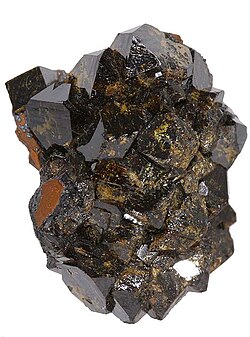 Large brown crystals of beudantite | |
| General | |
| Category | Arsenate minerals |
| Formula | PbFe(OH)SOAsO |
| IMA symbol | Bdn[1] |
| Strunz classification | 8.BL.10 |
| Dana classification | 43.4.1.1 |
| Crystal system | Trigonal |
| Crystal class | Hexagonal scalenohedral (3m) H-M symbol: (3 2/m) |
| Space group | R3m |
| Unit cell | a = 7.32 Å, c = 17.02 Å; Z = 3 |
| Identification | |
| Color | black, dark green, brown, yellowish, red, greenish yellow, brown |
| Crystal habit | tabular, acute rhombohedral, pseudo-cubic, pseudo-cuboctahedral |
| Cleavage | distinct; good on {0001} |
| Mohs scale hardness | 3.5–4.5 |
| Luster | vitreous, resinous |
| Streak | grayish yellow to green |
| Diaphaneity | transparent, translucent |
| Specific gravity | 4.48 |
| Optical properties | Uniaxial (−) |
| Refractive index | n = 1.957 n = 1.943 |
| Birefringence | δ = 0.014 |
| Pleochroism | visible |
| Other characteristics | Soluble in HCl |
| References | [2][3][4] |
Beudandite is a secondary mineral occurring in the oxidized zones of polymetallic deposits.[4] It is a lead, iron, arsenate, sulfate with endmember formula: PbFe(OH)SOAsO.
Beudantite is in a subgroup of the alunite group. It is the arsenate analogue of the phosphate corkite. Beudantite also forms a solid-solution with segnitite and plumbojarosite.[2]
It crystallizes in the trigonalcrystal system and shows a variety of crystal habits including tabular, acute rhombohedral, pseudo-cubic and pseudo-cuboctahedral.
It occurs in association with carminite, scorodite, mimetite, dussertite, arseniosiderite, pharmacosiderite, olivenite, bayldonite, duftite, anglesite, cerussite and azurite.[4]
Discovery
บิวแดนไทต์ได้รับการอธิบายครั้งแรกในปี พ.ศ. 2369 จากการพบในเหมืองหลุยส์ เขตแร่เหล็กวีดเวสเตอร์วัลด์ไร น์ แลนด์-พาลาทิเนตประเทศเยอรมนี โดย อาร์มานด์ เลวีเป็นผู้ตั้งชื่อตามฟรองซัวส์ ซุลปิซ บิวแดนต์ นักแร่วิทยาชาวฝรั่งเศส (พ.ศ. 2330-2383) [ 2 ]