
ตัวอ่อนไม้ทั่วไป
| ตัวอ่อนไม้ทั่วไป | |
|---|---|
 | |
การจำแนกทางวิทยาศาสตร์ | |
| อาณาจักร: | แอนิมอลเลีย |
| ไฟลัม: | อาร์โทรโปดา |
| กลุ่มสายพันธุ์ : | แพนครัสเตเชีย |
| ระดับ: | แมลง |
| คำสั่ง: | เลปิโดปเทรา |
| ตระกูล: | นิมฟาลิดี |
| ประเภท: | เซอร์ซีโอนิส |
| สายพันธุ์: | ซี. เพกาลา |
| ชื่อทวินาม | |
| เซอร์ซีโอนิส เพกาลา ( ฟาบริเซียส , 1775) | |
 | |
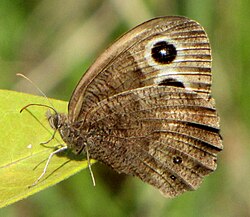
ผีเสื้อไม้ธรรมดา ( Cercyonis pegala ) เป็น ผีเสื้อชนิดหนึ่งในอเมริกาเหนืออยู่ในวงศ์Nymphalidaeเรียกอีกอย่างว่าผีเสื้อไม้ผีเสื้อสีเทา[ 2 ] ผีเสื้อ สีเทาตาฟ้า[ 3 ]และผีเสื้อตาโปน[ 4 ]
อนุกรมวิธาน
มีการยอมรับสายพันธุ์ย่อยดังต่อไปนี้:
- Cercyonis pegala abbotti (สีน้ำตาล, 1969)
- Cercyonis pegala alope (Fabricius, 1793) – รัฐเท็กซัส
- Cercyonis pegala ariane (Boisduval, 1852) – ออริกอน ยูทาห์
- Cercyonis pegala blanca (Emmel & Mattoon, 1972)
- Cercyonis pegala boopis (Behr, 1864) – บริติชโคลัมเบีย
- Cercyonis pegala damei (Barnes & Benjamin, 1926)
- Cercyonis pegala ino (Hall, 1924) – ทุ่งหญ้าแพรรี
- Cercyonis pegala nephele (Kirby, 1837) – ทางตอนเหนือของแคนาดาและสหรัฐอเมริกา
- Cercyonis pegala olympus (เอ็ดเวิร์ด, 1880)
- Cercyonis pegala pegala (Fabricius, 1775) - ทางตะวันออกของสหรัฐอเมริกา
- Cercyonis pegala stephensi (ไรท์, 1905)
- Cercyonis pegala texana (Edwards, 1880) – รัฐเท็กซัส
- Cercyonis pegala wheeleri (เอ็ดเวิร์ด, 1873)
คำอธิบาย

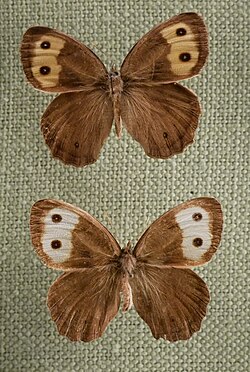
ผีเสื้อกลางคืน ชนิด Common wood-nymph สามารถมีความหลากหลายได้มาก[ 5 ]ทุกตัวมีสีน้ำตาลและมีจุดคล้ายตา 2 จุดบนปีกหน้าแต่ละข้าง โดยจุดล่างมักจะมีขนาดใหญ่กว่าจุดบน บางตัวอาจมีจุดคล้ายตามาก น้อย หรือไม่มีเลยบนพื้นผิวด้านล่างของปีกหลัง ในส่วนตะวันออกเฉียงใต้ของถิ่นที่อยู่ ผีเสื้อชนิดนี้จะมีแถบสีเหลืองขนาดใหญ่บนพื้นผิวทั้งสองด้านของปีกหน้า ในส่วนตะวันตกของถิ่นที่อยู่ ผีเสื้อชนิดนี้อาจมีแถบสีเหลืองอ่อนหรืออาจไม่มีเลย ผีเสื้อในภาคตะวันออกเฉียงเหนือก็ไม่มีแถบสีเหลืองเช่นกัน เช่นC. p. nepheleในผีเสื้อที่ไม่มีแถบสีเหลือง จะมีวงแหวนสีเหลืองอ่อน 2 วงล้อมรอบจุดคล้ายตาบนปีกหน้าทั้งสองข้าง[ 6 ]ความกว้างปีกวัดได้ 5.3 ถึง 7.3 ซม. (2.1 ถึง 2.9 นิ้ว) [ 2 ]
These butterflies have ears at their forewing bases that are most sensitive to low frequency sounds (less than 5 kHz). A conspicuous swelling of their forewing subcostal vein is directly connected to the ears.[7]
Similar species
In the western part of the common wood-nymph's range, there are a few similar species. The Great Basin wood-nymph (Cercyonis sthenele) and the small wood-nymph (Cercyonis oetus) are smaller, and the lower forewing eyespot is smaller than the upper one. Mead's wood-nymph (Cercyonis meadii) has a bright red-orange area on the ventral forewing.[6]
Distribution and habitat
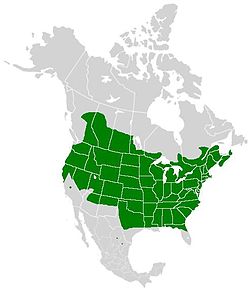
The common wood-nymph ranges from Nova Scotia and Quebec west to northern British Columbia south to northern California southeast to Texas and east to northern Florida.[6]
The common wood-nymph is found in a variety of open habitats, such as open woodlands, woodland edges, fields, pastures, wet meadows, prairies, salt marshes, and savannas.[3][8]
Ecology and behaviour
Life cycle
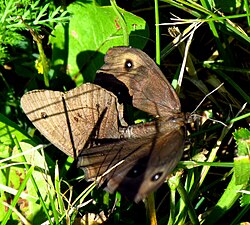
The female common wood-nymph is the active flight partner.[2] The female lays her eggs on or near the host plant. The egg is pale yellow, later turning to a tan color with orange or pink blotches. The caterpillar makes no shelters or nests.[4] It is green or yellowish green with darker green stripes that run the length of the body. It has two short pinkish projections on the end of the abdomen. It has yellow spiracles and is covered in thin, white hairs. The caterpillar will reach a length of 5 cm (2 in). The common wood-nymph caterpillar is very similar to satyr caterpillars in the genera Hermeuptychia, Cyllopsis, and Neonympha. It can be separated by its larger size and habitat.[9] The pale green chrysalis is striped in white or pale yellow. The first instar caterpillar hibernates.[4]
Flight period
แมลงน้ำชนิดทั่วไปจะพบได้ตั้งแต่กลางเดือนพฤษภาคมถึงต้นเดือนตุลาคมในพื้นที่ทางตะวันออกของถิ่นที่อยู่[ 3 ]และพบได้ตั้งแต่ปลายเดือนมิถุนายนถึงต้นเดือนกรกฎาคมในแคลิฟอร์เนีย[ 4 ]และแอริโซนา[ 10 ] โดยมีการออกลูกปีละ ครั้งตลอดทั้งถิ่นที่อยู่[ 6 ]
พืชอาศัย
ต่อไปนี้เป็นรายชื่อพืชอาศัยที่ตัวอ่อนของไม้ทั่วไปใช้: [ 3 ] [ 10 ] [ 9 ]
- Andropogon sp. – หญ้าเครา
- Danthonia spicata – หญ้าโอ๊ตยากจน
- Poa pratensis – หญ้าเคนตักกี้บลูแกรส
- Schizachyrium sp. – บลูสเต็มส์
- Tridens flavus – ดอกสีม่วง
แหล่งอาหารสำหรับผู้ใหญ่
ตัวอ่อนของไม้ทั่วไปกินน้ำหวานน้ำเลี้ยงต้นไม้ และซากพืชที่เน่าเปื่อย[ 3 ] [ 8 ]พืชบางชนิดที่มันดูดน้ำหวานได้แก่: [ 8 ]
- แอสเคลเปียส ทูเบอโรซา – ผักบุ้งผีเสื้อ
- Cirsium arvense – ต้นธิสเซิลแคนาดา
- Cirsium vulgare – ต้นธิสเซิลวัว
- Daucus carota – แครอทป่า
- Dipsacus sylvestris - ต้นทีเซล
- Monarda Fistulosa – มะกรูดป่า
- Pycnanthemum virginianum – มินต์ภูเขาเวอร์จิเนีย
- รัดเบคเคีย ฮิร์ตา – แบล็กอายซูซาน
- Trifolium pratense – โคลเวอร์แดง
- เวอร์โนเนีย ไจแกนเทีย – ต้นเหล็กสูง
แกลเลอรีรูปภาพ
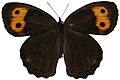 ด้านหลัง
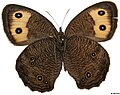 ท้อง
ท้อง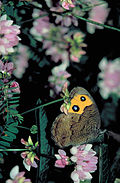

ลิงก์ภายนอก


- โอเปลอร์, พอล เอ.; ล็อตส์, เคลลี; นาเบอร์เฮาส์, โทมัส (ผู้ประสานงาน). "ผีเสื้อกลางคืนไม้ธรรมดา" . ผีเสื้อและผีเสื้อกลางคืนแห่งอเมริกาเหนือ . เก็บถาวรจากต้นฉบับเมื่อวันที่ 17 พฤศจิกายน 2550. สืบค้นเมื่อ26 มกราคม 2551 .
- "ตัวอ่อนของไม้ธรรมดา" . ศูนย์ข้อมูลความหลากหลายทางชีวภาพของแคนาดา . 2002 . สืบค้นเมื่อ4 กันยายน 2009 .