
อ่าน 4 นาที
โดกิก
โด กิค (Dogic ) ( / ˈ d ɒ dʒ ɪ k / ) เป็น ปริศนารูปทรง ทรงยี่สิบหน้า คล้ายกับ รูบิค สามารถหมุนสามเหลี่ยม 5 ชิ้นที่มาบรรจบกันที่ปลาย หรือหมุนหน้าทั้งหมด 5 หน้า (รวมถึงสามเหลี่ยม)...
โดกิก
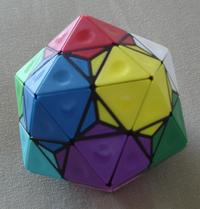
โดกิค (Dogic ) ( / ˈ d ɒ dʒ ɪ k / ) เป็น ปริศนารูปทรง ทรงยี่สิบหน้าคล้ายกับรูบิคสามารถหมุนสามเหลี่ยม 5 ชิ้นที่มาบรรจบกันที่ปลาย หรือหมุนหน้าทั้งหมด 5 หน้า (รวมถึงสามเหลี่ยม) รอบปลายก็ได้ มีชิ้นส่วนที่เคลื่อนย้ายได้ทั้งหมด 80 ชิ้น เทียบกับ 20 ชิ้นในรูบิค
ประวัติศาสตร์

Dogic ได้รับการจดสิทธิบัตรโดย Zsolt และ Robert Vecsei ในประเทศฮังการี เมื่อวันที่ 20 ตุลาคม 1993 สิทธิบัตรได้รับการอนุมัติเมื่อวันที่ 28 กรกฎาคม 1998 (HU214709) เดิมที VECSO จำหน่ายในสองรุ่นภายใต้ชื่อ "Dogic" และ "Dogic 2" แต่ผลิตออกมาในปริมาณที่น้อยกว่าความต้องการมาก
ในปี 2004 อูเว่ เมฟเฟิร์ตได้ซื้อแม่พิมพ์พลาสติกจากผู้ผลิตดั้งเดิมตามคำขอของแฟนๆ และนักสะสมปริศนาทั่วโลก และได้ผลิต Dogic ขึ้นมาอีกครั้ง Dogic เหล่านี้เริ่มจัดส่งครั้งแรกในเดือนมกราคม 2005 และปัจจุบันวางจำหน่ายโดยเมฟเฟิร์ตในร้านขายปริศนาของเขาเอง ชื่อMeffert'sจนถึงเดือนกันยายน 2010 เมื่อความสนใจใน Dogic ของเมฟเฟิร์ตลดลง อูเว่ เมฟเฟิร์ต จึงหยุดการผลิต Dogic ไป
ตามข้อมูลของUwe Mèffertเขาได้ผลิตชิ้นส่วนดังกล่าวไปแล้ว 2,000 ชิ้น
คำอธิบาย
โครงสร้างพื้นฐานของ Dogic คือทรงยี่สิบหน้าซึ่งถูกตัดออกเป็นชิ้นสามเหลี่ยม 60 ชิ้น โดยตัดผ่านจุดยอด 12 จุดและจุดศูนย์กลางของหน้า 20 จุด ชิ้นส่วนทั้ง 80 ชิ้นสามารถเคลื่อนที่สัมพันธ์กันได้ นอกจากนี้ยังมีชิ้นส่วนเคลื่อนที่ภายในจำนวนมาก ซึ่งจำเป็นต่อการคงรูปของจิ๊กซอว์ไว้ในขณะที่ชิ้นส่วนบนพื้นผิวถูกจัดเรียงใหม่

สามารถบิดได้สองแบบ คือ การบิดตื้น ซึ่งหมุนสามเหลี่ยม 5 รูปไปรอบปลายแหลมเดียว และการบิดลึก ซึ่งหมุนหน้าทั้งหมด 5 หน้า (รวมถึงสามเหลี่ยมรอบปลายแหลม) ไปรอบปลายแหลม การบิดตื้นจะเคลื่อนย้ายสามเหลี่ยมระหว่างหน้าต่างๆ แต่ยังคงอยู่รอบปลายแหลมเดิม ในขณะที่การบิดลึกจะเคลื่อนย้ายสามเหลี่ยมระหว่างปลายแหลมทั้ง 5 ที่อยู่ตรงฐานของหน้าที่หมุนแล้ว แต่ยังคงอยู่บนหน้าเดิม สามเหลี่ยมแต่ละรูปมีสีเดียว ในขณะที่จุดศูนย์กลางของหน้าอาจมีได้ถึง 3 สี ขึ้นอยู่กับรูปแบบการลงสีที่ใช้
โซลูชัน
The solutions for the different versions of the Dogic differ.
The 12-color Dogic is the more challenging version, where the face centers must be rearranged to match the colors of the face centers in adjacent faces. The triangles must then match the corresponding colors in the face centers. The face centers are mathematically equivalent to the corner pieces of the Megaminx, and so the same algorithms may be used for solving either. The triangles are relatively easy to solve once the face centers are in place, because the 5 triangles per tip are identical in color and may be freely interchanged.
The 10-color Dogic is slightly less challenging, since there is no unique solved state: the face centers may be randomly placed relative to each other, and the result would still look 'solved'. However, it may still be desirable to put them in aesthetically pleasing arrangements, such as pairing up faces of the same color, as depicted in the second photograph. The triangles are slightly more tricky to solve than in the 12-color Dogic, because adjacent triangles in the solved state are not the same color and so cannot be freely interchanged.
The 5-color and 2-color Dogics are even less of a challenge, since there is a large number of identical pieces. These simpler versions cater to those puzzle fans who are not yet at the skill level to manage the full complexity of the 12-color Dogic.
Number of combinations
Due to different numbers of visually identical pieces in the two versions of the puzzle, they each have a different number of possible combinations. There are 60 tip pieces and 20 centres with 3 orientations, giving a theoretical maximum of 60!·20!·320 positions. This limit is not reached on either puzzle, due to reducing factors detailed below.
12-color Dogic
- Only even permutations of centres are possible (2)
- The orientation of the first 19 centres determines the orientation of the last centre. (3)
- Some tip pieces are indistinguishable (5!12)
- The orientation of the puzzle does not matter (60): all 60 possible positions and orientations of the first center are equivalent because of the lack of fixed reference points.
This leaves positions for the 12-color Dogic.
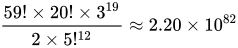
The precise figure is 21 991 107 793 244 335 592 538 616 581 443 187 569 604 232 889 165 919 156 829 382 848 981 603 083 878 400 000 (roughly 22 sesvigintillion on the short scale or 22 tredecilliard on the long scale).
10-color Dogic
- Only even permutations of the centres are possible (2)
- Centre orientation does not matter (320)
- Ten of the centres are visually identical to the other ten (210)
- Some tip pieces are indistinguishable (6!10)
- The orientation of the puzzle does not matter (60)
ซึ่งทำให้มีตำแหน่งว่างสำหรับ Dogic แบบ 10 สี
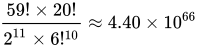
ตัวเลขที่แน่นอนคือ 4,400,411,583,858,825,100,777,127,453,704,140,502,784,413,155,112,522,644,357,120,000,000 (ประมาณ 4.4 อุนวิจินทิลเลียนในมาตราส่วนสั้น หรือ 4.4 อุนเดซิลเลียนในมาตราส่วนยาว)
ดูเพิ่มเติม
สรุปเนื้อหา
ข้อมูลสำคัญจากบทความ
ข้อมูลสำคัญเกี่ยวกับ โดกิก
โด กิค (Dogic ) ( / ˈ d ɒ dʒ ɪ k / ) เป็น ปริศนารูปทรง ทรงยี่สิบหน้า คล้ายกับ รูบิค สามารถหมุนสามเหลี่ยม 5 ชิ้นที่มาบรรจบกันที่ปลาย หรือหมุนหน้าทั้งหมด 5 หน้า (รวมถึงสามเหลี่ยม)...
ประวัติศาสตร์
Dogic ได้รับการจดสิทธิบัตรโดย Zsolt และ Robert Vecsei ในประเทศฮังการี เมื่อวันที่ 20 ตุลาคม 1993 สิทธิบัตรได้รับการอนุมัติเมื่อวันที่ 28 กรกฎาคม 1998 (HU214709) เดิมที VECSO จำหน่ายในสองรุ่นภายใต้ชื่อ "Dogic" และ "Dogic 2"...
คำอธิบาย
โครงสร้างพื้นฐานของ Dogic คือ ทรงยี่สิบหน้า ซึ่งถูกตัดออกเป็นชิ้นสามเหลี่ยม 60 ชิ้น โดยตัดผ่านจุดยอด 12 จุดและจุดศูนย์กลางของหน้า 20 จุด ชิ้นส่วนทั้ง 80 ชิ้นสามารถเคลื่อนที่สัมพันธ์กันได้ นอกจากนี้ยังมีชิ้นส่วนเคลื่อนที่ภายในจำนวนมาก...
โซลูชัน
The solutions for the different versions of the Dogic differ.