
อ่าน 8 นาที
Deformation (engineering)
In engineering, deformation is the change in size or shape of an object when subjected to force, and may be elastic or plastic depending on whether the deformation is reversible...
Deformation (engineering)

In engineering, deformation is the change in size or shape of an object when subjected to force, and may be elastic or plastic depending on whether the deformation is reversible when the actuating force is removed. An object's intrinsic resistance to deformation is known as its stiffness or rigidity. If the deformation is negligible under stress, the object is said to be rigid; conversely, it is said to be flexible or pliable.
Main concepts
Occurrence of deformation in engineering applications is based on the following background concepts:
- Displacements are any change in position of a point on the object, including whole-body translations and rotations (rigid transformations).
- Deformation are changes in the relative position between internals points on the object, excluding rigid transformations, causing the body to change shape or size.
- Strain is the relativeinternal deformation, the dimensionless change in shape of an infinitesimal cube of material relative to a reference configuration. Mechanical strains are caused by mechanical stress, see stress-strain curve.
The relationship between stress and strain is generally linear and reversible up until the yield point and the deformation is elastic. Elasticity in materials occurs when applied stress does not surpass the energy required to break molecular bonds, allowing the material to deform reversibly and return to its original shape once the stress is removed. The linear relationship for a material is known as Young's modulus. Above the yield point, some degree of permanent distortion remains after unloading and is termed plastic deformation. The determination of the stress and strain throughout a solid object is given by the field of strength of materials and for a structure by structural analysis.
In the above figure, it can be seen that the compressive loading (indicated by the arrow) has caused deformation in the cylinder so that the original shape (dashed lines) has changed (deformed) into one with bulging sides. The sides bulge because the material, although strong enough to not crack or otherwise fail, is not strong enough to support the load without change. As a result, the material is forced out laterally. Internal forces (in this case at right angles to the deformation) resist the applied load.
Types of deformation
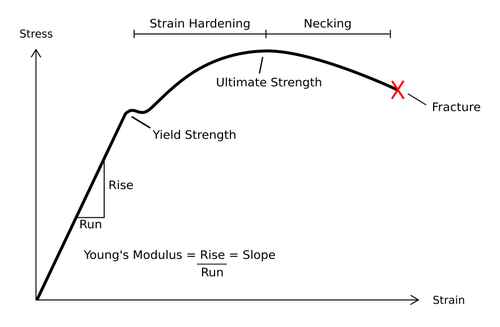
Depending on the type of material, size and geometry of the object, and the forces applied, various types of deformation may result. The image to the right shows the engineering stress vs. strain diagram for a typical ductile material such as steel. Different deformation modes may occur under different conditions, as can be depicted using a deformation mechanism map.
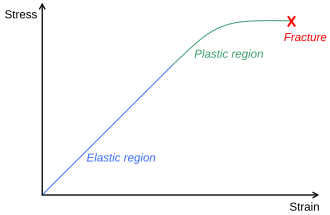
Permanent deformation is irreversible; the deformation stays even after removal of the applied forces, while the temporary deformation is recoverable as it disappears after the removal of applied forces. Temporary deformation is also called elastic deformation, while the permanent deformation is called plastic deformation.
Elastic deformation
The study of temporary or elastic deformation in the case of engineering strain is applied to materials used in mechanical and structural engineering, such as concrete and steel, which are subjected to very small deformations. Engineering strain is modeled by infinitesimal strain theory, also called small strain theory, small deformation theory, small displacement theory, or small displacement-gradient theory where strains and rotations are both small.
For some materials, e.g. elastomers and polymers, subjected to large deformations, the engineering definition of strain is not applicable, e.g. typical engineering strains greater than 1%,[1] thus other more complex definitions of strain are required, such as stretch, logarithmic strain, Green strain, and Almansi strain. Elastomers and shape memory metals such as Nitinol exhibit large elastic deformation ranges, as does rubber. However, elasticity is nonlinear in these materials.
Normal metals, ceramics and most crystals show linear elasticity and a smaller elastic range.
Linear elastic deformation is governed by Hooke's law, which states:

where
- σ is the applied stress;
- E is a material constant called Young's modulus or elastic modulus;
- ε is the resulting strain.
This relationship only applies in the elastic range and indicates that the slope of the stress vs. strain curve can be used to find Young's modulus (E). Engineers often use this calculation in tensile tests. The area under this elastic region is known as resilience.
Note that not all elastic materials undergo linear elastic deformation; some, such as concrete, gray cast iron, and many polymers, respond in a nonlinear fashion. For these materials Hooke's law is inapplicable.[2]
Plastic deformation
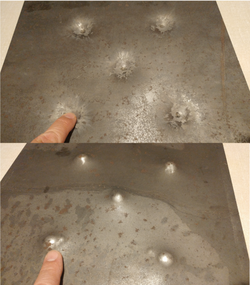
This type of deformation is not undone simply by removing the applied force. An object in the plastic deformation range, however, will first have undergone elastic deformation, which is undone simply by removing the applied force, so the object will return part way to its original shape. Soft thermoplastics have a rather large plastic deformation range as do ductile metals such as copper, silver, and gold. Steel does, too, but not cast iron. Hard thermosetting plastics, rubber, crystals, and ceramics have minimal plastic deformation ranges. An example of a material with a large plastic deformation range is wet chewing gum, which can be stretched to dozens of times its original length.
Under tensile stress, plastic deformation is characterized by a strain hardening region and a necking region and finally, fracture (also called rupture). During strain hardening the material becomes stronger through the movement of atomic dislocations. The necking phase is indicated by a reduction in cross-sectional area of the specimen. Necking begins after the ultimate strength is reached. During necking, the material can no longer withstand the maximum stress and the strain in the specimen rapidly increases. Plastic deformation ends with the fracture of the material.
Failure
Compressive failure
Usually, compressive stress applied to bars, columns, etc. leads to shortening.
Loading a structural element or specimen will increase the compressive stress until it reaches its compressive strength. According to the properties of the material, failure modes are yielding for materials with ductile behavior (most metals, some soils and plastics) or rupturing for brittle behavior (geomaterials, cast iron, glass, etc.).
In long, slender structural elements — such as columns or truss bars — an increase of compressive force F leads to structural failure due to buckling at lower stress than the compressive strength.
Fracture
A break occurs after the material has reached the end of the elastic, and then plastic, deformation ranges. At this point forces accumulate until they are sufficient to cause a fracture. All materials will eventually fracture, if sufficient forces are applied.
Types of stress and strain
ความเค้นทางวิศวกรรมและความเครียดทางวิศวกรรมเป็นค่าประมาณของสถานะภายในที่สามารถกำหนดได้จากแรงภายนอกและการเสียรูปของวัตถุ โดยมีเงื่อนไขว่าขนาดของวัตถุต้องไม่เปลี่ยนแปลงอย่างมีนัยสำคัญ เมื่อขนาดของวัตถุเปลี่ยนแปลงอย่างมีนัยสำคัญความเค้นและความเครียดที่แท้จริงสามารถหาได้จากขนาดของวัตถุ ณ ขณะนั้น
ความเค้นและความเครียดทางวิศวกรรม
พิจารณาแท่งโลหะที่มีพื้นที่หน้าตัด เดิม A₀ซึ่งถูกแรงF ที่เท่ากันและตรงข้ามกันดึงที่ปลายทั้งสองข้าง ทำให้แท่งโลหะอยู่ใน ดึง วัสดุนี้กำลังประสบกับความเค้นซึ่งนิยามว่าคืออัตราส่วนของแรงต่อพื้นที่หน้าตัดของแท่งโลหะ รวมถึงการยืดตัวตามแนวแกนด้วย
| ความเครียด | ความเครียด |
|---|---|

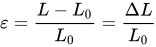
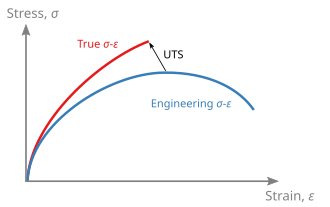
เลขห้อย 0 หมายถึงขนาดดั้งเดิมของชิ้นงานหน่วยอนุพันธ์ของระบบ SIสำหรับความเค้นคือนิวตันต่อตารางเมตร หรือปาสคาล (1 ปาสคาล = 1 Pa = 1 N/m² )และความเครียดไม่มีหน่วย กราฟความสัมพันธ์ระหว่างความเค้นและความเครียดของวัสดุนี้ได้มาจากการยืดชิ้นงานและบันทึกการเปลี่ยนแปลงของความเค้นกับความเครียดจนกระทั่งชิ้นงานแตกหักตามธรรมเนียมแล้ว ความเครียดจะถูกกำหนดให้เป็นแกนแนวนอน และความเค้นจะถูกกำหนดให้เป็นแกนแนวตั้ง โปรดทราบว่าเพื่อวัตถุประสงค์ทางวิศวกรรม เรามักจะสมมติว่าพื้นที่หน้าตัดของวัสดุไม่เปลี่ยนแปลงตลอดกระบวนการการเสียรูปทั้งหมด ซึ่งไม่เป็นความจริง เนื่องจากพื้นที่จริงจะลดลงในขณะที่เกิดการเสียรูปเนื่องจากการเสียรูปยืดหยุ่นและการเสียรูปพลาสติก กราฟที่อิงตามพื้นที่หน้าตัดและความยาวดั้งเดิมเรียกว่า กราฟความสัมพันธ์ระหว่างความเค้นและความเครียดทางวิศวกรรมในขณะที่กราฟที่อิงตามพื้นที่หน้าตัดและความยาว ณ ขณะนั้นเรียกว่ากราฟความสัมพันธ์ระหว่างความเค้นและความเครียดที่แท้จริงเว้นแต่จะระบุไว้เป็นอย่างอื่น โดยทั่วไปจะใช้กราฟความสัมพันธ์ระหว่างความเค้นและความเครียดทางวิศวกรรม
ความเครียดและความกดดันที่แท้จริง
ในคำจำกัดความของความเค้นและความเครียดทางวิศวกรรมข้างต้นนั้น ได้ละเลยพฤติกรรมของวัสดุสองประการในการทดสอบแรงดึง:
- พื้นที่หน้าตัดที่ลดลง
- การพัฒนาการยืดตัวแบบทวีคูณ
ความเค้นจริงและความเครียดจริงนั้นถูกกำหนดแตกต่างจากความเค้นและความเครียดทางวิศวกรรม เพื่อให้สามารถอธิบายพฤติกรรมเหล่านี้ได้ โดยจะระบุไว้ดังนี้
| ความเครียด | ความเครียด |
|---|---|


ในที่นี้ มิติที่ระบุคือค่า ณ เวลาใดเวลาหนึ่ง โดยสมมติว่าปริมาตรของตัวอย่างคงที่และการเปลี่ยนแปลงรูปร่างเกิดขึ้นอย่างสม่ำเสมอ

ความเค้นและความเครียดที่แท้จริงสามารถแสดงได้ด้วยความเค้นและความเครียดทางวิศวกรรม สำหรับความเค้นที่แท้จริงนั้น

สำหรับสายพันธุ์นั้น

รวมทั้งสองข้างและใช้เงื่อนไขขอบเขต
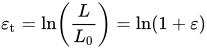
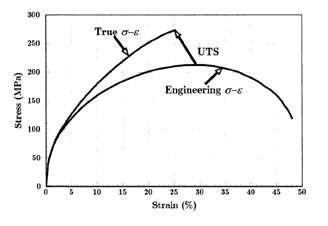
ดังนั้นในการทดสอบแรงดึง ความเค้นจริงจะมีค่ามากกว่าความเค้นทางวิศวกรรม และความเครียดจริงจะมีค่าน้อยกว่าความเครียดทางวิศวกรรม ดังนั้น จุดที่กำหนดเส้นโค้งความเค้น-ความเครียดจริงจึงเลื่อนขึ้นไปทางซ้ายเพื่อกำหนดเส้นโค้งความเค้น-ความเครียดทางวิศวกรรมที่เทียบเท่ากัน ความแตกต่างระหว่างความเค้นและความเครียดจริงและทางวิศวกรรมจะเพิ่มขึ้นตาม การเสียรูป พลาสติกที่ความเครียดต่ำ (เช่น การเสียรูป ยืดหยุ่น ) ความแตกต่างระหว่างทั้งสองค่าจะน้อยมาก สำหรับจุดความแข็งแรงดึงนั้น เป็นจุดสูงสุดในเส้นโค้งความเค้น-ความเครียดทางวิศวกรรม แต่ไม่ใช่จุดพิเศษในเส้นโค้งความเค้น-ความเครียดจริง เนื่องจากความเค้นทางวิศวกรรมเป็นสัดส่วนกับแรงที่กระทำตามแนวชิ้นงาน เกณฑ์สำหรับ การเกิด คอคอดจึงสามารถกำหนดได้ดังนี้

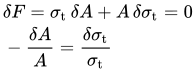
การวิเคราะห์นี้ชี้ให้เห็นถึงลักษณะของ จุด ความแข็งแรงดึงสูงสุด (UTS) ผลของ การเพิ่มความแข็งแรงจากการทำงานจะสมดุลอย่างพอดีกับการหดตัวของพื้นที่หน้าตัด ณ จุด UTS
หลังจากเกิดการคอดตัวแล้ว ตัวอย่างจะเกิดการเสียรูปที่ไม่สม่ำเสมอ ดังนั้นสมการข้างต้นจึงใช้ไม่ได้ ความเค้นและความเครียดที่บริเวณคอดตัวสามารถแสดงได้ดังนี้:

สมการเชิงประจักษ์มักใช้เพื่ออธิบายความสัมพันธ์ระหว่างความเค้นจริงและความเครียดจริง

ในที่นี้nคือเลขชี้กำลังการแข็งตัวของความเครียด และKคือสัมประสิทธิ์ความแข็งแรงnเป็นตัววัดพฤติกรรมการแข็งตัวของวัสดุ วัสดุที่มีค่าn สูงกว่า จะมีความต้านทานต่อการคอคอดมากกว่า โดยทั่วไป โลหะที่อุณหภูมิห้องจะมีค่าnอยู่ในช่วง 0.02 ถึง 0.5 [ 3 ]
การอภิปราย
เนื่องจากเราไม่คำนึงถึงการเปลี่ยนแปลงพื้นที่ระหว่างการเสียรูปข้างต้น ดังนั้นเส้นโค้งความเค้นและความเครียดที่แท้จริงจึงต้องได้รับการหาใหม่ สำหรับการหาเส้นโค้งความเค้นและความเครียด เราสามารถสมมติได้ว่าการเปลี่ยนแปลงปริมาตรเป็น 0 แม้ว่าเราจะทำให้วัสดุเสียรูปก็ตาม เราสามารถสมมติได้ว่า:

ดังนั้น ค่าความเค้นที่แท้จริงสามารถแสดงได้ดังนี้:
![{\displaystyle {\begin{aligned}\sigma _{T}={\frac {F}{A_{f}}}&={\frac {F}{A_{i}}}\times {\frac {A_{i}}{A_{f}}}\\&=\sigma _{e}\times {\frac {l_{f}}{l_{i}}}\\[2pt]&=\sigma _{E}\times {\frac {l_{i}+\delta l}{l_{i}}}\\[2pt]&=\sigma _{E}(1+\varepsilon _{E})\end{aligned}}}](https://wikimedia.org/api/rest_v1/media/math/render/svg/c9910460a3a7c87f08f619708a3813bc7e0808a8)
นอกจากนี้ ค่าความเครียดที่แท้จริงε สามารถแสดงได้ดังต่อไปนี้:

จากนั้น เราสามารถแสดงค่าได้ดังนี้

ดังนั้น เราจึงสามารถสร้างกราฟโดยใช้และดังรูปด้านขวาได้


นอกจากนี้ จากกราฟความเค้น-ความเครียดที่แท้จริง เราสามารถประมาณบริเวณที่เริ่มเกิดการคอดได้ เนื่องจากการคอดเริ่มปรากฏหลังจากความเค้นดึงสูงสุด ซึ่งเป็นจุดที่แรงกระทำสูงสุด เราจึงสามารถแสดงสถานการณ์นี้ได้ดังนี้:

ดังนั้น รูปแบบนี้จึงสามารถแสดงได้ดังต่อไปนี้:
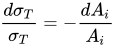
นั่นแสดงว่าการคอดเริ่มปรากฏขึ้นในบริเวณที่พื้นที่ลดลงอย่างมีนัยสำคัญเมื่อเทียบกับการเปลี่ยนแปลงของความเค้น จากนั้นความเค้นจะกระจุกตัวอยู่ในบริเวณเฉพาะที่เกิดการคอดขึ้น
นอกจากนี้ เรายังสามารถสร้างความสัมพันธ์ต่างๆ โดยอิงจากเส้นโค้งความเค้น-ความเครียดที่แท้จริงได้อีกด้วย
1) เส้นโค้งความเครียดและความเค้นจริงสามารถแสดงได้ด้วยความสัมพันธ์เชิงเส้นโดยประมาณ โดยการหาค่าลอการิทึมของความเค้นและความเครียดจริง ความสัมพันธ์ดังกล่าวสามารถแสดงได้ดังนี้:

โดยที่คือสัมประสิทธิ์ความเค้น และคือสัมประสิทธิ์การแข็งตัวของความเครียด โดยปกติแล้ว ค่าของจะอยู่ในช่วงประมาณ 0.02 ถึง 0.5 ที่อุณหภูมิห้อง ถ้ามีค่าเป็น 1 เราสามารถแสดงวัสดุนี้ว่าเป็นวัสดุยืดหยุ่นที่สมบูรณ์แบบได้[ 4 ] [ 5 ]


2) ในความเป็นจริง ความเค้นยังขึ้นอยู่กับอัตราการเปลี่ยนแปลงของความเครียดอย่างมาก ดังนั้น เราจึงสามารถสร้างสมการเชิงประจักษ์โดยอิงจากการเปลี่ยนแปลงอัตราความเครียดได้

โดยที่ค่าคงที่นั้นเกี่ยวข้องกับความเค้นไหลของวัสดุแสดงถึงอนุพันธ์ของความเครียดเทียบกับเวลา ซึ่งเรียกอีกอย่างว่าอัตราความเครียดคือความไวต่ออัตราความเครียด นอกจากนี้ ค่าของยังเกี่ยวข้องกับความต้านทานต่อการคอดตัว โดยปกติแล้ว ค่าของจะอยู่ในช่วง 0-0.1 ที่อุณหภูมิห้อง และสูงถึง 0.8 เมื่ออุณหภูมิเพิ่มขึ้น


โดยการรวมข้อ 1) และ 2) เข้าด้วยกัน เราสามารถสร้างความสัมพันธ์ขั้นสุดท้ายได้ดังต่อไปนี้:

ค่าคงที่สากลที่ใช้ในการเชื่อมโยงความเครียด อัตราความเครียด และความเค้น อยู่ที่ไหน

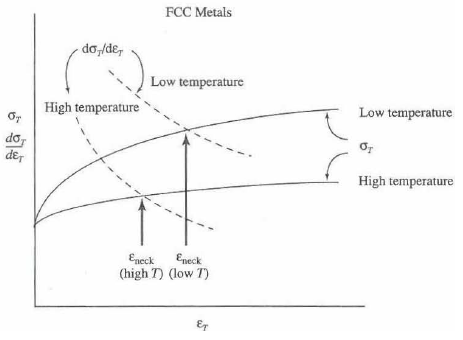
3) จากกราฟความเค้น-ความเครียดจริงและรูปแบบอนุพันธ์ของกราฟนั้น เราสามารถประมาณค่าความเครียดที่จำเป็นต่อการเริ่มต้นการคอดได้ ซึ่งสามารถคำนวณได้จากจุดตัดระหว่างกราฟความเค้น-ความเครียดจริง ดังแสดงในภาพด้านขวา
ภาพนี้ยังแสดงให้เห็นถึงความสัมพันธ์ของความเครียดที่ทำให้เกิดการคอดตัวที่อุณหภูมิต่างๆ ในกรณีของโลหะ FCC ทั้งเส้นโค้งความเค้น-ความเครียดและอนุพันธ์ของเส้นโค้งนั้นขึ้นอยู่กับอุณหภูมิอย่างมาก ดังนั้นที่อุณหภูมิสูงขึ้น การคอดตัวจะเริ่มปรากฏขึ้นแม้ที่ค่าความเครียดต่ำ
คุณสมบัติทั้งหมดเหล่านี้บ่งชี้ถึงความสำคัญของการคำนวณเส้นโค้งความเค้น-ความเครียดที่แท้จริง เพื่อการวิเคราะห์พฤติกรรมของวัสดุในสภาพแวดล้อมที่เปลี่ยนแปลงอย่างฉับพลันต่อไป
4) วิธีการทางกราฟิกที่เรียกว่า "การพิจารณาโครงสร้าง" สามารถช่วยกำหนดพฤติกรรมของเส้นโค้งความเค้น-ความเครียดได้ว่าเกิดการคอดหรือการยืดตัวบนชิ้นงานหรือไม่ โดยการกำหนดค่าความเค้นและความเครียดที่แท้จริงเป็นตัวกำหนด ซึ่งสามารถแสดงได้ด้วยความเค้นและความเครียดทางวิศวกรรมดังต่อไปนี้:


ดังนั้น ค่าความเค้นทางวิศวกรรมสามารถแสดงได้ด้วยเส้นตัดจากค่าความเค้นจริงไปยังค่าความเค้นจริงโดยการวิเคราะห์รูปทรงของแผนภาพและเส้นตัด เราสามารถระบุได้ว่าวัสดุนั้นแสดงอาการดึงหรือคอดหรือไม่


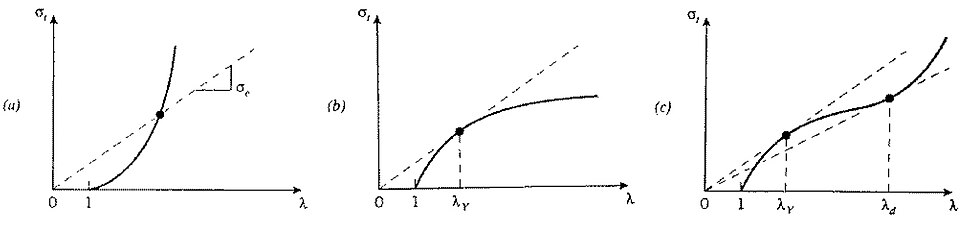
ในรูป (a) จะเห็นเพียงเส้นโค้งเว้าขึ้นด้านบนเท่านั้น แสดงว่าไม่มีการลดลงของจุดคราก ดังนั้นวัสดุจะเกิดการแตกหักก่อนที่จะถึงจุดคราก ในรูป (b) มีจุดเฉพาะที่เส้นสัมผัสตรงกับเส้นตัดที่จุดนั้นหลังจากค่านี้ ความชันจะน้อยกว่าเส้นตัด ซึ่งเริ่มปรากฏการคอด ในรูป (c) มีจุดที่เริ่มปรากฏการคราก แต่เมื่อการดึงจะเกิดขึ้น หลังจากดึงแล้ว วัสดุทั้งหมดจะยืดออกและในที่สุดก็จะแตกหัก ระหว่างและวัสดุเองจะไม่ยืดออก แต่มีเพียงส่วนคอดเท่านั้นที่เริ่มยืดออก


ความเข้าใจผิด
ความเข้าใจผิดที่แพร่หลายคือ วัสดุทุกชนิดที่โค้งงอได้นั้น "อ่อนแอ" และวัสดุที่ไม่โค้งงอได้นั้น "แข็งแรง" ในความเป็นจริง วัสดุหลายชนิดที่เกิดการเสียรูปยืดหยุ่นและพลาสติกขนาดใหญ่ เช่น เหล็ก สามารถดูดซับแรงเค้นที่อาจทำให้วัสดุที่เปราะบาง เช่น แก้ว ซึ่งมีช่วงการเสียรูปพลาสติกน้อย แตกหักได้[ 7 ]
ดูเพิ่มเติม
- การดัดแปลงรูปทรงกะโหลกศีรษะเทียม
- เพิ่มพลังโจมตี
- การคืบตัว (การเสียรูป)
- การโก่งตัว (ทางวิศวกรรม)
- การเปลี่ยนรูป (กลศาสตร์)
- แผนที่กลไกการเปลี่ยนรูป
- การตรวจสอบการเปลี่ยนแปลงรูปทรง
- การหดกลับของรูปทรง
- ทฤษฎีการเปลี่ยนรูป
- ความยืดหยุ่น
- ความอ่อนตัว
- ลักษณะการเปลี่ยนรูปในระนาบ
- ความยืดหยุ่น (ฟิสิกส์)
- อัตราส่วนปัวซง
- เทนเซอร์ความเครียด
- ความแข็งแรงของวัสดุ
- การบิดงอของไม้
เอกสารอ้างอิง
- ↑รีส์, เดวิด (2006). ความยืดหยุ่นพื้นฐานทางวิศวกรรม: บทนำพร้อมการประยุกต์ใช้ทางวิศวกรรมและการผลิตบัตเตอร์เวิร์ธ-ไฮเนมันน์ หน้า 41 ISBN 0-7506-8025-3เก็บถาวรจากต้นฉบับเมื่อวันที่ 22 ธันวาคม 2017
- ↑ Callister, William D. (2004)พื้นฐานวิทยาศาสตร์และวิศวกรรมวัสดุ , John Wiley and Sons, ฉบับพิมพ์ครั้งที่ 2 หน้า 184. ISBN 0-471-66081-7.
- ↑ Courtney, Thomas (2005). พฤติกรรมเชิงกลของวัสดุ . Waveland Press, Inc. หน้า6–13 .
- 1 2 Courtney, Thomas (2000). พฤติกรรมเชิงกลของวัสดุ . อิลลินอยส์: Waveland Press. หน้า165. ISBN 9780073228242.
- ↑ "ความเค้นและความเครียดที่แท้จริง" (PDF) . เก็บถาวรจากต้นฉบับ(PDF)เมื่อ 2018-01-27 . เรียกดูเมื่อ2018-05-15 .
- ↑โรแลนด์, เดวิด. "เส้นโค้งความเครียด-ความเครียด" (PDF ) เอ็มไอที .
- ↑ Rice, Peter และ Dutton, Hugh (1995). กระจกโครงสร้าง . Taylor & Francis. หน้า33. ISBN 0-419-19940-3.
{{cite book}}: CS1 maint: multiple names: authors list (link)
สรุปเนื้อหา
ข้อมูลสำคัญจากบทความ
ข้อมูลสำคัญเกี่ยวกับ Deformation (engineering)
In engineering, deformation is the change in size or shape of an object when subjected to force, and may be elastic or plastic depending on whether the deformation is reversible...
Main concepts
Occurrence of deformation in engineering applications is based on the following background concepts:Displacements are any change in position of a point on the object, including whole-body translations and rotations (rigid transformations).Deformation are...
Types of deformation
Depending on the type of material, size and geometry of the object, and the forces applied, various types of deformation may result. The image to the right shows the engineering stress vs. strain diagram for a typical ductile material such as steel. Different...
Elastic deformation
The study of temporary or elastic deformation in the case of engineering strain is applied to materials used in mechanical and structural engineering, such as concrete and steel, which are subjected to very small deformations. Engineering strain is modeled by...