
อ่าน 15 นาที
ทีมโกลเด้น
ทีม ทองคำ ( ภาษาฮังการี : Aranycsapat , ออกเสียงว่า [a'rany ts'apat] ) หมายถึง ทีมฟุตบอลทีมชาติฮังการี ในทศวรรษ 1950 ทีมนี้มีความเกี่ยวข้องกับแมตช์สำคัญหลายนัด...
ทีมโกลเด้น
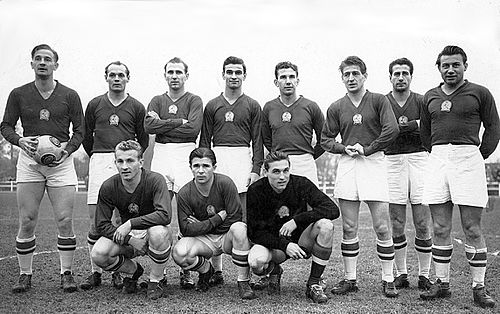
ทีมทองคำ ( ภาษาฮังการี : Aranycsapat , ออกเสียงว่า[a'rany ts'apat] ) หมายถึงทีมฟุตบอลทีมชาติฮังการีในทศวรรษ 1950 ทีมนี้มีความเกี่ยวข้องกับแมตช์สำคัญหลายนัด รวมถึงรอบก่อนรองชนะเลิศ (" ยุทธการแห่งเบิร์น ") กับบราซิล รอบรองชนะเลิศ (กับอุรุกวัย ) และรอบชิงชนะเลิศของฟุตบอลโลก 1954ทีมนี้สร้างความพ่ายแพ้ครั้งสำคัญให้กับมหาอำนาจฟุตบอลของโลกในขณะนั้นได้แก่ อุรุกวัย สหภาพโซเวียต อังกฤษ เยอรมนีบราซิลและอิตาลีก่อนที่การปฏิวัติฮังการีในปี 1956 จะทำให้ทีมแตกสลาย ทีมทองคำยังเป็นที่รู้จักกันในชื่อเล่นต่างๆ เช่น "ชาวแมกยาร์ผู้ยิ่งใหญ่" "ชาวแมกยาร์ผู้ มีเวทมนตร์" และ "ชาวแมกยาร์ผู้ยิ่งใหญ่"
| บันทึกเหรียญรางวัล | ||
|---|---|---|
| กีฬาโอลิมปิก | ||
 | เฮลซิงกิ 1952 | ทีม |
| ฟุตบอลโลก | ||
 | สวิตเซอร์แลนด์ 1954 | ทีม |
| ถ้วยนานาชาติยุโรปกลาง | ||
| ยุโรปกลาง ค.ศ. 1948–53 | ทีม |
ระหว่างปี 1950 ถึง 1956 ทีมลงเล่น 69 เกม บันทึกชัยชนะ 58 ครั้ง เสมอ 10 ครั้ง และโดยทั่วไปถือว่าแพ้เพียงครั้งเดียวในรอบชิงชนะเลิศฟุตบอลโลกปี 1954 กับเยอรมนีตะวันตก[ 1 ]ในระหว่างกระบวนการนี้ พวกเขายิงประตูได้ 436 ประตู ภายใต้ระบบการจัดอันดับ Eloพวกเขาได้รับการจัดอันดับสูงสุดที่บันทึกไว้โดยทีมชาติ (2231 คะแนน ซึ่งทำได้เมื่อวันที่ 30 มิถุนายน 1954) ในปี 2016 บีบีซีได้จัดอันดับให้ทีมนี้เป็นทีมฟุตบอลนานาชาติที่ดีที่สุดในประวัติศาสตร์ฟุตบอล[ 2 ]
โดยทั่วไปแล้ว ทีมนี้ได้รับการยกย่องว่าประสบความสำเร็จในการนำรูปแบบ " ฟุตบอลรวม " (Total Football) มาใช้ ซึ่งต่อมา ทีมชาติ เนเธอร์แลนด์นำไปใช้อย่างมีประสิทธิภาพในช่วงทศวรรษ 1970 นอกจากนี้ ทีมยังได้รับการยอมรับโดยทั่วไปว่าได้นำเสนอนวัตกรรมการฝึกสอนและยุทธวิธีทางวิทยาศาสตร์ใหม่ๆ ซึ่งต่อมาได้ถูกนำไปใช้ทั่วทั้งวงการฟุตบอล ความสำเร็จของทีมกลายเป็นความภาคภูมิใจของชาติในช่วงเวลาที่ถูกกดขี่โดยระบอบคอมมิวนิสต์ที่สหภาพโซเวียตบังคับใช้กับฮังการี ในช่วงเวลานี้ การแสดงออกถึง "ชาตินิยม" หรือแม้แต่ความรักชาติใดๆ ก็ถูกประณามอย่างรุนแรง เนื่องจากถือว่าขัดกับอุดมคติสากลนิยมของรัฐบาลคอมมิวนิสต์ ความสำเร็จของทีมนี้ถูกยกมาเป็นตัวอย่างว่าความภาคภูมิใจของชาติยังคงเชื่อมโยงกับกีฬาในฮังการีภายใต้การปกครองของโซเวียต แม้ว่าระบอบคอมมิวนิสต์จะสงสัยในลัทธิชาตินิยมก็ตาม[ 3 ]
บุคคลสำคัญ
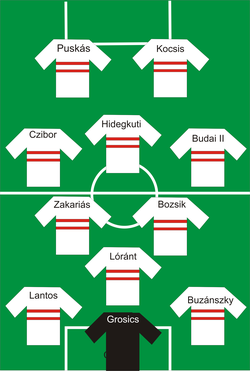
ทีมถูกสร้างขึ้นโดยมีผู้เล่นหลัก 6 คน ได้แก่ กองหน้าFerenc Puskás , Sándor KocsisและZoltán Czibor , József Bozsik กองกลางตัวรับ และGyula Grosics ผู้รักษาประตู , ผู้เล่น Kispest Honvédทั้งหมดรวมถึงNándor Hidegkutiกองกลางตัวรุกของ MTKผู้จัดการทีมคือGusztáv Sebesซึ่งเคยเป็น ผู้จัดการ สหภาพแรงงานในบูดาเปสต์ และ ปารีสก่อนสงครามที่ โรงงานรถยนต์ เรโนลต์ดังนั้นจึงได้รับอนุมัติร่างพระราชบัญญัติสุขภาพที่สะอาดทางการเมืองเพื่อดำเนินกิจการโดยรัฐมนตรีช่วยว่าการกีฬา
เซเบสได้รับการยกย่องว่าเป็นผู้ริเริ่มนวัตกรรมสำคัญ 3 ประการ ประการแรก เขาได้นำระบบการฝึกความฟิตมาใช้กับผู้เล่นของเขา รวมถึงนโยบายแบบสโมสรในระดับนานาชาติ เพื่อกระตุ้นให้มีการฝึกซ้อมอย่างสม่ำเสมอ ประการที่สอง เขาเป็นผู้ริเริ่มแนวคิดทางยุทธวิธีของกองหน้าตัวกลางที่ถอยลงมาต่ำ ในขณะนั้น ทีมฟุตบอลส่วนใหญ่ใช้แผนการเล่น WMซึ่งมีกองหน้าตัวกลางเป็นหัวหอกในการโจมตีโดยมีกองหน้า 3 คนและปีก 2 คน ยุทธวิธีของเซเบสคือการดึงกองหน้าตัวกลางลงมาที่แดนกลาง รวมถึงดึงปีกทั้งสองข้างลงมาที่แดนกลางเมื่อจำเป็น ซึ่งทำให้เกิดแผนการเล่น 3–2–3–2 ที่ยืดหยุ่นอย่างมาก ช่วยให้ทีมสามารถสลับระหว่างการโจมตีและการป้องกันได้อย่างรวดเร็ว ยุทธวิธีนี้ยังดึงกองหลังออกจากตำแหน่ง เนื่องจากกองหลังตัวกลางที่เคยประกบกองหน้าตัวกลางจะตามกองหน้าตัวกลางที่ถอยลงมาต่ำที่แดนกลาง ประการที่สาม เซเบสสนับสนุนให้ผู้เล่นของเขามีความหลากหลาย – ในอุดมคติแล้ว ผู้เล่นของเขาทุกคนควรสามารถเล่นได้ในทุกตำแหน่ง นี่เป็นแนวคิดที่ปฏิวัติวงการ – ผู้เล่นส่วนใหญ่คุ้นเคยกับการเล่นในตำแหน่งเฉพาะตำแหน่งเดียว นี่เป็นรูปแบบแรกเริ่มของTotal Footballเฟเรนซ์ ปุสคัส แสดงความคิดเห็นว่า "เมื่อเราโจมตี ทุกคนก็โจมตี และในการป้องกันก็เช่นเดียวกัน เราเป็นต้นแบบของ Total Football" [ 4 ]
สุดท้ายนี้ อิทธิพลของจิมมี่ โฮแกนที่มีต่อเซเบสและทีมนั้นไม่อาจมองข้ามได้ ซานดอร์ บาร์คส์ ประธานสมาคมฟุตบอลฮังการีในขณะนั้นกล่าวว่า "จิมมี่ โฮแกนสอนทุกสิ่งที่เราเรียนรู้เกี่ยวกับฟุตบอล" [ 5 ]และเซเบสเองก็กล่าวถึงโฮแกนว่า "เราเล่นฟุตบอลตามที่จิมมี่ โฮแกนสอน เมื่อประวัติศาสตร์ฟุตบอลของเราถูกเล่าขาน ชื่อของเขาควรถูกเขียนด้วยตัวอักษรสีทอง" [ 6 ]
การแข่งขันที่น่าสนใจ
กีฬาโอลิมปิก ค.ศ. 1952 (ยูโกสลาเวีย ปะทะ ฮังการี)
ทีม ฮังการีเข้าร่วมการแข่งขันกีฬาโอลิมปิกฤดูร้อนปี 1952โดยไม่แพ้ใครมาสองปีติดต่อกัน พวกเขาเอาชนะคู่ต่อสู้ในรอบแรกได้อย่างง่ายดาย ก่อนจะพบกับสวีเดน แชมป์โอลิมปิกปี 1948 ในรอบรองชนะเลิศ ฮังการีถล่มสวีเดน 6-0 ผ่านเข้าไปชิงชนะเลิศกับยูโกสลาเวียประตูจากเฟเรนซ์ ปุสกัส และโซลตัน ซิบอร์ ทำให้ฮังการีคว้าชัยชนะ 2-0 และได้เหรียญทองโอลิมปิกไปครอง
การแข่งขันชิงแชมป์ยุโรปกลาง ปี 1953 (อิตาลี พบ ฮังการี)
ฮังการีเข้าร่วมการ แข่งขันฟุตบอลชิง แชมป์นานาชาติยุโรปกลางระหว่างปี 1948-1953ซึ่งเป็นการแข่งขันระหว่างชาติจากยุโรปกลางและเป็นต้นกำเนิดของการแข่งขันชิงแชมป์ยุโรปทีมที่เข้าร่วมแข่งขันได้แก่ออสเตรียเชโกสโลวาเกียอิตาลีและสวิตเซอร์ แลนด์ ฮังการีผ่านเข้ารอบชิง ชนะเลิศไปพบกับอิตาลีในวันที่ 17 พฤษภาคม 1953 ซึ่งพวกเขาชนะไปด้วยสกอร์ 3-0 โดยได้ประตูจากนันดอร์ ฮิเดกกูติและอีกสองประตูจากปุสกัส
การแข่งขันแห่งศตวรรษ ปี 1953 (อังกฤษ ปะทะ ฮังการี)
มีการจัดการแข่งขันกระชับมิตรในวันที่ 25 พฤศจิกายน พ.ศ. 2496 กับอังกฤษอังกฤษไม่เคยพ่ายแพ้ในบ้านให้กับทีมจากนอกหมู่เกาะอังกฤษ (พวกเขาแพ้สาธารณรัฐไอร์แลนด์ในปี พ.ศ. 2492) และสมาคมฟุตบอลอังกฤษ (FA)ก็มั่นใจ – ในฐานะผู้คิดค้นเกมนี้ พวกเขามั่นใจว่าผู้เล่นของพวกเขามีเทคนิคและกลยุทธ์ที่เหนือกว่าประเทศอื่นๆ ในขณะนั้น อังกฤษได้รับการจัดอันดับให้เป็นทีมที่ดีที่สุดอันดับ 3 ของโลก และฮังการีได้รับการจัดอันดับให้เป็นทีมที่ดีที่สุดของโลก การแข่งขันครั้งนี้เป็นที่รอคอยอย่างมาก สื่ออังกฤษรายงานว่าเป็น "การแข่งขันแห่งศตวรรษ" [ 7 ] [ 8 ]
เกมนี้เล่นต่อหน้าผู้ชม 105,000 คนในสนามเวมบลีย์ฮังการีทำประตูได้ในนาทีแรก และหลังจาก 27 นาที พวกเขานำ 4–1 ผลการแข่งขันจบลงด้วยสกอร์ 6–3 โดยฮิเดกกูติทำแฮตทริก ปุสกัสทำสองประตู และบอซิกทำอีกหนึ่งประตู นับเป็นบทเรียนฟุตบอลที่สร้างความตกตะลึงให้กับวงการฟุตบอลอังกฤษและในที่สุดก็ทำให้สโมสรในอังกฤษต้องปรับใช้การฝึกสอนและกลยุทธ์ที่ทันสมัยมากขึ้น[ 7 ]
ฮังการี 7 อังกฤษ 1 พ.ศ. 2497

อังกฤษกระหายการแก้แค้นหลังจากความพ่ายแพ้ที่เวมบลีย์ และได้กำหนดการแข่งขันนัดล้างแค้นขึ้นที่บูดาเปสต์ในวันที่ 23 พฤษภาคม 1954 ซึ่งเป็นเวลาสามสัปดาห์ก่อนเริ่มการแข่งขันฟุตบอลโลกปี 1954ความหวังใดๆ ที่ว่าเกมที่เวมบลีย์จะเป็นเพียงความผิดปกติก็ถูกปัดเป่าไปในทันทีเมื่อฮังการีชนะ 7–1 ซึ่งเป็นความพ่ายแพ้ที่หนักที่สุดของอังกฤษที่ยังคงอยู่จนถึงทุกวันนี้[ 7 ]
การแข่งขันฟุตบอลโลก รอบแรก ปี 1954
Hungary went to the 1954 World Cup in Switzerland as firm favourites; they were unbeaten since 1950, and had issued served notice of their ability with 6–3 and 7–1 thrashings of England. The 16 finalists were assigned to four groups, with each group having four teams in it. Each group contained two seeded teams and two unseeded teams. Only four matches were scheduled for each group, each pitting a seeded team against an unseeded team (this contrasts with a conventional round-robin in which every team plays every other team, which would have resulted in six matches in each group). In a further oddity, extra time would be played if the teams were level after ninety minutes in the group games, with the result being a draw if the scores were still level after 120 minutes.
The top two teams from each group would qualify for the quarter-finals. Hungary shared Group B with Turkey, West Germany and South Korea; Hungary and Turkey were the two seeded sides in the group. Hungary won their opening game against South Korea 9–0, with Kocsis scoring a hat-trick. In the second game, Hungary thrashed West Germany 8–3, with Kocsis scoring another 4 goals; however, fouling on Puskás left him with a hairline fracture of the ankle which left him unavailable for selection for the quarter-final and semi final stages.
1954 World Cup Quarter-final: "Battle of Berne" (Brazil vs. Hungary 1954)
Hungary met Brazil in an eagerly anticipated quarter final; both sides had a reputation for open, attacking football. The Brazilians had lost the last and deciding match of the 1950 World Cup to Uruguay, and were anxious to reach the final again. The game was notable for the number of cynical fouls performed by both sides rather than as an exhibition of footballing technique; Hungary took a 2–0 lead after 7 minutes, and after that the game descended into a series of fouls, free kicks and fights on the pitch resulting in three dismissals. The game ended 4–2 to Hungary. Fighting continued off the pitch in the tunnels and in the players' dressing rooms. The game's English referee Arthur Ellis commented: "I thought it was going to be the greatest game I'd ever see. I was on top of the world. Whether politics and religion had something to do with it I don't know, but they behaved like animals. It was a disgrace. It was a horrible match. In today's climate so many players would have been sent off the game would have been abandoned. My only thought was that I was determined to finish it."[9]
1954 World Cup Semi-final (Uruguay vs. Hungary)
Uruguay were the defending champions, and had never lost a World Cup match in their history, winning both tournaments they had previously entered. Hungary were without Puskás, but still managed to take the lead via Zoltán Czibor. Uruguay rallied but were unable to even the scores before half-time. Almost immediately after the restart, Nándor Hidegkuti scored a second goal for Hungary. Uruguay's unbeaten World Cup record seemed to be over, but they still had most of the second half to recover.
The champions were not going to give up without a fight, and spent much of the remainder of the match launching attack after attack at the Hungarian defence. With a quarter of an hour to play Juan Hohberg scored for Uruguay; Hungary defended desperately until the 86th minute, when Hohberg scored his second to force extra time. Appearing to have much more energy than their opponents, Hungary retook the lead midway through the second period of extra-time when Sándor Kocsis headed home from close range; Kocsis scored again four minutes from injury time. Uruguay were beaten 4–2, their first ever World Cup loss, while Hungary went on to their second World Cup final. The game was in direct contrast to the quarter-final between Hungary and Brazil; both Hungary and Uruguay had played attractive, attacking football in what was arguably one of the finest displays of football in a World Cup.
1954 World Cup Final: "The Miracle of Bern" (West Germany vs. Hungary)

The final was between Hungary and West Germany. Hungary were in their second World Cup Final (their 1938 team had lost to Italy 4–2 in Paris); in addition, they had a record of 34 wins, 6 draws, and 1 defeat since August 1949, and were unbeaten in their last 32 matches. Hungary had beaten West Germany 8–3 in a first-round game. The only issue the Hungarians faced was the ankle injury sustained to Puskás in the same game, from which he had not fully recovered – Sebes still took the decision to play him.
Hungary took an early lead in the 6th minute, with a goal from Puskás. Two minutes later, Czibor made it 2–0 to Hungary. However, the Germans rallied, and swiftly pulled the score back to 2–1 through Max Morlock. In the 18th minute, the Germans drew level from a corner kick; the goal was scored by Helmut Rahn. In the second half, Hungary poured forward looking to retake the lead, but their attempts were repeatedly foiled by the German defence, with goalkeeper Toni Turek pulling off several fine saves.[10]
เหลือเวลาอีก 6 นาที และสกอร์ยังคงเสมอกัน 2-2 เฮลมุต ราห์น ยิงประตูที่สามให้เยอรมนีตะวันตก ก่อนหมดเวลา 2 นาที ปุสคัสดูเหมือนจะตีเสมอได้ แต่ถูกตัดสินว่าล้ำหน้า การแข่งขันครั้งนี้ยุติสถิติไร้พ่ายของฮังการี ซึ่งถือเป็นการพลิกล็อกครั้งใหญ่ที่สุดครั้งหนึ่งในประวัติศาสตร์ฟุตบอล เยอรมนีตะวันตกชนะ 3-2 ใน "ปาฏิหาริย์แห่งเบิร์น" มีเหตุการณ์ที่เป็นข้อถกเถียง 3 เหตุการณ์ในรอบชิงชนะเลิศ ซึ่งแต่ละเหตุการณ์ล้วนเป็นผลดีต่อเยอรมนี ผู้รักษาประตูฮังการี โกรซิช ถูกกล่าวหาว่าถูกขัดขวางในประตูที่สองของเยอรมนี ปุสคัสดูเหมือนจะตีเสมอได้ในนาทีที่ 89 แต่ถูกตัดสินว่าล้ำหน้า และมีการทำฟาวล์ใส่ โคชิส ในเขตโทษในนาทีสุดท้ายของเกม
1955 สก็อตแลนด์ 2 ฮังการี 4
เมื่อวันที่ 8 ธันวาคม พ.ศ. 2497 สกอตแลนด์เป็นเจ้าภาพจัดการแข่งขันกระชับมิตรกับฮังการีที่สนามแฮมป์เดนพาร์คต่อหน้าผู้ชม 113,000 คน[ 11 ]สกอตแลนด์ตั้งใจแน่วแน่ว่าจะไม่ยอมถูกทำให้ขายหน้าเหมือนที่อังกฤษเคยเจอเมื่อปีก่อน และพยายามบุกใส่ฮังการีด้วยการเล่นฟุตบอลแบบโต้กลับ ทำให้เกมเปิดกว้างและน่าสนใจ มีประตูเกิดขึ้นมากมาย ฮังการีทำประตูได้ในนาทีที่ 20 โดยบอซิก และฮิเดกกูติทำประตูที่สองได้ในอีกหกนาทีต่อมา สกอตแลนด์ฮึดสู้และตีตื้นขึ้นมาได้ในนาทีที่ 36 โดยทอมมี ริงแต่แซนดอร์ทำประตูที่สามให้ฮังการีได้ก่อนหมดครึ่งแรก
ครึ่งหลังดำเนินไปในลักษณะเดียวกัน โดยจอห์น แม็คเคนซี ปีกของพาร์ทิก ทิสเซิ ล เอาชนะมิฮาลี ลันโตส ฟูล แบ็กของฮังการีได้อย่างต่อเนื่อง บ็อบ บี้ จอห์นสโตนทำประตูที่สองให้สกอตแลนด์ในนาทีที่ 46 และการจบสกอร์ที่ไม่ดีทำให้สกอตแลนด์ไม่สามารถตีเสมอได้ ทีมเจ้าบ้านยังคงบุกอย่างต่อเนื่อง แต่ถูกสวนกลับในช่วงท้ายเกมเมื่อโคซิสทำประตูได้ ทำให้สกอร์สุดท้ายเป็น 2–4 สำหรับฮังการี นี่เป็นการที่ทีมใดทีมหนึ่งเข้าใกล้การเอาชนะฮังการีมากที่สุดในการแข่งขันกระชับมิตรนับตั้งแต่ปี 1950 หลังจากนั้น ปุสคัสได้ชมเชยผลงานที่ยอดเยี่ยมของแม็คเคนซี โดยกล่าวว่าเขา "ไม่เคยเห็นการเล่นปีกที่มีมาตรฐานสูงเช่นนี้มาก่อน" [ 12 ]
สหภาพโซเวียต 0 ฮังการี 1 พ.ศ. 2499
เมื่อวันที่ 23 กันยายน พ.ศ. 2499 สหภาพโซเวียตได้เล่นเกมกระชับมิตรกับฮังการีที่สนามกีฬาเลนินกลางในกรุงมอสโก ต่อหน้าผู้ชม 102,000 คน[ 13 ]สหภาพโซเวียตไม่เคยแพ้ใครในบ้าน และโดยทั่วไปถือว่าเป็นผู้สืบทอดตำแหน่งต่อจากฮังการีในฐานะทีมฟุตบอลชั้นนำของโลก นอกจากนี้ ทีมและผู้เล่นของโซเวียตยังถูกมองว่าเป็นแบบอย่างของหลักการสังคมนิยมโดยผู้มีอำนาจระดับสูงของพรรคคอมมิวนิสต์ ซึ่งคาดหวังว่าสหภาพโซเวียตจะชนะอย่างสบายๆ สมกับที่เป็นสมาชิกอาวุโสของกลุ่มประเทศตะวันออกอย่างไรก็ตาม ประตูเดียวจากโซลตัน ซิบอร์ ทำให้สถิติไม่แพ้ใครในบ้านของสหภาพโซเวียตสิ้นสุดลง ผลการแข่งขันนี้ไม่ได้ช่วยส่งเสริมความสัมพันธ์ที่ดีระหว่างสองประเทศ และเป็นปัจจัยเล็กน้อยที่ก่อให้เกิดกระแสความรักชาติที่นำไปสู่การปฏิวัติฮังการีในปี พ.ศ. 2499
ความตาย
ฮังการียังคงครองความเป็นใหญ่ในวงการฟุตบอลระดับนานาชาติ ระหว่างเดือนกรกฎาคม 1954 ถึงเดือนกุมภาพันธ์ 1956 ฮังการีลงเล่นอีก 19 นัด ชนะ 16 นัด เสมอ 3 นัด และไม่แพ้เลย ตั้งแต่ปี 1950 จนถึงการล่มสลายในปี 1956 ทีมลงเล่นทั้งหมด 69 นัด ชนะ 58 นัด เสมอ 10 นัด และแพ้เพียงนัดเดียว และทำประตูได้ 436 ประตู แม้จะเป็นเช่นนั้น ผู้จัดการทีม เซเบส ก็ถูกปลดออกจากตำแหน่งในเดือนมิถุนายน 1956 และถูกแทนที่โดยมาร์ตอน บูโควีอย่างไรก็ตาม เซเบสยังคงดำรงตำแหน่งประธานคณะกรรมการโอลิมปิกฮังการีตั้งแต่ปี 1948 ถึง 1960 และยังเป็นรองประธานยูฟ่าตั้งแต่ปี 1954 ถึง 1960 อีกด้วย
นักเตะส่วนใหญ่เล่นให้กับบูดาเปสต์ ฮอนเวดซึ่งเข้าร่วมการแข่งขันยูโรเปียนคัพฤดูกาล 1956–57และจับฉลากเจอกับแอธเลติก บิลเบาในรอบแรก ฮอนเวดแพ้ในนัดเยือน 3–2 แต่ก่อนที่นัดเหย้าจะเริ่มขึ้นการปฏิวัติฮังการีก็ปะทุขึ้นในบูดาเปสต์ นักเตะตัดสินใจไม่กลับฮังการีและจัดการแข่งขันนัดสองกับแอธเลติกที่สนามเฮย์เซลในบรัสเซลส์ ประเทศเบลเยียม ผลการแข่งขันนัดสองจบลงด้วยผลเสมอ 3–3 ทำให้ฮอนเวดตกรอบด้วยผลรวม 6–5 และนักเตะชาวฮังการีก็ตกอยู่ในสถานการณ์ที่ลำบาก พวกเขาเรียกครอบครัวจากบูดาเปสต์ และแม้จะได้รับการต่อต้านจากฟีฟ่าและหน่วยงานฟุตบอลของฮังการี พวกเขาก็จัดการทัวร์ระดมทุนในอิตาลี โปรตุเกส สเปน และบราซิล หลังจากกลับมายังยุโรป นักเตะก็แยกย้ายกันไป
Kocsis and Czibor moved to Spain to play for Barcelona. Puskás emigrated to Spain to play for Real Madrid, was naturalized before the 1962 FIFA World Cup and earned caps for Spain. Hidegkuti returned to Hungary as a player and later became manager of MTK Budapest FC before emigrating to successfully manage clubs in Italy, Poland and Egypt. Bozsik also returned in Hungary, and later becoming the manager of several Hungarian teams. They, as well as others who chose to return to Hungary, were among the few remnants of the Golden Team to take part in the following World Cup, in Sweden. Sebes also managed several Hungarian clubs in the 1960s (Ujpesti Dozsa, Budapest Honvéd FC and Diosgyori VTK) with moderate success.[14]
Historic significance

The historical significance of the team lay in three areas; the introduction of new tactics, the concept of using a core set of well trained players used to playing as a team, and the idea that each player could play in any position if necessary. The importance of Gusztáv Sebes and the influence of Jimmy Hogan cannot be underestimated. The tactics of Sebes – especially the concept of a deep lying centre forward – revolutionised a game where the majority of club and international sides had played the WM formation for the previous 20 years. The introduction and success of the Hungarian 3–2–3–2 formation led other managers and countries to experiment, with the 3–2–3–2 eventually evolving into the 4–2–4 formation.
Sebes's idea of using a core set of players, drawn from just a handful of clubs, was a new idea that was critical to the success of the team. Most national teams were selected on the concept of picking the best players, not the best team; England famously had a selection committee that selected the team for each game, with little or no sense of continuity. By using players who were familiar with each other's strengths at a club level, Sebes introduced a sense of continuity at a national level – something no other nation had at the time. The Soviet Union adopted this approach throughout the 1960s, with success at a European level; England won the World Cup in 1966 with a core of players from one club, West Ham United. Sebes also demanded rigorous training and standards of physical fitness from his players, as well as good tactic awareness – again, these were areas that many national sides of the time neglected. As a consequence, the Hungarian side were able to outrun, outpass and outplay their opposition.
Finally, Sebes's successful implementation of Jimmy Hogan's theory that every player should be able to play in all positions was critical to the success of the team; previously, each player in a team was assigned a specific position or role, usually marking a specific opposition player. The Hungarian tactic of players constantly changing roles and positions could only be introduced by using a core set of talented players who were used to playing together at both a club and national level for a period of time. It would be nearly 20 years before the Netherlands national team of the 1970s utilised the same approach with their concept of Total Football.
All-time team highs and lows
The following is a list of national football teams ranked by the highest Elo rating they ever reached.[15] The table also includes the highest ranking as well as the lowest rating and ranking reached by each nation. The team that has achieved the highest rank in each confederation is shown in color.
|


การแข่งขันฟุตบอลระดับนานาชาติที่มีเรตติ้งสูงสุด
ทีม Mighty Magyars ปรากฏอยู่ใน 3 แมตช์จาก 10 แมตช์ที่มีคะแนน Elo รวมสูงสุดตลอดกาล รายชื่อ 10 แมตช์ระหว่างทีมที่มีคะแนน Elo รวมสูงสุด (คะแนนของแต่ละประเทศก่อนการแข่งขัน) ณ วันที่ 16 กรกฎาคม 2553
| อันดับ | คะแนนรวม | ประเทศที่ 1 | อีโล 1 | ประเทศที่ 2 | อีโล 2 | คะแนน | วันที่ | โอกาส | ที่ตั้ง |
|---|---|---|---|---|---|---|---|---|---|
| 1 | 4211 |  เนเธอร์แลนด์ เนเธอร์แลนด์ | 2100 |  สเปน สเปน | 2111 | 0 : 1 | 11 กรกฎาคม 2553 | ฟุตบอลโลก F |  โจฮันเนสเบิร์ก โจฮันเนสเบิร์ก |
| 2 | 4161 |  เยอรมนีตะวันตก เยอรมนีตะวันตก | พ.ศ. 2538 |  ฮังการี ฮังการี | 2166 | 3 : 2 | 4 กรกฎาคม 1954 | ฟุตบอลโลก F |  เบิร์น เบิร์น |
| 3 | 4157 | เนเธอร์แลนด์ | 2050 |  บราซิล บราซิล | 2107 | 2 : 1 | 2 กรกฎาคม 2553 | รอบก่อนรองชนะเลิศฟุตบอลโลก | พอร์ตเอลิซาเบธ |
| 4 | 4148 | เยอรมนีตะวันตก | 2068 | บราซิล | 2080 | 0 : 1 | 16 มิถุนายน 1973 | เป็นกันเอง | เบอร์ลิน |
| 5 | 4129 | สเปน | 2085 | เยอรมนี | 2044 | 1 : 0 | 2010-07-07 | รอบรองชนะเลิศฟุตบอลโลก | เดอร์บัน |
| 6 | 4119 | บราซิล | 2050 | เยอรมนีตะวันตก | 2069 | 1 : 0 | 21 มีนาคม 1982 | เป็นกันเอง | ริโอเดจาเนโร |
| 7 | 4118 | ฮังการี | 2108 | บราซิล | 2010 | 4 : 2 | 27 มิถุนายน 1954 | รอบก่อนรองชนะเลิศฟุตบอลโลก | เบิร์น |
| 8 | 4116 | ฮังการี | 2141 |  อุรุกวัย อุรุกวัย | พ.ศ. 2518 | 4 : 2 | 30 มิถุนายน 1954 | รอบรองชนะเลิศฟุตบอลโลก | โลซานน์ |
| 9 | 4113 | เยอรมนีตะวันตก | 2079 | เนเธอร์แลนด์ | 2034 | 2 : 1 | 7 กรกฎาคม 1974 | ฟุตบอลโลก F | มิวนิก |
| 10 | 4108 | บราซิล | 2015 | เยอรมนีตะวันตก | 2093 | 1 : 1 | 12 มิถุนายน 1977 | เป็นกันเอง | ริโอเดจาเนโร |
ผลลัพธ์


บันทึกและสถิติ

- สถิติโลก : (4 มิถุนายน 1950 – 19 กุมภาพันธ์ 1956) ชนะ 42 ครั้ง เสมอ 7 ครั้ง แพ้ 1 ครั้ง (" ปาฏิหาริย์แห่งเบิร์น ") – อัตราการชนะ 91.0%
- สถิติของทีม (4 มิถุนายน 1950 – 3 กรกฎาคม 1954) ไม่แพ้ใคร 32 นัดติดต่อกัน
- สถิติโลก : ทำประตูได้อย่างน้อยหนึ่งประตูติดต่อกันมากที่สุด: 73 เกม (10 เมษายน 1949 – 16 มิถุนายน 1957)
- สถิติโลก : ช่วงเวลาที่ไม่แพ้ใครยาวนานที่สุดในศตวรรษที่ 20 และ 21: 4 ปี 1 เดือน (4 มิถุนายน 1950 – 4 กรกฎาคม 1954)
- สถิติโลก : ประตูที่เกิดจากการร่วมมือกันมากที่สุดระหว่างผู้เล่นตัวจริงสองคน (เฟเรนซ์ ปุสกาส และซานดอร์ ค็อกซิส) ในทีมชาติเดียวกัน (159 ประตู)
- สถิติโลก : คะแนนสูงสุดเท่าที่เคยมีมาในประวัติศาสตร์ของกีฬาชนิดนี้ โดยใช้ ระบบ การจัดอันดับ Eloสำหรับทีมชาติ ด้วยคะแนน 2230 คะแนน เมื่อวันที่ 30 มิถุนายน 1954

- สถิติแห่งศตวรรษที่ 20 : กุสตาฟ เซเบส ผู้จัดการทีมชาติฮังการี ครองสถิติอัตราส่วนชัยชนะต่อเกมสูงสุดใน 30 นัดหลังสุด ด้วย 82.58% (ชนะ 49 นัด เสมอ 11 นัด แพ้ 6 นัด)
- บันทึกแห่งศตวรรษที่ 20 : ประตูระดับนานาชาติมากที่สุด: เฟเรนซ์ ปุสกาส (84 ประตู)
- สถิติฟุตบอลโลก : ยิงได้ 27 ประตูในการแข่งขันฟุตบอลโลกรอบสุดท้ายครั้งเดียว
- สถิติสูงสุดในฟุตบอลโลก : เฉลี่ย 5.4 ประตูต่อแมตช์ ในการแข่งขันฟุตบอลโลกรอบสุดท้ายครั้งเดียว
- สถิติฟุตบอลโลก : ผลต่างประตู +17 ในการแข่งขันฟุตบอลโลกรอบสุดท้ายครั้งเดียว
- สถิติในฟุตบอลโลก : เฉลี่ย 2.2 ประตูต่อแมตช์สำหรับการทำประตูของแต่ละบุคคลในทัวร์นาเมนต์ฟุตบอลโลกรอบสุดท้าย (ซานดอร์ โคชิส 11 ประตูใน 5 เกม)
- สถิติฟุตบอลโลก : ผลต่างประตูสูงสุดที่เคยบันทึกไว้ในการแข่งขันฟุตบอลโลกรอบสุดท้าย (ฮังการี 9, เกาหลีใต้ 0 – 17 กรกฎาคม 1954)
- ประวัติศาสตร์ฟุตบอลโลก : ทีมชาติแรกที่เอาชนะ อุรุกวัยแชมป์ฟุตบอลโลกสองสมัยและแชมป์ปัจจุบันในรอบสุดท้ายของฟุตบอลโลก (ฮังการี 4, อุรุกวัย 2, รอบรองชนะเลิศ — 30 กรกฎาคม 1954)
- ประวัติศาสตร์ฟุตบอลโลก : ซานดอร์ โคชิส เป็นผู้เล่นคนแรกที่ทำแฮตทริกได้สองครั้งในรอบสุดท้ายของฟุตบอลโลก (ฮังการี 8, เยอรมนีตะวันตก 3 – 20 กรกฎาคม 1954 และ ฮังการี 9, เกาหลีใต้ 0 – 17 กรกฎาคม 1954)
- สถิติระดับชาติ : ผลต่างคะแนนสูงสุดของทีมชาติฮังการี (ฮังการี 12, อัลบาเนีย 0 – 23 กันยายน 1950)
- Precedent: first national side from outside the British Isles to defeat England at home since the codification of association football in 1863, a span of 90 years (Hungary 6, England 3, see "Match of the Century" – Nov. 25 1953).
- Hungary's 7–1 defeat of England in Budapest the next year is still England's record defeat.
- Precedent: first national side in the world to eclipse an 1888 Scottish record of being undefeated in 22 consecutive matches (32 games).
- Precedent: first non-South American national side to defeat Uruguay (Hungary 4, Uruguay 2, semi-final — July 30, 1954), breaking a 17-game Uruguayan unbeaten run against non-South American competition dating from May 26, 1924.
- Precedent: first national side to defeat the Soviet Union at home (Hungary 1, Soviet Union 0 – Sept. 23 1956).
- Precedent: first national team in history to simultaneously host the No.1 and No. 2 world record holders for most goals scored internationally (Ferenc Puskás 84 goals, Sándor Kocsis 75 goals) from May 11, 1955, to October 14, 1956.
- Team Record vs. Elo Ranked Opponents: (June 4, 1950 – Oct. 14 1956), vs. world Top 10 ranked opponents: 11 wins, 2 draws, 1 loss / vs. world Top 5 opponents: 4 wins, 0 draw, 1 loss.
Honours
- Central European International Cup
- Champions (1): 1948–53
- Summer Olympics
- Gold medal (1): 1952
- FIFA World Cup
- Runners-up (1): 1954
บรรณานุกรม
- Rogan Taylor, บรรณาธิการ (1998). Puskas on Puskas: The Life and Times of a Footballing Legend . Robson Books. ISBN 1861051565.
- เทอร์รี ครอว์ช บรรณาธิการ (2006). ฟุตบอลโลก: ประวัติศาสตร์ฉบับสมบูรณ์ . สำนักพิมพ์ออรัม จำกัด. ISBN 1845131495.
- Michael L. LaBlanc และ Richard Henshaw, บรรณาธิการ (1994). สารานุกรมฟุตบอลโลก . สำนักพิมพ์ Invisible Ink. ISBN 0810394421.
- Jonathan Wilson, บรรณาธิการ (2006). Behind the Curtain: Travels in Eastern European Football . สำนักพิมพ์ Orion. ISBN 9780752879451.
- Rogan Taylor และ Andrew War (บรรณาธิการ) (1996). Kicking & Screaming: An Oral History of Football in England . Robson Books. ISBN 0860519120.
- Diego Mariottini, "Tiki-taka Budapest: leggenda, ascesa e declino dell'Ungheria di Puskás", Bradipolibri, 2016, ISBN 9788899146214
ลิงก์ภายนอก
- Aranycsapat – หน้าเว็บเฉพาะ(เป็นภาษาฮังการี)
- ชีวประวัติของกุสตาฟ เซเบส
- ชัยชนะอันเลื่องชื่อของฮังการี
- ถ้วยรางวัลดร.เกโร 1948–53
- อันดับทีมฟุตบอลระดับชาติ