
Hong Kong Stadium
Po Tau (埔頭) | |
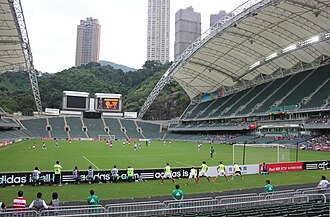 Hong Kong Stadium as seen from the North Stand in November 2012 | |
 Interactive map of 香港大球場 Hong Kong Stadium | |
Former names | Government Stadium |
|---|---|
| Location | 55 Eastern Hospital Road, Causeway Bay, Hong Kong |
| Coordinates | 22°16′25.9″N114°11′19.4″E/22.273861°N 114.188722°E |
| Owner | Leisure and Cultural Services Department |
| Operator | Leisure and Cultural Services Department |
| Capacity | 40,116[1] |
| Surface | Grass |
Field size | 105 by 68 metres (344 ft × 223 ft) |
| Public transit | Causeway Bay station Exit A and F1 |
| Construction | |
| Opened | 1953 |
| Renovated | 1994 |
Cost | US$85 million |
| Architect | HOK Sport[2] |
| Tenants | |
| Hong Kong national football teamEastern (2018–2019) | |
| Website | |
| lcsd.gov.hk/hks | |
| Hong Kong Stadium | |||||||||||||||||||||
|---|---|---|---|---|---|---|---|---|---|---|---|---|---|---|---|---|---|---|---|---|---|
| Traditional Chinese | 香港大球場 | ||||||||||||||||||||
| Simplified Chinese | 香港大球场 | ||||||||||||||||||||
| |||||||||||||||||||||
| Hong Kong Government Stadium | |||||||||||||||||||||
| Traditional Chinese | 香港政府大球場 | ||||||||||||||||||||
| Simplified Chinese | 香港政府大球场 | ||||||||||||||||||||
| |||||||||||||||||||||
| nickname | |||||||||||||||||||||
| Traditional Chinese | 埔頭 | ||||||||||||||||||||
| Simplified Chinese | 埔头 | ||||||||||||||||||||
| Literal meaning | Head of the port | ||||||||||||||||||||
| |||||||||||||||||||||
Hong Kong Stadium is the main sports venue of Hong Kong. Redeveloped from the original Government Stadium, it reopened as Hong Kong Stadium in March 1994. It has a maximum seating capacity of 40,000, including 18,260 at the main level, 3,173 at executive level, 18,510 upper-level seats and 57 seats for wheelchair users.
The stadium is located in Causeway Bay, Hong Kong Island, in valley of Caroline Hill. It hosted the inauguralAFC Asian Cup finals and the AFC Women's Asian Cup for four times. Most international football matches held in Hong Kong are held at this stadium. Between 1982 and 2024, it hosted the Hong Kong Sevens annually. Hong Kong Stadium has also hosted the Rugby World Cup Sevens twice, in 1997 and 2005. The stadium is home to the Hong Kong national football team and hosts international matches for Hong Kong Premier League club side Kitchee SC.
History
So Kon Po was formerly the burial ground for the 1918 Fire at Happy Valley Racecourse. Then the Hong Kong Government moved all the tombs to Aberdeen. The old Government Stadium was a U-shaped constructed by 1953 and had a capacity of 28,000[3] with partially covered seating.
The old Government Stadium was only partially covered, without sufficient seats or lighting systems. In the 90s, the Royal Hong Kong Jockey Club proposed a reconstruction plan so that Hong Kong can have a world class sports stadium.
1994 Re-construction and Wembley International
In the early 1990s, the Government Stadium was reconstructed into a 40,000-seat rectangular stadium. No running track was built due to the restricted land size. This forced the schools to look for alternative venues.
The stadium's management contract was won by Wembley International, a foreign subsidiary of Wembley Stadium, against strong competition, in March 1994.
From the first day there have been serious problems with the pitch. The owners of the stadium, the Urban Council, were disappointed.[4] It came under fire from local football officials, sports promoters and even Manchester United manager Alex Ferguson, who said, before the exhibition match between Manchester United and South China AA on 20 July 1997, "The pitch is cutting up. The surface is just sand-based and the turf doesn't hold well. Injuries can occur."[5]
The government had hoped that the stadium could be used as a music concert venue in order to bring in more rental income. But nearby citizens complained endlessly about 'noise levels', leading to restrictions on noise levels that effectively rendered the stadium unsuitable for concerts. This reduced greatly the income levels of the stadium and the management company, Wembley, ran into financial troubles.
1998 Hong Kong government takeover
Wembley's management tenure at the stadium was abruptly terminated by the Provisional Urban Council (PUC) on 26 May 1998. PUC also asked Urban Services Department (USD) to assume temporary management of the Hong Kong Stadium and has also agreed to USD's proposals to return the entire pitch of the Hong Kong Stadium.[6] The fundamental issue between the parties was the care and maintenance of the stadium pitch, but also a complaint about an unauthorized bungy jump by Canadian Paul G. Boyle.
In the end, the Hong Kong government was judged to have wrongfully terminated the management agreement and had to pay over HK$20 million in damages to Wembley Plc.[7]
Hong Kong Stadium is now managed by the Leisure and Cultural Services Department of Hong Kong, after the Urban Council was disbanded.
Football
Local matches
Hong Kong Premier League
Hong Kong Premier League clubs South China, Kitchee, Pegasus and Eastern had used Hong Kong Stadium as home.
Full house
The first full house official football match (i.e. non-exhibition match) at the Hong Kong Stadium was the 2009 AFC Cup semi-final second leg between South China AA and Kuwait SC.[8] This was added to in the same year by the 2009 East Asian Games football final between Hong Kong U23 and Japan U23. Although there were empty seats in the stadium, all tickets were sold or distributed.[9]
International matches
Hong Kong Stadium had hold numerous exhibition games. Notable national teams include Argentina and England. For clubs, all Premier LeagueBig Six clubs—Arsenal, Chelsea, Liverpool, Manchester City, Manchester United, and Tottenham Hotspur have played in the stadium. Other famous clubs include Aston Villa, Atlético Madrid, Barcelona, PSV Eindhoven, Juventus, Leicester City, AC Milan, Inter Milan, Newcastle United, Paris Saint-Germain, Real Madrid and São Paulo.[10]
AFC Asian Cup
The inauguralAFC Asian Cup finals was held in Hong Kong Stadium from 1 September to 15 September 1956 as a four-team round-robin competition with no final. It was won by South Korea, while Hong Kong finished third place.[11][12] The stadium has also hosted the AFC Women's Asian Cup for four times, including the inaugural in 1975, 1981, 1986 and 1989.[13]
Lunar New Year Cup
The stadium has hosted matches of the Lunar New Year Cup. Notable visiting national teams include Brazil, Chile, Colombia, Denmark, Mexico, Sweden, Switzerland, Uruguay, and FR Yugoslavia.[14]
1997–98 Asian Club Championship
The semi-finals and final of the 1997–98 Asian Club Championship were held at Hong Kong Stadium.[15]
Hong Kong v Real Madrid
Luis Figo scored the first goal for Real Madrid from the penalty spot after Roberto Carlos was brought down in the area during the pre-season friendly match against Hong Kong select XI at the Hong Kong Stadium on 8 August 2003. Real Madrid won the match 4–2.[16]
Kitchee v Manchester City
On 24 July 2019, Hong Kong Stadium held a club friendly match between Premier League champions Manchester City and Hong Kong Premier League club Kitchee. where Manchester City won 6–1.[17]
Hong Kong v Inter Miami
On 4 February 2024, Hong Kong Stadium held a friendly match between Hong Kong League XI and Inter Miami CF, led to a controversy due to Lionel Messi's absence.[18]
Premier League Asia Trophy
The ground has hosted the Premier League Asia Trophy for four times, including the 2007, 2011, 2013 and 2017 edition, more than any other stadium.[19]
Saudi Super Cup
Hong Kong Stadium hosted the Saudi Super Cup in 2025.[20]
Notable football matches held at Hong Kong Stadium


Rugby
From 1982 to 2024, the annual Hong Kong Sevens tournament was hosted at Hong Kong Stadium. The stadium has also hosted the Rugby World Cup Sevens twice, in 1997 and 2005.
On 1 November 2008, the ground became the first stadium outside of Australia and New Zealand to host a Bledisloe Cuptest match, where New Zealand's All Blacks triumphed over Australia's Wallabies with a score of 19–14.[64] In 2010, the Hong Kong Stadium welcomed 26,210 spectators for the second Bledisloe Cup rugby union game.[65]
On 1 June 2013, the British and Irish Lions and Barbarian F.C. played a rugby union match at the Hong Kong Stadium.[66]
Hong Kong International Cricket Sixes
The ground has hosted matches of the Hong Kong International Cricket Sixes since 1996 to 1997.
2009 East Asian Games
The stadium was used as the final venue for both the Rugby 7s and Football tournaments of the 2009 East Asian Games. Hong Kong's rugby 7s team and football team both made the final against Japan. The rugby 7s team finished second to Japan. While the football team defeated them in front of over 31,000 spectators, including Donald Tsang, winning the Hong Kong football team's first ever international medal.
2013 muddy turf fiasco
In 2013, during the Barclays Asia Trophy, Sunderland manager Paolo Di Canio described the pitch as "a killer", while Manchester City centre-back Matija Nastasić is injured on the mudheap pitch, although Nastasić's injury was caused by a kick to the ankle according to City manager Manuel Pellegrini, who refused to blame the muddy pitch. Tottenham Hotspur manager André Villas-Boas was also critical of the pitch after Jan Vertonghen, a first-choice Spurs defender, incurred an ankle injury playing on the surface. "If I can be sincere, I would prefer not to play, but this is the reality that we have to face," said the Portuguese on the eve of his side's friendly against South China AA.[67]Manchester United then cancelled their public training session at the stadium on Sunday amid concerns over the playing surface, did not want to further damage the playing surface or risk any injuries to their players, ahead of their exhibition match with Kitchee SC on 29 July.[68]
On 30 July, the director of leisure and cultural services, Betty Fung Ching Suk-yee said returfing the much-criticised Hong Kong Stadium pitch is being considered, after football fans worldwide slammed the sodden, muddy surface during Barclays Asia Trophy matches on 24 and 27 July. South China FC chairman Steven Lo said in an official blog that recent matches have exposed a serious management problem. Chief Executive Leung Chun-ying said he has asked the Home Affairs Bureau and the Leisure and Cultural Services Department for short, medium and long-term remedies.[69]
In 2015, with support from the Jockey Club, the pitch was completely returfed. The existing turf and soil was removed, the irrigation and drainage systems replaced, and new turf laid.[70]
Non-sports events
Jean-Michel Jarre held a concert at the Hong Kong Stadium on 11 March 1994. It was the first event after the re-construction of the Hong Kong Stadium.
Alan Tam held a concert at the Hong Kong Stadium from 22 to 24 April 1994. It was the first local artist held here.
On 16 March 1994 British band Depeche Mode performed at the Hong Kong Stadium as a stop of its Exotic Tour/Summer Tour '94.

The only time the venue is used for live events is the Extravaganza of China Olympic Gold Medallists celebration show for the Chinese gold medallists.[71]
Bon Jovi played a concert at the stadium on 25 September 1993 during I'll Sleep When I'm Dead Tour. It was their first concert in Hong Kong.
Canadian Paul G. Boyle illegally bungy jumped from the roof of the Hong Kong Stadium on the morning of Friday 24 May 1996. He was not arrested but was given a lifetime ban from all Urban Council facilities.[72]
Facilities
Hong Kong Stadium can accommodate 40,000. The spread is as below:
- 18,256 at Main level
- 18,507 at Upper levels
- 3,153 at Executive levels
- 57 wheelchair spaces
In addition, there are many refreshment kiosks inside the stadium.
Other use
The stadium was supposed to be a multi purpose entertainment and sports venue, due to its much greater capacity compared to the other popular and over used Hong Kong Coliseum, where nearly all uses are now strictly for popular entertainment. However, its open-air nature has led to noise complaints from residents in tower blocks surrounding the stadium. It has not been allowed to host entertainment events since 1999.
Gallery

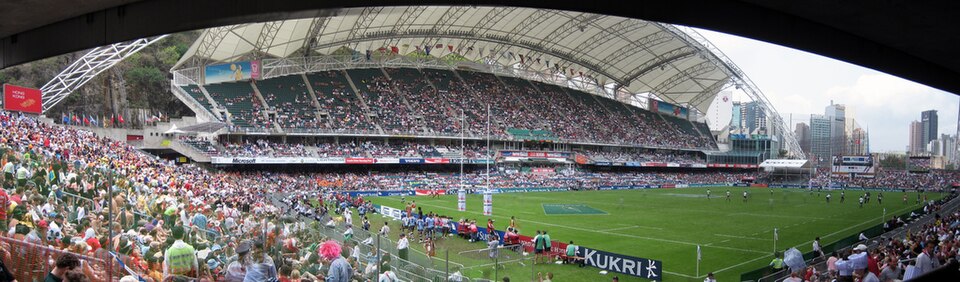
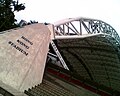 Steel frame that supports the canopy
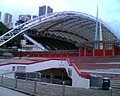 East Grandstand
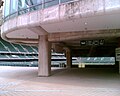 Walkway at the Grandstand
 Memorial plaque
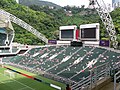 lawn
lawn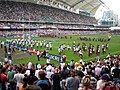 ceremony
 2009
2009
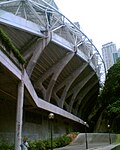 2006
2006
See also
ลิงก์ภายนอก

- เว็บไซต์อย่างเป็นทางการ

- ภาพถ่ายสนามกีฬารัฐบาลเก่าและสนามกีฬาฮ่องกง