
ไม้เบสบอลอิปาเนมา
| ไม้เบสบอลอิปาเนมา | |
|---|---|
 | |
การจำแนกทางวิทยาศาสตร์ | |
| อาณาจักร: | แอนิมอลเลีย |
| ไฟลัม: | คอร์ดาต้า |
| ระดับ: | สัตว์เลี้ยงลูกด้วยนม |
| อินฟราคลาส: | รก |
| คำสั่ง: | ค้างคาว |
| ตระกูล: | ฟิลโลสโตมิเด |
| ประเภท: | ไพโกเดอร์มาปีเตอร์ส , 1863 |
| สายพันธุ์: | พี. บิลาเบียตัม |
| ชื่อทวินาม | |
| ไพโกเดอร์มา บิลาเบียตัม ( วากเนอร์ , 1843) | |
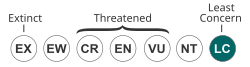
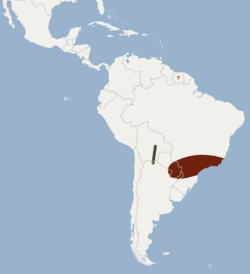 | |
ค้างคาวอิปาเนมา ( Pygoderma bilabiatum ) เป็นค้างคาวชนิดหนึ่งในอันดับChiropteraและวงศ์ Phyllostomidae พบในภาคเหนือของอาร์เจนตินา โบลิเวีย ทางตะวันออกเฉียงใต้ของบราซิล และปารากวัย[ 1 ]เป็นชนิดเดียวในสกุลนี้[ 2 ]
คำอธิบาย
ค้างคาวอิปาเนมาเป็นค้างคาวขนาดกลาง มีขนสีน้ำตาลทั่วทั้งตัว ยกเว้นบริเวณไหล่ที่มีขนสีขาว[ 3 ]ขนบริเวณหลังมีสีน้ำตาลเข้มกว่าบริเวณหน้าอก[ 3 ]มีขนบริเวณไหล่และหน้าอกส่วนบนน้อยกว่าส่วนอื่นๆ ของร่างกาย โดยเฉพาะในตัวผู้[ 3 ] [ 4 ]จะงอยปากสั้นกว่าและมีรูปร่างเป็นสี่เหลี่ยมมากกว่าค้างคาวชนิดอื่นๆ ในวงศ์ย่อยStenodermatinae [ 3 ] [ 5 ] มีจมูกขนาดใหญ่และไม่มีหาง มีหูกลมๆ และมี ติ่งหูขนาดเล็ก 4–5 มม. (0.16–0.20 นิ้ว) [ 3 ]
ขนาดจะแตกต่างกันไปตามเพศและสถานที่ทางภูมิศาสตร์ โดยทั่วไปตัวเมียจะมีขนาดใหญ่กว่าตัวผู้[ 5 ] [ 6 ] [ 4 ]กะโหลกของค้างคาวอิปาเนมาจากอาร์เจนตินาและโบลิเวียมีขนาดใหญ่กว่ากะโหลกของค้างคาวชนิดเดียวกันในปารากวัยและบราซิล[ 6 ] P. bilabiatumโดยทั่วไปจะมีฟันกรามสองซี่[ 3 ] [ 7 ]อย่างไรก็ตาม ตัวเมียบางตัวมีฟันกรามซี่ที่สาม (โดยปกติจะอยู่ในขากรรไกรล่าง) ซึ่งไม่พบในตัวผู้[ 3 ] [ 7 ]สิ่งนี้อาจมีความสัมพันธ์กับขนาดขากรรไกรที่ใหญ่กว่าของตัวเมีย[ 7 ]
While both males and females have glands below the jaw and surrounding the eyes, the glands in males are generally larger.[4] Males also have forelimb swellings, which are not seen in females.[5] The size and presence of such swellings varies geographically.[5] Additionally, forelimb swellings appear to be correlated with development of the males' eye glands.[5] Due to the dimorphism of forelimb swellings, It is thought that they could be correlated with mating behaviors.[5]
Range and habitat
The Ipanema bat resides in northern Argentina, southeastern Brazil, Paraguay, and Bolivia.[8][6] Their preferred habitats are tropical forests, subtropical forests, and secondary forests.[9] Although atypical, they are sometimes found in the coastal shrublands of Brazil.[9] This suggests that perhaps P. bilabiatum can expand its habitat into dryer, more sparsely vegetated areas.[9]
Biology
P. bilabiatum is frugivorous, specializing in fruit that is easily digested.[4] These fruits are usually very ripe and fleshy, with few seeds.[4] The fruit choices of the Ipanema bat are diverse, including the fruits of Lucuma caimito, Miconia brasiliensis, and trees of the genus Celtis, as well as Maclura tinctoria, Solanum granuloso-leprosum, and Ficus enormis.[3][4][10][11] Some may also feed on nectar.[4]
P. bilabiatum usually reproduces in either the fall or the winter.[4] It is thought that they give birth during the later end of the dry period and wean their young at the beginning of the wet period.[11] This strategy coordinates birth with the highest amount of fruit attainability.[11] Females only carry one fetus at a time.[4]
Behavior
รูปแบบ การอพยพอาจได้รับอิทธิพลจากปริมาณน้ำฝนและ/หรืออุณหภูมิP. biliabatumดูเหมือนจะชอบภูมิภาคที่มีปริมาณน้ำฝนรายปีขั้นต่ำ 1,500 มม. (59 นิ้ว) และอุณหภูมิปานกลาง 16–23 °C (61–73 °F) [ 8 ]ความพร้อมของอาหารและความสามารถในการหาอาหารดูเหมือนจะเป็นปัจจัยสำคัญในการกำหนดช่วงเวลาและระยะทางที่เดินทางระหว่างการอพยพ[ 8 ]เพศเมียและเพศผู้มีการอพยพแตกต่างกัน[ 8 ]เพศผู้มักจะอาศัยอยู่ในระดับความสูงต่ำ ในขณะที่เพศเมียอาศัยอยู่ในระดับความสูงปานกลางและสูง[ 8 ]