
รัฐบาลอิหร่าน
 ตราสัญลักษณ์ของสาธารณรัฐอิสลามอิหร่าน | |
| การก่อตัว | 1 เมษายน 2522 ( 1979-04-01 ) (ก่อตั้งสาธารณรัฐอิสลาม) 21 สิงหาคม 2523 ( 1980-08-21 ) (การประชุมสมัชชาที่ปรึกษาอิสลามครั้งแรก) |
|---|---|
| เอกสารก่อตั้ง | รัฐธรรมนูญแห่งสาธารณรัฐอิสลามอิหร่าน |
| เขตอำนาจศาล | อิหร่าน |
| เว็บไซต์ | irangov |
| ฝ่ายนิติบัญญัติ | |
| สภานิติบัญญัติ | สภาที่ปรึกษาอิสลาม |
| จุดนัดพบ | บาฮาเรสตาน |
| ฝ่ายบริหาร | |
| ผู้นำ | ประมุขแห่งรัฐ(โดยนิตินัย) :ผู้นำการปฏิวัติ (1979) ผู้นำสูงสุด (ตั้งแต่ปี 1979) สภาผู้นำชั่วคราว (2026) ผู้กำกับดูแลสามสาขาของรัฐ (ตุลาการ นิติบัญญัติ และบริหาร): ผู้นำสูงสุด (ตั้งแต่ปี 1979) สภาผู้นำชั่วคราว (2026) ประมุขแห่งรัฐ(ตามองค์การสหประชาชาติ) : ประธานาธิบดี (ตั้งแต่ปี 1980) หัวหน้าฝ่ายบริหาร: นายกรัฐมนตรี (1979) ประธานสภาการปฏิวัติอิสลาม (1979–1980) นายกรัฐมนตรี (1980–1989) ประธานาธิบดี (ตั้งแต่ปี 1989) รักษาการหัวหน้าฝ่ายบริหาร: ประธานาธิบดี (ตั้งแต่ปี 1980) รองหัวหน้าฝ่ายบริหาร: รองประธานาธิบดีคนที่หนึ่ง(ตั้งแต่ปี 1989) ผู้บัญชาการทหารสูงสุดแห่งกองทัพอิหร่าน:ผู้นำการปฏิวัติ (1979) ผู้นำสูงสุด (1979–1980) ประธานาธิบดี (1980–1981) ผู้นำสูงสุด (ตั้งแต่ปี 1981) สภาผู้นำชั่วคราว (2026) |
| ผู้แต่งตั้ง | สภาผู้เชี่ยวชาญ (ผู้นำสูงสุด) การเลือกตั้งโดยตรงจากประชาชน (ประธานาธิบดี) |
| สำนักงานใหญ่ | ปาสเตอร์ |
| อวัยวะหลัก | ตู้ |
| แผนกต่างๆ | 19 กระทรวง |
| ฝ่ายตุลาการ | |
| ศาล | ระบบยุติธรรมของสาธารณรัฐอิสลามอิหร่าน |
| ที่นั่ง | ศาลแห่งเตหะราน |
|
|---|
| รัฐบาลอิหร่าน• รัฐธรรมนูญของอิหร่าน |
|


รัฐบาลแห่งสาธารณรัฐอิสลามอิหร่าน ( ภาษาเปอร์เซีย: نظام جمهوری اسلامی ایران , โรมันไนซ์ : Nezâm-e Jomhuri-ye Eslâmi-ye Irân ) [ 1 ]คือรัฐบาลแห่งชาติของอิหร่าน [ 2 ]ซึ่งตามรัฐธรรมนูญของสาธารณรัฐอิสลามอิหร่านนั้นก่อตั้งขึ้นบนหลักการของอิสลาม
Its constitution, adopted in 1979 by referendum,[3] established a system combining elements of theocracy and republican governance. The constitution provides for separation of powers, among executive, legislative and judicial systems.[4] The supreme leader of Iran serves as the country's head of state and commander-in-chief of the armed forces and holds ultimate authority over key state institutions, including the military, judiciary, and state broadcasting.[5]
It is currently one of the three governments using the title Islamic Republic.[6][7] Iran operates as a unitary state.[8][9]
Creation

The Islamic Republic of Iran was created shortly after the Islamic Revolution. The first major demonstrations with the intent to overthrow the ShahMohammad Reza Pahlavi began in January 1978,[10] with a new, Islam-based, theocratic Constitution being approved in December 1979, ending the monarchy. The Shah left Iran for exile[11] in January 1979 after large strikes and demonstrations against him and his regime paralyzed the country. Ayatollah Khomeini would return in February of the same year after a long period of exile, greeted in the capital of Tehran by several million Iranians.[12] The final collapse of the Pahlavi dynasty occurred shortly after on 11 February when Iran's military declared itself officially "neutral" after guerrillas and rebel troops overwhelmed forces loyal to the Shah in street fights throughout the country.
หลังจากการปฏิวัติอิสลาม ได้รับชัยชนะ รัฐบาลรักษาการของอิหร่านได้จัดการลงประชามติในวันที่ 30 และ 31 มีนาคม พ.ศ. 2522 (10 และ 11 ฟาร์วาร์ดินพ.ศ. 2391) โดยขอให้ประชาชนลงคะแนนเสียงว่าเห็นด้วยหรือไม่เห็นด้วยกับการจัดตั้งสาธารณรัฐอิสลาม[ 13 ]ผลการลงประชามติได้รับการประกาศในเวลาต่อมาโดยอยาตอลลาห์ โคมัยนีในวันที่ 2 เมษายน พ.ศ. 2522 โดยมีประชาชนชาวอิหร่าน 98.2 เปอร์เซ็นต์ลงคะแนนเสียงเห็นด้วยกับการจัดตั้งสาธารณรัฐอิสลาม[ 14 ] [ 15 ]
รัฐธรรมนูญ
ในวันที่ 2–3 ธันวาคม พ.ศ. 2522 รัฐธรรมนูญแห่งสาธารณรัฐอิสลามอิหร่านได้รับการให้สัตยาบันโดยการลง ประชามติ ในการลงประชามตินี้ ผู้มีสิทธิเลือกตั้งชาวอิหร่าน 99.5 เปอร์เซ็นต์เห็นชอบรัฐธรรมนูญ[ 16 ] [ 17 ] สิบปีต่อมา ในช่วงฤดูร้อนของ ปีพ.ศ. 2532 ผู้มีสิทธิเลือกตั้งชาวอิหร่านได้อนุมัติการแก้ไขเพิ่มเติมรัฐธรรมนูญ พ.ศ. 2522 ในการลงประชามติอีกครั้ง [ 18 ] [ 19 ]รัฐธรรมนูญนี้ถูกเรียกว่าเป็น "ลูกผสม" ของ "องค์ประกอบเทวธิปไตยและประชาธิปไตย" ในขณะที่มาตรา 1 และ 2 มอบอำนาจอธิปไตยให้แก่พระเจ้า มาตรา 6 "กำหนดให้มีการเลือกตั้งประธานาธิบดีและรัฐสภา" [ 20 ]ขั้นตอนและสิทธิทางประชาธิปไตยทั้งหมดอยู่ภายใต้สภาผู้พิทักษ์และผู้นำสูงสุดซึ่งอำนาจของพวกเขาระบุไว้ในบทที่แปด (มาตรา 107–112) [ 20 ] [ 21 ]
หลักการ
รัฐบาลของสาธารณรัฐอิสลามอิหร่านเป็นสาธารณรัฐเทวธิปไตย อย่าง เป็นทางการ [ 18 ]มาตรา 2 ของรัฐธรรมนูญอธิบายหลักการของรัฐบาลสาธารณรัฐอิสลามอิหร่าน:
มาตรา 2
สาธารณรัฐอิสลามเป็นระบบที่ตั้งอยู่บนความเชื่อใน:
1. พระเจ้าองค์เดียว (ดังที่กล่าวไว้ในวลี "ไม่มีพระเจ้าอื่นใดนอกจากอัลลอฮ์") อำนาจอธิปไตยแต่เพียงผู้เดียวของพระองค์ และสิทธิในการออกกฎหมาย รวมถึงความจำเป็นในการเชื่อฟังพระบัญชาของพระองค์ 2. การเปิดเผยจากพระเจ้าและบทบาทพื้นฐานในการกำหนดกฎหมาย 3. การกลับคืนสู่พระเจ้าในโลกหน้า และบทบาทเชิงสร้างสรรค์ของความเชื่อนี้ในการยกระดับมนุษย์ไปสู่พระเจ้า 4. ความยุติธรรมของพระเจ้าในการสร้างและการออกกฎหมาย 5. การนำโดยผู้นำ (อิมามะห์) อย่างต่อเนื่องและการชี้นำตลอดกาล และบทบาทพื้นฐานในการรับประกันกระบวนการปฏิวัติอิสลามอย่างไม่ขาดตอน 6. ศักดิ์ศรีและคุณค่าอันสูงส่งของมนุษย์ และเสรีภาพของเขาควบคู่ไปกับความรับผิดชอบต่อพระเจ้า ซึ่งความเสมอภาค ความยุติธรรม ความเป็นอิสระทางการเมือง เศรษฐกิจ สังคม และวัฒนธรรม ตลอดจนความสามัคคีของชาติได้รับการรับประกันโดยอาศัย: 1. การวินิจฉัยอย่างต่อเนื่องของบรรดานักนิติศาสตร์ผู้ทรงคุณวุฒิที่มีคุณสมบัติเหมาะสม ซึ่งดำเนินการบนพื้นฐานของอัลกุรอานและซุนนะห์ของบรรดาผู้ทรงคุณธรรม ขอความสันติสุขจงมีแด่พวกเขาทุกคน; 2. วิทยาศาสตร์และศิลปะ และผลลัพธ์ที่ก้าวหน้าที่สุดจากประสบการณ์ของมนุษย์ พร้อมทั้งความพยายามที่จะพัฒนาสิ่งเหล่านั้นให้ดียิ่งขึ้นไปอีก
3. การปฏิเสธการกดขี่ทุกรูปแบบ ทั้งการกระทำและการยอมจำนนต่อการกดขี่ และการครอบงำ ทั้งการบังคับและการยอมรับการครอบงำ[ 22 ]
โครงสร้างทางการเมือง
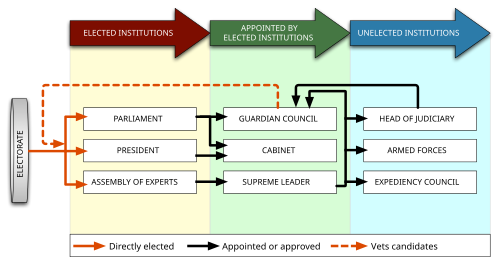
ความเป็นผู้นำ
ผู้นำสูงสุดของสาธารณรัฐอิสลามอิหร่าน หรือที่เรียกอย่างเป็นทางการว่า ผู้นำสูงสุดในอิหร่าน เป็นตำแหน่งที่จัดตั้งขึ้นตามมาตรา 5 ของรัฐธรรมนูญแห่งสาธารณรัฐอิสลามอิหร่าน ตามแนวคิดของ การปกครองโดยนัก นิติศาสตร์อิสลาม [ 22 ]ตำแหน่งนี้มีวาระตลอดชีพ[ 23 ]ตามมาตรา 110 ของรัฐธรรมนูญ ผู้นำสูงสุดเป็นผู้กำหนดนโยบายทั่วไปของสาธารณรัฐอิสลาม มาตรา 109 เกี่ยวกับคุณสมบัติของผู้นำและมาตรา 110 กล่าวถึงหน้าที่และภาระหน้าที่ของผู้นำสูงสุดตามมาตรานี้ เขาเป็นผู้บัญชาการทหารสูงสุด นอกจากนี้ ตามมาตรา 57 ระบบนิติบัญญัติ บริหาร และตุลาการจะต้องดำเนินการภายใต้การกำกับดูแลของผู้นำสูงสุด[ 22 ]สาธารณรัฐอิสลามมีผู้นำสูงสุด 3 คน ได้แก่ อยาตอลลาห์ รูฮอลลาห์ โคมัยนี ซึ่งดำรงตำแหน่งตั้งแต่การปฏิวัติอิหร่านในปี 1979 จนกระทั่งเสียชีวิตในปี 1989 อยาตอลลาห์ อาลี คาเมเนอี ซึ่งดำรงตำแหน่งตั้งแต่การเสียชีวิตของโคมัยนีจนกระทั่งถูกลอบสังหารในปี 2026 และโมจตาบา คาเมเนอีซึ่งดำรงตำแหน่งตั้งแต่บิดาของเขาถูกลอบสังหาร
สภาผู้เชี่ยวชาญ
สภาผู้เชี่ยวชาญ หรือสภาผู้เชี่ยวชาญของผู้นำ เป็นองค์กรพิจารณาของ มุจตะฮิดจำนวน 88 คนสมาชิกได้รับการเลือกตั้งโดยการลงคะแนนเสียงโดยตรงจากประชาชนเป็นระยะเวลา 8 ปี[ 24 ]
ตามมาตรา 107, 109 และ 111 ของรัฐธรรมนูญ หน้าที่ของสภาได้แก่ การเลือกตั้งและถอดถอนผู้นำสูงสุดของอิหร่าน[ 22 ] [ 25 ]
การเลือกตั้งครั้งล่าสุดจัดขึ้นเมื่อวันที่ 1 มีนาคม พ.ศ. 2567 ส่งผลให้มีการจัดตั้งสมัชชาผู้เชี่ยวชาญชุดที่หกขึ้น โดยมีการประชุมครั้งแรกเมื่อวันที่ 21 พฤษภาคม พ.ศ. 2567 และได้เลือกโมฮัมหมัด-อาลี โมวาเฮดี เคอร์มานีเป็นประธาน[ 26 ]
สภานิติบัญญัติ
สภานิติบัญญัติแห่งสาธารณรัฐอิสลามอิหร่านประกอบด้วยสองส่วน คือ สภาที่ปรึกษาอิสลามและสภาผู้พิทักษ์รัฐธรรมนูญ มาตรา 62-99 กล่าวถึงสภานิติบัญญัติแห่งสาธารณรัฐอิสลามอิหร่าน
สมัชชาที่ปรึกษา
มาตรา 62-90 ของรัฐธรรมนูญแห่งสาธารณรัฐอิสลามอิหร่านกล่าวถึงสภาที่ปรึกษาอิสลาม ในมาตรา 71 ระบุว่า สภาที่ปรึกษาอิสลามสามารถออกกฎหมายได้ในทุกเรื่อง ภายในขอบเขตอำนาจหน้าที่ตามที่กำหนดไว้ในรัฐธรรมนูญ ตามมาตรา 62 สภาที่ปรึกษาอิสลามประกอบด้วยผู้แทนของประชาชนที่ได้รับการเลือกตั้งโดยตรงและโดยการลงคะแนนลับ มาตรา 64 ระบุว่า สภาที่ปรึกษาอิสลามจะต้องมีสมาชิก 270 คน ซึ่งเมื่อพิจารณาปัจจัยด้านมนุษย์ การเมือง ภูมิศาสตร์ และปัจจัยอื่น ๆ ที่คล้ายคลึงกัน อาจเพิ่มขึ้นได้ไม่เกิน 20 คน ในแต่ละช่วง 10 ปี นับจากวันที่การลงประชามติระดับชาติในปี ค.ศ. 1368 ตามปฏิทินสุริยคติอิสลาม[ 22 ]ปัจจุบันรัฐสภามีผู้แทน 290 คน ซึ่งเปลี่ยนแปลงจาก 272 ที่นั่งก่อนหน้านี้ นับตั้งแต่การเลือกตั้งเมื่อวันที่ 18 กุมภาพันธ์ พ.ศ. 2543 การเลือกตั้ง ครั้งล่าสุดเกิดขึ้นเมื่อวันที่ 26 กุมภาพันธ์ พ.ศ. 2559 และรัฐสภาใหม่เปิดทำการเมื่อวันที่ 28 พฤษภาคม พ.ศ. 2559 [ 27 ]
สภาผู้พิทักษ์
สภาผู้พิทักษ์เป็นส่วนหนึ่งของฝ่ายนิติบัญญัติซึ่งทำหน้าที่ในหลายแง่มุมเสมือนสภาสูงของสภาที่ปรึกษา สภานี้จะตรวจสอบกฎหมายที่ออกโดยสภาที่ปรึกษาเพื่อพิจารณาความสอดคล้องกับศาสนาอิสลามและรัฐธรรมนูญ[ 28 ]
มาตรา 91-99 เกี่ยวกับสภาผู้พิทักษ์ ตามมาตรา 91 สภานี้มีสมาชิก 12 คน ครึ่งหนึ่งเป็นฟากีฮ์ที่ได้รับการเลือกโดยผู้นำสูงสุด และอีก 6 คนเป็นนักนิติศาสตร์ที่ได้รับการเลือกตั้งโดยสภาที่ปรึกษาอิสลามจากบรรดานักนิติศาสตร์มุสลิมที่ได้รับการเสนอชื่อโดยหัวหน้าผู้พิพากษาของอิหร่าน[ 22 ]
ผู้บริหาร
ประธาน
In the Islamic Republic of Iran, the president is the second person of government and the head of government. He is the highest nominally popularly elected official in Iran, although he answers to the Supreme Leader of Iran, who functions as the country's head of state. Chapter 9 (Articles 133–142) of the Constitution of the Islamic Republic of Iran sets forth the qualifications for presidential candidates and procedures for election, as well as the powers and responsibilities as "functions of the executive". These include signing treaties and other agreements with foreign countries and international organizations, administering national planning, budget and state employment affairs and appointing ministers subject to the approval of Parliament.[22]
According to article 114 the President of Iran is elected for a four-year term by the direct vote of the people and may not serve for more than two consecutive terms nor more than eight years.[22]
Vice president
Cabinet
Judicial system
The judiciary of the Islamic Republic of Iran is an independent power, the protector of the rights of the individual and society, responsible for the implementation of justice, and entrusted with the following duties:
- investigating and passing judgement on grievances, violations of rights, and complaints; the resolving of litigation; the settling of disputes; and the taking of all necessary decisions and measures in probate matters as the law may determine;
- restoring public rights and promoting justice and legitimate freedoms;
- supervising the proper enforcement of laws;
- uncovering crimes; prosecuting, punishing, and chastising criminals; and enacting the penalties and provisions of the Islamic penal code;
- taking suitable measures to prevent the occurrence of crime and to reform criminals. (Article 156 of Constitution).[22]
Other institutions
Expediency Discernment Council
The Expediency Discernment Council is an administrative assembly appointed by the Supreme Leader[29] and was created upon the revision to the Constitution of the Islamic Republic of Iran on 6 February 1988.[30] According to article 112 of Constitution[22] it was originally set up to resolve differences or conflicts between the Consultative Assembly and the Guardian Council, but "its true power lies more in its advisory role to the Supreme Leader".
Members of the council are chosen by the Supreme Leader every five years.[31]
Sadiq Amoli Larijani is the chairman of this council.
Local councils

According to Article 7, city and village councils form one of the decision-making and administrative organs of the country. Chapter seven (article 100–106) of Iran's constitution is about these local councils. According to article 100: In order to expedite social, economic, development, public health, cultural, and educational programmes and facilitate other affairs relating to public welfare with the cooperation of the people according to local needs, the administration of each village, division, city, municipality, and province will be supervised by a council to be named the Village, Division, City, Municipality, or Provincial Council. Members of each of these councils will be elected by the people of the locality in question. Qualifications for the eligibility of electors and candidates for these councils, as well as their functions and powers, the mode of election, the jurisdiction of these councils, the hierarchy of their authority, will be determined by law, in such a way as to preserve national unity, territorial integrity, the system of the Islamic Republic, and the sovereignty of the central government.[22]

Islamic Republic of Iran Broadcasting
The Islamic Republic of Iran Broadcasting (IRIB) according to Constitution is the only radio and television services in Iran.[32] According to article 175 of Constitution the appointment and dismissal of the head of the Islamic Republic of Iran Broadcasting rests with the Leader. A council consisting of two representatives each of the President, the head of the judiciary branch and the Islamic Consultative Assembly shall supervise the functioning of this organization.[22]
Armed forces
General Staff of Armed Forces of the Islamic Republic of Iran
The Supreme Leader appoints the General staff of Armed forces of the Islamic Republic of Iran which is the highest military body in Iran, with an aim to implement policy, monitor and coordinate activities within Armed Forces of the Islamic Republic of Iran.[33]
Islamic Republic of Iran Army
The Islamic Republic of Iran Army (Artesh) is the "conventional military of Iran"[34] and part of Armed Forces of the Islamic Republic of Iran. The army is tasked to protect the territorial integrity of Iranian state from external and internal threats and to project power.[34] According to article 143 of Constitution the Army of the Islamic Republic of Iran is responsible for guarding the independence and territorial integrity of the country, as well as the order of the Islamic Republic.[22] Artesh has its own Joint Staff[35] which coordinates its four separate service branches: Ground Forces, Air Force, Navy and Air Defense Base.[34] The current chief of Army is MG Amir Hatami.[36]
Islamic Revolution Guard Corps
The Islamic Revolutionary Guard Corps (Sepah) is a branch of Iran's Armed Forces, established after the Islamic revolution on 5 May 1979.[37] Article 150 says about Sepah that The Islamic Revolution Guards Corps, organized in the early days of the triumph of the Revolution, is to be maintained so that it may continue in its role of guarding the Revolution and its achievements.[22]
Law Enforcement Force of the Islamic Republic of Iran
Law Enforcement Force of the Islamic Republic of Iran is the uniformed police force in Iran. It was established in 1992 by merging the Shahrbani, Gendarmerie and Committee of Iran into a single force, it has more than 60,000 police personnel served under the Ministry of Interior, including border patrol personnel.[38]
See also
- Ayatollah Ruhollah Khomeini
- Human rights in the Islamic Republic of Iran
- Politics of Iran (links to ministries and government agencies)
Notes
- ↑except in matters directly related to the Leadership
External links
 Media related to Government of Iran at Wikimedia Commons
- Official website of the Executive branch