
เลตเตอร์แฟรก
เลตเตอร์แฟรก ภาษาไอริช : Leitir Fraic | |
|---|---|
หมู่บ้าน | |
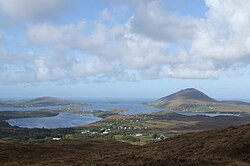 ภาพทิวทัศน์ของเล็ตเตอร์แฟรกและท่าเรือบัลลินาคิลล์ปี 2008 | |
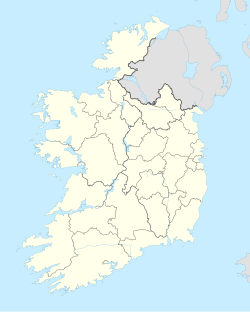  เลตเตอร์แฟรก ที่ตั้งในประเทศไอร์แลนด์ | |
| พิกัด: 53.55°เหนือ 9.95°ตะวันตก53°33′เหนือ9°57′ตะวันตก / | |
| ประเทศ | ไอร์แลนด์ |
| จังหวัด | คอนนาคท์ |
| เขต | เคาน์ตี้กัลเวย์ |
| พิกัดกริดของไอร์แลนด์ | แอล697591 |
LetterfrackหรือLetterfrac ( ภาษาไอริช : Leitir Fraic หรือ Leiter Bhreacซึ่งหมายถึง 'เนินเขาหรือทุ่งลาดเอียงที่มีจุดด่าง') [ 1 ]เป็นหมู่บ้านเล็กๆ ใน เขต Connemaraของเคาน์ตี Galwayประเทศไอร์แลนด์ ก่อตั้งโดยกลุ่มเควกเกอร์ในช่วงกลางศตวรรษที่ 19 หมู่บ้านตั้งอยู่ทางตะวันออกเฉียงใต้ของ คาบสมุทร Renvyle และห่างจาก Clifdenไปทางตะวันออกเฉียงเหนือ 15 กิโลเมตร (9 ไมล์) บน อ่าว Barnadergและตั้งอยู่บริเวณหัวท่าเรือ Ballinakill Letterfrack มีศูนย์บริการนักท่องเที่ยวสำหรับอุทยานแห่งชาติ Connemara
ประวัติศาสตร์
เจมส์และแมรี เอลลิส คู่สามีภรรยาชาวเควกเกอร์จากแบรดฟอร์ด ประเทศอังกฤษ ย้ายมาอยู่ที่เล็ตเตอร์แฟรกในช่วงภาวะอดอยากครั้งใหญ่เอลลิสกลายเป็นเจ้าของที่ดินในเล็ตเตอร์แฟรกในปี 1849 [ 2 ]ในฐานะชาวเควกเกอร์ ครอบครัวเอลลิสต้องการช่วยเหลือในความพยายามบรรเทาทุกข์หลังภาวะอดอยาก พวกเขาเช่าที่ดินรกร้างเกือบ 1,000 เอเคอร์ (405 เฮกตาร์) และเริ่มทำการเกษตรและปลูกป่า[ 3 ]พวกเขาสร้างโรงเรียน ที่พักสำหรับช่างฝีมือ ร้านค้า สถานพยาบาล และโรงแรมปลอดสุรา[ 4 ]ในปี 1857 ทรัพย์สินถูกขายให้กับจอห์น ฮอลล์ ผู้เคร่งศาสนาโปรเตสแตนต์และผู้สนับสนุนคณะมิชชันนารีคริสตจักรไอริชเพื่อชาวโรมันคาทอลิก ICM ใช้ประโยชน์จากอาคารนี้โดยมีเป้าหมายในการเปลี่ยนชาวคาทอลิกให้เป็นโปรเตสแตนต์ หลังจากดำเนินกิจการมา 25 ปีโดยไม่ประสบความสำเร็จมากนัก ฮอลล์จึงขายที่ดินในปี พ.ศ. 2425 ให้กับอาร์ชบิชอปคาทอลิกแห่งทูอัม จอห์น แมคอีวิลลีซึ่งใช้ชื่อปลอมเพื่อให้ฮอลล์เข้าใจผิดว่าผู้ซื้อเป็นโปรเตสแตนต์ ในราคา 3,000 ปอนด์สำหรับที่ดิน 1,000 เอเคอร์ (405 เฮกตาร์) [ 5 ] [ 6 ]ในปี พ.ศ. 2428 เขาได้ก่อตั้งโรงเรียนอุตสาหกรรมเซนต์โจเซฟ เล็ตเตอร์แฟรก[ 4 ]ซึ่งเปิดทำการในปี พ.ศ. 2430 เช่นเดียวกับสถาบันอื่นๆ อีกมากมายที่ดำเนินการโดยคณะภราดรคริสเตียนโรงเรียนอุตสาหกรรมเล็ตเตอร์แฟรกได้กลายเป็นที่รู้จักในทางที่ไม่ดีในเรื่องการใช้การลงโทษทางร่างกาย อย่างรุนแรง การละเลย และการล่วงละเมิดทางเพศเด็กชายที่อยู่ในความดูแล และถูกปิดตัวลงในปี พ.ศ. 2517 [ 7 ] [ 8 ]
สถานีวิทยุมาร์โคนี
Marconi selected St. Joseph's Industrial School in Letterfrack as the location for the transatlantic wireless receiver station for his new duplex transatlantic wireless service. It is one of the earliest Marconi stations still standing in the world. The duplex operation was initially developed by Marconi's engineers at Letterfrack using a balanced Carborundum detector connected to a drop wire from an aerial suspended between Diamond Hill and Mweelin. Duplex communication soon became standard practice for commercial and military radiotelegraphy communication worldwide.
Beginning in April 1911, eastbound messages were sent from Marconi Towers, a high power wireless station in Nova Scotia, to Letterfrack; while westbound messages were sent simultaneously from the Clifden high power wireless station to Louisbourg in 1913. The Letterfrack station was moved to Currywongaun and closed in April 1917. Some experimental work on shortwave and other work, by Marconi engineers Franklin and Witt, was carried out into the early 1920s.
St. Joseph's church

In 1924–26 a church was built on the ground of the Industrial School after the designs of the architect Rudolf Maximilian Butler in a Romanesque Revival style. The church was dedicated to Saint Joseph by Thomas Gilmartin on 12 June 1926. The church consists of a single four-bay nave aligned north–south with two small side chapels and an attached sacristy on its western side.[9][10][11]
Atlantic TU (GMIT) campus

In 1987 the Connemara West began running furniture courses which has become the Furniture College/Campus for the Atlantic Technological University.[14][15]
Sport
West Coast United F.C., the local association football team, was founded in 1984. As of 2021, the club had approximately 250 members across their senior team, over 40s team and the West Coast Utd Academy (launched in 2013) for boys and girls aged 5 to 11. The club won the Second Division Cup in 1994 and 1996/97, and the Jack Lillis Cup in 2010/11. The club's facility in Letterfrack has a sand-based playing pitch, a floodlit all-weather training pitch, and a clubhouse with changing rooms, meeting room and gymnasium.[16]
Media
สถานีวิทยุชุมชนคอนเนมาราออกอากาศจากเมืองเล็ตเตอร์แฟรก
ดูเพิ่มเติม
อ่านเพิ่มเติม
- Whelan D. (บรรณาธิการ) ก่อตั้งบนความกลัว: โรงเรียนอุตสาหกรรมเล็ตเตอร์แฟรก สงคราม และการเนรเทศโดยปีเตอร์ ไทเรลล์ สำนักพิมพ์ Irish Academic Press 2006 ISBN 978-0-7165-3403-7