
Pachyphytum
| Pachyphytum | |
|---|---|
 | |
| Pachyphytum oviferum | |
Scientific classification | |
| Kingdom: | Plantae |
| Clade: | Embryophytes |
| Clade: | Tracheophytes |
| Clade: | Spermatophytes |
| Clade: | Angiosperms |
| Clade: | Eudicots |
| Order: | Saxifragales |
| Family: | Crassulaceae |
| Subfamily: | Sempervivoideae |
| Tribe: | Sedeae |
| Genus: | PachyphytumLink, Klotzsch & Otto |
| Species | |
See text | |
| Synonyms[1] | |
DiotostemonSalm-Dyck | |
Pachyphytum is a small genus of succulents in the stonecrop family, Crassulaceae, native to Mexico, where species can be found growing at elevations from 600 to 1,500 metres (2,000 to 4,900 ft) above sea level. The generic name comes from the ancient Greekpachys ('thick') and phyton ('plant'), a reference of the succulent nature of the leaves.
Description
The member species of the genus Pachyphytum are perennial succulent plants, which grow as hairless rosettes on ever-lengthening, somewhat delicate stems. The upright plants grow up to 70 cm when young, and develop into a prostrate growth habit over time (to over 1 meter in length, in some cases). The simple, occasionally basally-branching, shoots can reach a diameter of up to 3.5 cm. The rosettes have a diameter of 6 to 20 cm and are made up of roughly 10 leaves; larger specimens may contain 40, rarely up to 80, clearly separated leaves that are often intensely blue-, teal- or lavender-frosted. Towards the tip, the newer leaves are much tighter and more crowded-together. The youngest leaves are, more or less, erect, later spreading and flattening slightly; the older foliage often curls-back. Leaves are obovate to spatulate or elliptical-oblong to lanceolate and usually end blunted to slightly pointed.
The upright inflorescence emerges laterally from the leaf axils of the uppermost foliage. The lower 10 to 20 cm of the flower stalks are leafless, the upper 6 to 9 cm are covered with basally spurred, leaf-like bracts. The inflorescence is simple and initially overhanging. Later it is erect and bears up to 50 individual flowers. The bracts (brachts) are mostly overlapping and elliptical to obovate or lanceolate in shape. They are, basally, often arrow- to stalk-shaped, encompassing or more or less bidentate spurred.
ก้านดอกจะหนาขึ้นบริเวณส่วนบน มีเส้นผ่านศูนย์กลาง 2 ถึง 15 มิลลิเมตร ดอกมี 5 กลีบ หรือบางครั้งอาจมี 6 กลีบ และเป็นดอกซ้อน กลีบดอกรูปทรงกระบอก ทรงกระบอก หรือทรงระฆัง บางครั้งเป็นรูปห้าเหลี่ยม มีขนาด 5.5 ถึง 17 มิลลิเมตร กว้าง 3.5 ถึง 10 มิลลิเมตร ที่โคน และ เส้นผ่านศูนย์กลาง 4.5 ถึง 17 มิลลิเมตร ที่ส่วนบน มีสีขาวถึงชมพู หรือบางครั้งอาจเป็นสีส้มถึงแดง หรือสีแดงอมชมพู กลีบดอกยาวรีถึงรูปใบหอกกลับ มีขนาด 7–17 มิลลิเมตร กว้าง 2.5–6 มิลลิเมตร ท่อดอกมักจะกางออกเหนือกลาง และโค้งงอไปด้านหลังเมื่อถึงเวลาออกดอก ด้านในมักมีจุดสีแดงอยู่เหนือกลาง เกสรตัวผู้เรียงเป็นสองวง เกสรตัวเมียสีเขียวหรือแดงแยกออกจากกันอย่างไม่ชัดเจน มี ขนาด 1 ถึง 2 มิลลิเมตร การผสมเกสรน่าจะเกิดจากนกฮัมมิ่งเบิร์ด
ผลมีลักษณะแผ่กว้างและเปิดออกบางส่วนถึงเต็มที่บริเวณรอยตะเข็บ เมล็ดรูปไข่กลับ ผิวเรียบ สีน้ำตาลแดงขนาด 0.5–0.8 มม. × 0.25–0.4 มม.
การกระจายตัวและถิ่นที่อยู่
การกระจายตัวตามธรรมชาติหลักของPachyphytumนั้นจำกัดอยู่เฉพาะทางตะวันออกและตอนกลางของเม็กซิโก ซึ่งพืชจะเติบโตบนเนินหินที่มีการระบายน้ำดีที่ระดับความสูง 600 ถึง 2500 เมตร บางชนิด เช่นP. oviferumและP. hookeriได้ถูกนำเข้าไปหรือตั้งรกรากในพื้นที่เล็กๆ ของประเทศอื่นๆในละตินอเมริกาเช่นบราซิลคอสตาริกาเอกวาดอร์เปรูและโบลิเวียเป็นต้น[ 2 ]
สายพันธุ์
สกุลPachyphytumก่อตั้งโดยHeinrich Friedrich Link , Johann Friedrich KlotzschและChristoph Friedrich Ottoในปี 1841และได้รับการอธิบายครั้งแรกในสิ่งพิมพ์ของเยอรมันAllgemeine Gartenzeitung ("หนังสือพิมพ์ General Gardening")
ตามข้อมูลของ Joachim Thiede สกุลPachyphytumประกอบด้วยสายพันธุ์ต่อไปนี้ ซึ่งแบ่งออกเป็นสองส่วน:
| ส่วน | ภาพ | ชื่อวิทยาศาสตร์ | การกระจาย |
|---|---|---|---|
| ส่วนไดโอโทสเตมอน | กุหลาบPachyphytum brevifolium | อากวัสกาเลียนเตส[ 3 ] | |
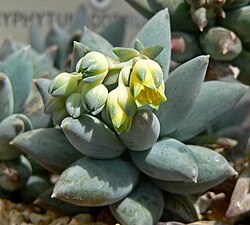 | Pachyphytum coeruleum J. Meyrán | เม็กซิโก | |
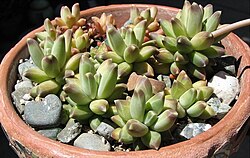 | กุหลาบPachyphytum compactum | กวานาฮัวโต , เกเรตาโร[ 4 ] | |
 | Pachyphytum hookeri (Salm-Dyck) A. Berger | กวานาวาโต , อีดัลโก , เกเรตาโร , ซาน หลุยส์ โปโตซี[ 5 ] | |
| Pachyphytum machucae I. García, Glass & see Cházaro Basáñoez, Miguel de Jesús | เม็กซิโก | ||
| ส่วน Pachyphytum | Pachyphytum brachetii Reyes, González และ Gutiérrez | เม็กซิโก | |
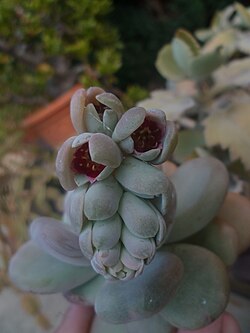 | Pachyphytum bracteosum Klotzsch | ฮิดัลโก[ 6 ] | |
| Pachyphytum cesium Kimnach และโมแรน | เม็กซิโก | ||
| Pachyphytum contrerasii E. Pérez-Calix, I. García & Cházaro | เม็กซิโก | ||
| Pachyphytum cuicatecanum (J. Reyes, Joel Pérez & Brachet) คิมนาช | เม็กซิโก | ||
 | Pachyphytum fittkaui Moran | เม็กซิโก | |
| Pachyphytum garciae Pérez-Calix และแก้ว | เม็กซิโก | ||
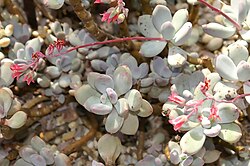 | Pachyphytum glutinicauleโมแรน | เม็กซิโก | |
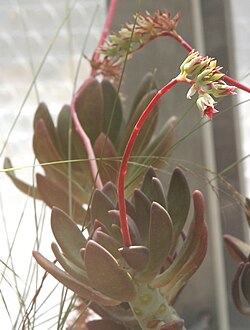 | Pachyphytum kimnachii Moran | เม็กซิโก | |
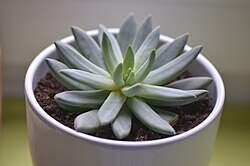 | กุหลาบPachyphytum longifolium | เม็กซิโก | |
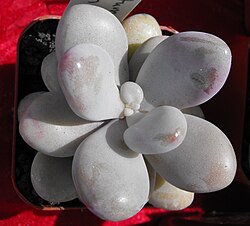 | Pachyphytum oviferum Purpus | เม็กซิโก (รัฐ), ซานหลุยส์โปโตซี[ 7 ] | |
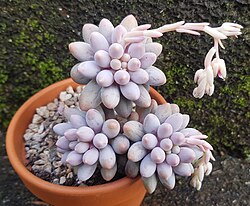 | Pachyphytum rzedowskii I. García, E. Pérez-Calix และ Meyrán | เม็กซิโก | |
| Pachyphytum saltense Brachet, Reyes และ Mondragón | เม็กซิโก (ซากาเตกัส) | ||
| Pachyphytum rogeliocardenasiiเปเรซ-คาลิกซ์ และ ตอร์เรส[ 8 ] | เกเรตาโรตะวันตกเฉียงเหนือ | ||
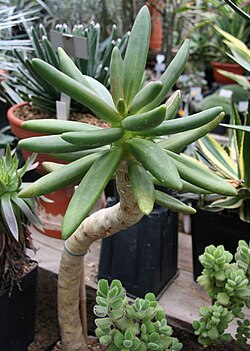 | Pachyphytum viride E.Walther | ||
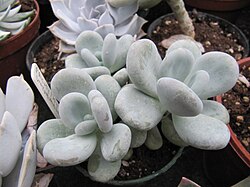 | Pachyphytum werdermannii Poelln. [ 9 ] [ 10 ] | เม็กซิโก | |
ลิงก์ภายนอก
 สื่อที่เกี่ยวข้องกับPachyphytum ใน Wikimedia Commons
 ข้อมูลที่เกี่ยวข้องกับPachyphytum ใน Wikispecies