
ปาซิงเกอร์ มาริเอนพลัตซ์
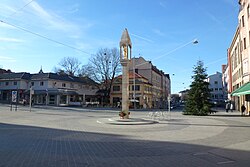
จัตุรัสพาซิงเกอร์ มาเรียนพลัตซ์ (Pasinger Marienplatz)เป็นจัตุรัสกลางของเมืองพาซิง ซึ่งเดิมเป็นเมืองอิสระ ปัจจุบัน พาซิงเป็นส่วนหนึ่งของเมืองมิวนิกตั้งแต่ปี 1938 เพื่อให้แตกต่างจากจัตุรัสมาเรียนพลัตซ์ (Munich Marienplatz)จึงได้ใช้ชื่อว่า พาซิงเกอร์ มาเรียนพลัตซ์ (Pasinger Marienplatz) มาตั้งแต่นั้นเป็นต้นมา
ประวัติศาสตร์
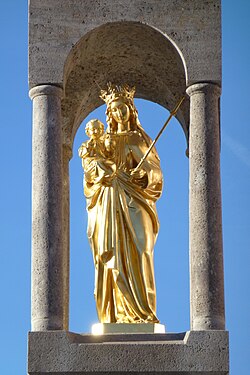
จัตุรัส Marienplatz จำลองมาจากจัตุรัส Marienplatzes ในมิวนิก ซึ่งเป็นจุดตัดของถนนสายหลักเลียบแม่น้ำสายประวัติศาสตร์ (ปัจจุบันคือ ถนน Planegger Straße) [ 1 ] กับ ถนนเกลือของดยุคเดิมที่ทอดยาวไปทางทิศตะวันออก-ตะวันตก(ปัจจุบันคือ ถนน Landsbergerstraße และถนน Bodenseestraße) จึงถูกตั้งชื่อว่า Marienplatz ด้วยเหตุนี้ จึงมีการเปิดตัว Pasinger Mariensäuleเมื่อวันที่ 31 ตุลาคม พ.ศ. 2323 ซึ่งในขณะนั้นประกอบด้วย เสา เหล็กหล่อทรง เรียว และ รูปปั้น พระแม่มารีที่ยังคงใช้มาจนถึงปัจจุบัน ต่อมาในปี พ.ศ. 2451 Mariensäuleก็ถูกรื้อถอน เนื่องจาก เส้นทางรถ ราง สายใหม่ (สาย 19 และบางครั้งก็สาย 29) มีจุดสิ้นสุดอยู่ที่นั่น และพื้นที่ดังกล่าวจำเป็นสำหรับการจัดแนวราง หรือจุดกลับรถของรถไฟ[ 2 ]
เนื่องจากปริมาณการจราจรที่เพิ่มมากขึ้น จึง มีการสร้าง เกาะกลางถนน ที่มีลักษณะยาวขึ้น บนจัตุรัส Marienplatz ซึ่งในระยะแรกสามารถใช้เป็นที่จอดรถยนต์ได้ ต่อมาจึงมีการจัดที่จอดรถแท็กซี่ไว้รอบๆ เกาะกลางถนน
หลังจากที่สมาคมPasinger Mariensäule eVเริ่มบูรณะMariensäuleในปี 1977 จัตุรัสก็ได้รับการออกแบบใหม่ในปี 1980 มีการสร้างเกาะกลางถนนรูปสามเหลี่ยมโดยมีMariensäuleอยู่ตรงกลาง บนฐานสี่เหลี่ยมผืนผ้าใหม่ยังมีเสาสี่เหลี่ยมจัตุรัสซึ่งมีหลังคาคลุมอยู่ และรูปปั้นพระแม่มารีตั้งอยู่ภายใน รูปปั้นหันหน้าไปทางทิศเหนือเช่นเดียวกับก่อนหน้านี้ ไปทางที่เรียกว่าบ้าน Kopfmiller [ 3 ]ขอบของเกาะกลางถนนถูกกั้นด้วยเสาและโซ่ทางด้านทิศเหนือ และรอบๆ เสามีกระถางดอกไม้ทรงถังขนาดใหญ่หลายใบ[ 2 ]
As part of the redevelopment and traffic reduction of the Pasinger center through the construction of the Nordumgehung Pasing (northern bypass), Pasing Marienplatz was rebuilt in 2013 and the Mariensäule was moved a bit to the north. According to plans by landscape architects Burger und Kühn, the old pillar was placed on a circular base, consisting of groups of rings of light granite and dark basalt. The direction that the statue faces was turned to the east (in the direction of Munich).
Location
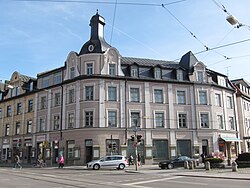
The Marienplatz is bordered to the north by the Gasthof zu Post and the Kopfmiller-Haus. On the east side are the so-called Kring-Haus and the Röder-Haus, where retail stores are located. This is followed by the Apothekerhaus with the St. Jakobs Apotheke, founded in 1880; one of the former owners was Fritz Dürrfeld.
The south side of Marienplatz borders the Institute of the English Miss. On the west side is the so-called Pappschachtel (cardboard box), a makeshift building with shops and restaurants from the period between the two world wars, the 1921 created little Marienbrunnen and the historically protected Confetti-Haus.[4]
Traffic
The center of Pasing was burdened in recent decades by heavy traffic, because of which the attractiveness of the district suffered and also restricted the development opportunities for retail. The formerly running over the Marienplatz, B 2, was relocated to the Pasinger station north running the Nordumgehung Pasing, at the end of 2012, and the Marienplatz was freed from the east–west transit traffic. The tram has been extended to the Pasinger station and now only touches the Marienplatz marginally when it turns off from the north coming Gleichmannstraße to the East leading Landsberger Straße.[5] This is the only way for cars to drive on the Pasinger Marienplatz, in addition to the turn-off from the west running Bodenseestraße into the south leading Planegger Straße (and vice versa). Only buses and taxis are allowed to cross the square from Planegger Straße.[6]
Criticism
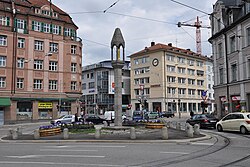
The redesign of the Pasinger Marienplatz was accepted differently. Often a positive feature is the enormous decline of former traffic loads and the idea of creating a pedestrian zone.[7] Critics complain however, that the place is not a welcome meeting place due to the lack of greenery (flowers or trees) and the lack of seating, making it feel drab and empty. Even the subsequently erected metal chairs could possibly provide a temporary solution. Likewise, the pattern of the pavement stones can only be seen from an aerial perspective and appear unstructured from the ground.[6] In addition, some critics say that it lacks an enclosure around the base of the Mariensäule, so that prayers could be spoken in a separate area, or the repeated damage to the lights on the base by users of the road could be prevented.
External links
- Square arrangement of Pasinger Marienplatz on muenchen.de
48°08′48″N11°27′34″E / 48.14676°N 11.45940°E / 48.14676; 11.45940